1 in 2 packaged food items listed on Quick Commerce platforms in India is junk/HFSS or ultra-processed food
- ● As much as 39% households who shop online say Gen Z’s in the family regularly buy packaged ultra-processed or HFSS foods via eCommerce/quick commerce apps
- ● Regularly purchased ultra-processed foods via online apps include soft drinks, juices, biscuits, cakes, ice creams, candies, chips, noodles, etc.
- ● 9 in 10 parents of Gen Z surveyed believe identification of HFSS foods with a RED bar will lead to healthier choices
- ● Comprehensive research conducted by LocalCircles covered every major platform and found that nearly 1 in 2 packed food listings is of junk or ultraprocessed food; Blinkit (62%) and Zepto (58%) have the highest percentage of such listings
December 3, 2025, New Delhi: The Indian Council for Medical Research (ICMR) and the National Institute of Nutrition (NIN) in May this year released the new Dietary Guidelines for Indians. The guidelines addressed a complaint of Food Safety and Standards Authority of India (FSSAI), the Indian food regulator, that it is hampered in regulating ultra-processed food (UPF) and foods high in fat, sugars and salt (HFSS) because the terms had “not been defined”.
The guidelines warn that lack of fibre and poor micronutrients makes these categories of food unhealthy. “Also, UPFs contribute to high calorie (energy) intake as they are often high in fat. UPFs are consumed in larger quantities by a large population since these have unique taste, high palatability and low cost as well as are easily available even in remote areas. …UPF consumption is associated with overweight/obesity and higher risks of coronary heart disease (heart attack), cerebrovascular diseases (stroke) and diabetes. UPFs also hasten the process of ageing,” the guidelines caution.
FSSAI on its part is yet to make any sizable progress in finding effective solutions to educate consumers about ultra-processed foods or get brands to display a RED label on front of the packs of high calorie foods. The food regulator defines a product as HFSS “if the declared value of these ingredients is such that the product does not satisfy the value of energy (kcal) from total sugar less than 10% of total energy or from saturated fat, and 10% of total energy and sodium is less than 1 mg/1 kcal”.
Ultra-processed foods are highly altered and typically contain a lot of added salt, sugar, fat, and industrial chemical additives. They are known to have harmful effects, particularly on the health of children and teenagers and those with vulnerable health conditions but have been unregulated for long. The urgency to do so was also underlined by this year’s Economic Survey, which drew attention to the fact that 56.4% of the total disease burden of India can at present be attributed to unhealthy diets. Reacting to the information, some health experts have mooted that the government should levy higher taxes on UPF and HFSS products, to make people rethink their decision to buy and consume them.
The sale of HFSS / UPF items, which dipped slightly during the Covid pandemic in India, has witnessed a 'V-shaped' recovery, according to a report by the World Health Organization (WHO) in collaboration with the Indian Council for Research on International Economic Relations (ICRIER). An analysis of sales trends of ultra-processed food - namely chocolate and sugar confectionery, salty snacks, beverages, ready-made and convenience food, and breakfast cereals - shows that the retail sales value of such foods stands at over 10%.
The Global Food Research Programme in a new report points out that “a large and rapidly growing body of research has found significant associations between high UPF intake and a multitude of elevated health risks, including for overweight and obesity, Type 2 diabetes, kidney and liver diseases, cardiovascular and cerebrovascular disease and mortality, cancers, and all-cause mortality.
Many systematic and narrative scientific reviews have now assessed the evidence for UPFs’ role in these and other health outcomes, and they are consistent in their findings: High consumption of UPF is significantly associated with one or more adverse health outcomes in nearly every study published to date”. In the light of UPFs’ poor nutritional profiles, hyper-palatability, and content of biologically harmful compounds all wreak havoc on health, increasing risks for obesity and other non-communicable diseases, Global Food Research Programme has urged policy interventions to curb rising UPF consumption and lessen their associated negative health and environmental outcomes.
LocalCircles in 2023 had escalated to FSSAI the findings of its national consumer study where 7 in 10 Indian consumers surveyed had expressed that all packaged HFSS foods must carry a Front of the Pack label (FOPL) which is RED in colour so consumers independent of their literacy level can understand that it is an unhealthy food item with excessive fat, salt or sugar and can make informed buying decisions. While no public consultation has been initiated by FSSAI, increasingly many consumers, especially parents of high school and college going youth in urban India have been expressing their concerns about regular and excessive ordering of ultra-processed foods via eCommerce and quick commerce platforms.
To understand these concerns better, LocalCircles did a follow-on study to understand the magnitude of the youth or Gen Z ordering packaged foods online and what could be done to enable the youth to make healthier choices when buying such foods online. The survey received over 24,000 responses from parents of Gen Z located in 277 districts of India. 63% respondents were men while 37% respondents were women. 48% respondents were from tier 1, 31% from tier 2 and 21% respondents were from tier 3, 4 and rural districts.
In addition to the survey, LocalCircles did an extensive research exercise to calculate ultra-processed or HFSS foods as a percentage of all packaged foods listed across all major online grocery, eCommerce and quick commerce platforms. It studied platforms like Amazon Fresh, Flipkart Minutes, Big Basket, JioMart, Zepto, Blinkit, Swiggy Instamart, and Milk Basket.
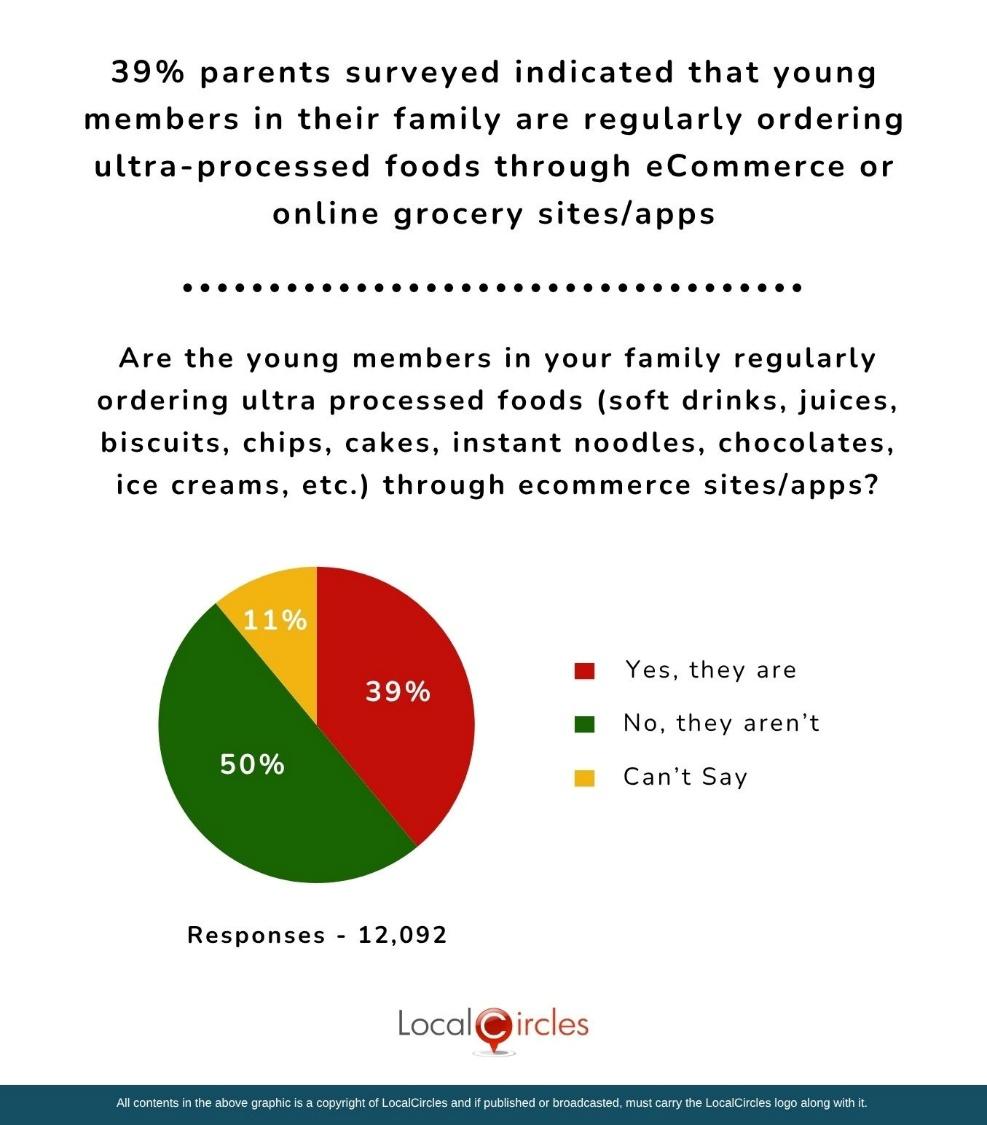
39% of parents surveyed indicated that young members in their family are regularly ordering ultra-processed foods through Quick Commerce or online grocery sites/apps
Food taste being a personal choice, some tend to overlook healthier choices, but it is still important to create awareness particularly among children and youth so over time they transition to healthier choices. The survey first asked parents, “Are the young members in your family regularly ordering ultra-processed foods (soft drinks, juices, biscuits, chips, cakes, instant noodles, chocolates, ice creams, etc.) through eCommerce/Quick Commerce sites/ apps? This query received 12,092 responses with 4 in 10 households or 39% of household consumers surveyed indicating that “yes, they are”; 50% indicated “no, they are not”; while 11% of respondents were not sure thus opted for “can’t say”. To sum up, 39% of parents surveyed indicated that young members in their family are regularly ordering ultra-processed food through Quick Commerce or online grocery sites/apps.
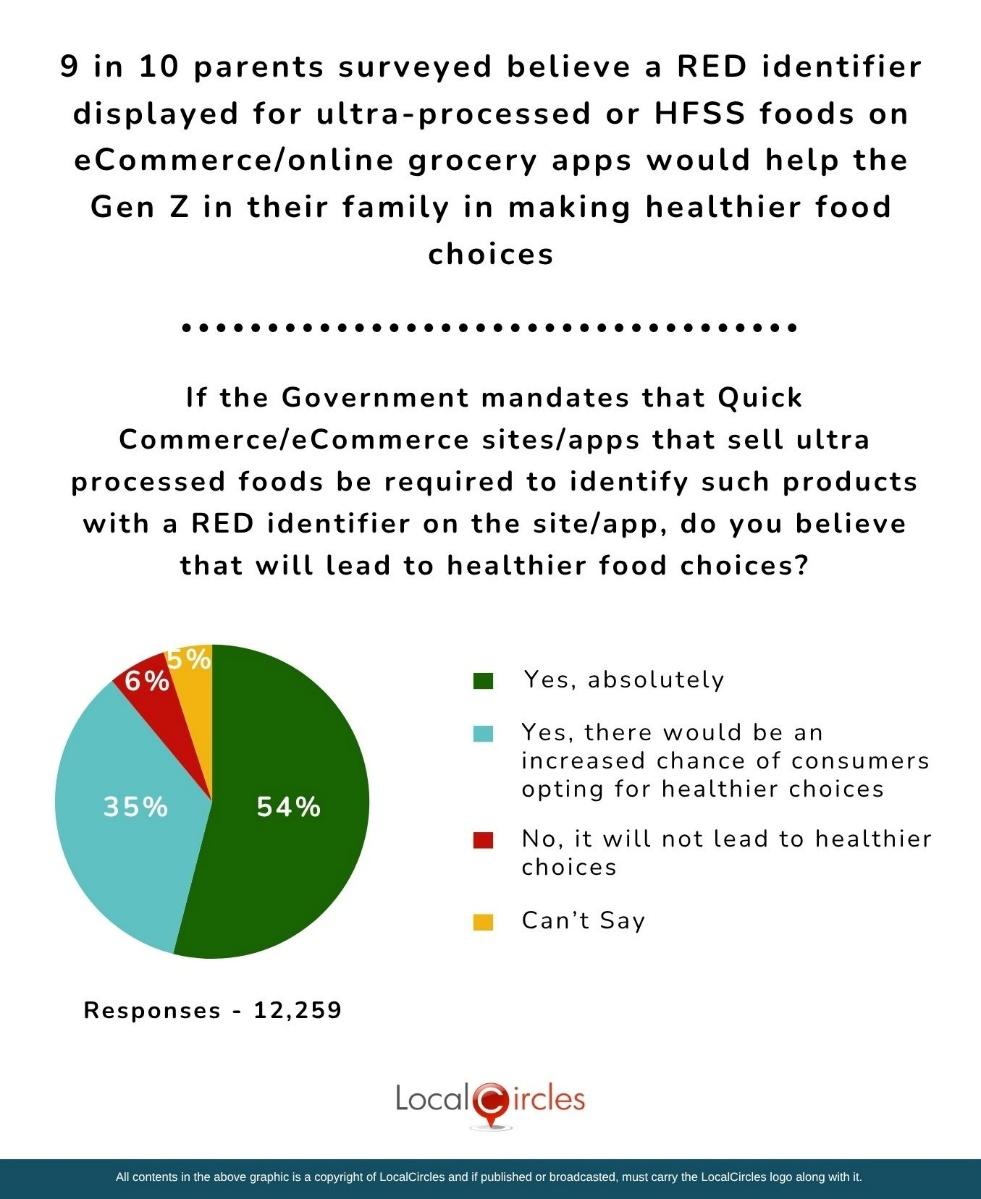
9 in 10 parents surveyed believe a RED identifier displayed for ultra-processed or HFSS foods on eCommerce/online grocery apps would help the Gen Z in their family in making healthier food choices
There has been considerable demand from health experts and some consumer groups to help consumers make healthy processed food choices for themselves and their family. This has specially been a concern for children and youth post pandemic with prevalence of conditions like obesity, diabetes and heart diseases steadily increasing among them.
The survey next asked parents of Gen Z, “If the government mandates that Quick Commerce/ eCommerce sites/ apps that sell ultra-processed food be required to identify such products with a RED identifier on the site/app, do you believe that will lead to healthier food choices?” Out of 12,259 parents who responded to this question, 9 in 10 indicated that if Quick Commerce/ eCommerce sites/ apps identify ultra-processed/ junk/ HFSS foods with a RED identifier, it will likely lead to healthier food choices for children and youth. Data shows that 54% of the parents felt this would “absolutely” help; 35% indicated that yes, with such an identifier there would be an increased chance of consumers opting for healthier choices”. However, 6% of respondents felt “it will not lead to healthier choices” while 5% opted for “can’t say”. To sum up, 9 in 10 parents of Gen Z surveyed believe the RED identifier displayed with all ultra-processed or HFSS foods listed on eCommerce/quick commerce or online grocery apps would help in making healthier food choices.
Given the rising trend of consumers shopping online for packaged foods, there is need to ensure that along with all the information about the ingredients, manufacturing date, best before date, calories and other relevant information about the ultra-processed food products, parents in the survey believe that online platforms should have a RED identifier next to such food listings thereby helping all consumers in making informed choices. To understand the magnitude of listings of ultra-processed foods on eCommerce/Quick Commerce/online grocery sites/apps, LocalCircles conducted an extensive research exercise which included sourcing information from consumers from different parts of the country (as listings may differ from city to city on the platforms). The research focused on calculating the packaged HFSS food listings as a percentage of the total packaged food listings on each one of the major platforms.
The exercise involved creating a master database which identified all packaged ultra-processed or HFSS foods and using that as a reference when calculating the percentages for each site/app. For example: If on a particular online grocery app there were 1000 items listed and out of them 670 were identified as HFSS or ultra-processed foods, the percentage of ultra-processed or HFSS foods for that app would be 67%. Based on current listings, LocalCircles has found that among 8 online sites, Blinkit has 62% products that fall in the HFSS foods category, Zepto has 58% of products in this category, Swiggy Instamart has 54% such products, Jiomart has 50%, BigBasket has 49% such products, Milkbasket 48%, Amazon Fresh has 44%, and Flipkart Minutes has 42% of its products falling in this category. All online grocery and Quick Commerce platforms have over 40% packaged food listings that are ultra-processed or have HFSS content indicating why it is essential to identify such foods on their apps for the consumers.
Majority online grocery platforms in India have very high levels of ultra-processed or HFSS packaged foods listed
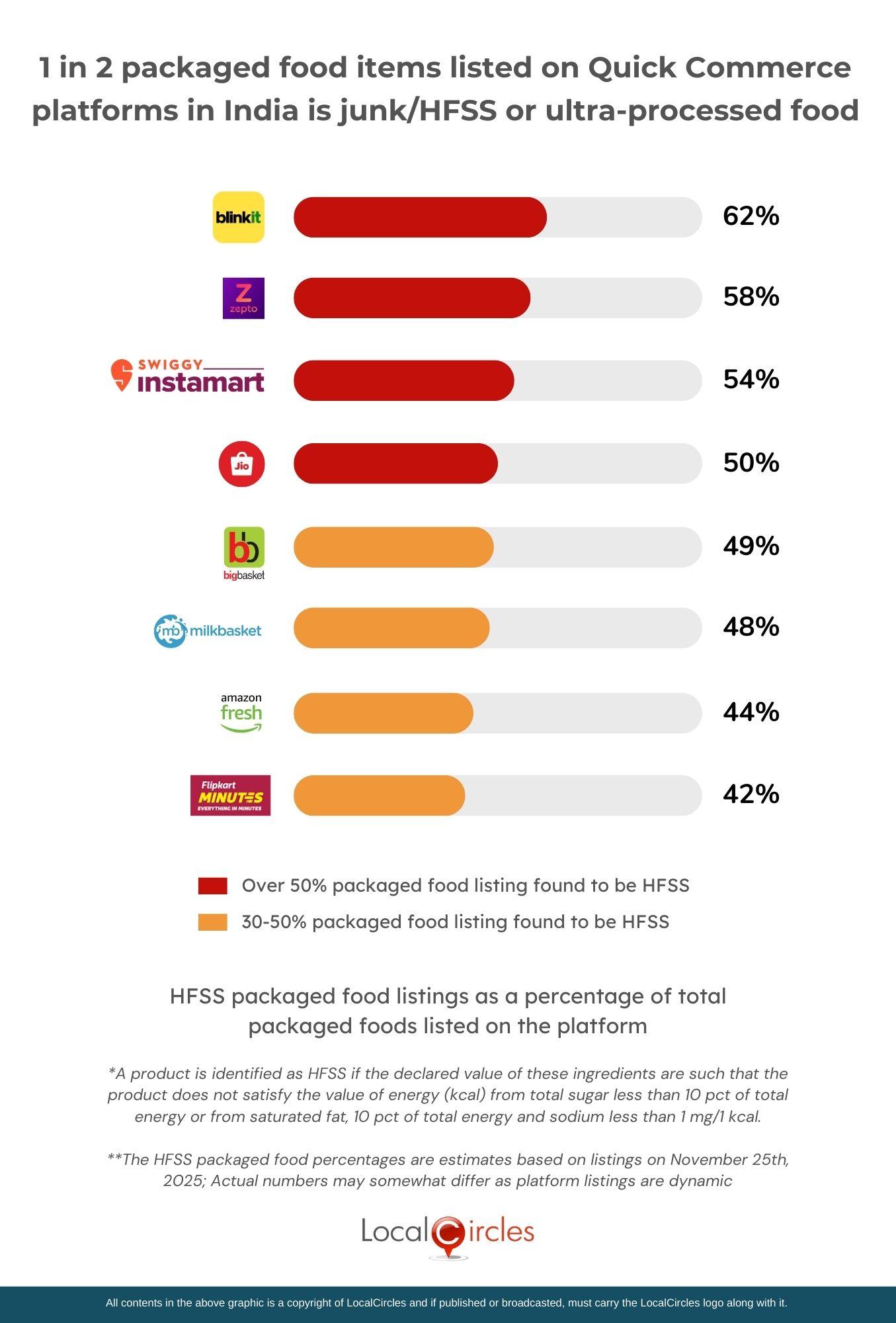
*A product is identified as HFSS if the declared value of these ingredients are such that the product does not satisfy the value of energy (kcal) from total sugar less than 10 pct of total energy or from saturated fat, 10 pct of total energy and sodium less than 1 mg/1 kcal.
**The HFSS packaged food percentages are estimates based on listings on November 25th, 2025; Actual numbers may somewhat differ as platform listings are dynamic
In summary, the ill effects of regular consumption of ultra-processed or HFSS foods over time are significant and include obesity, diabetes, heart disease and other health issue. With increasing consumption of ultra-processed or HFSS foods in India and many Gen Z or youth in metros utilizing eCommerce/Quick Commerce or online grocery apps/sites to order them, the survey finds the need for identification of such foods on these apps to enable them to make healthier choices. The survey finds from parents that in 39% households where eCommerce/Quick Commerce apps are being used, the Gen Z regularly order ultra-processed foods through them. What is more important though is that 9 in 10 parents of Gen Z who are using such apps believe that if a RED identifier is placed next to such foods listed on these apps, it will help the users in making healthier food choices. Currently, majority of the eCommerce/Quick Commerce/online grocery apps have almost 50% of their packaged food listed as ultra-processed or HFSS foods and do not identify such foods differently. These foods include soft drinks, juices, biscuits, chips, cakes, instant noodles, chocolates, ice creams, etc. With effective identification as demanded by parents and increased consumer awareness, an increasing number of food manufacturers are likely to start developing healthier versions of biscuits, chips, chocolates, juices, etc., and the same platforms will be able to present these healthier variants to consumers. Over time, such identification and availability of healthier food alternatives is likely to change consumption and make it healthier.
LocalCircles will escalate the findings of this study to FSSAI and Ministry of Health and Family Welfare for their consideration and action.
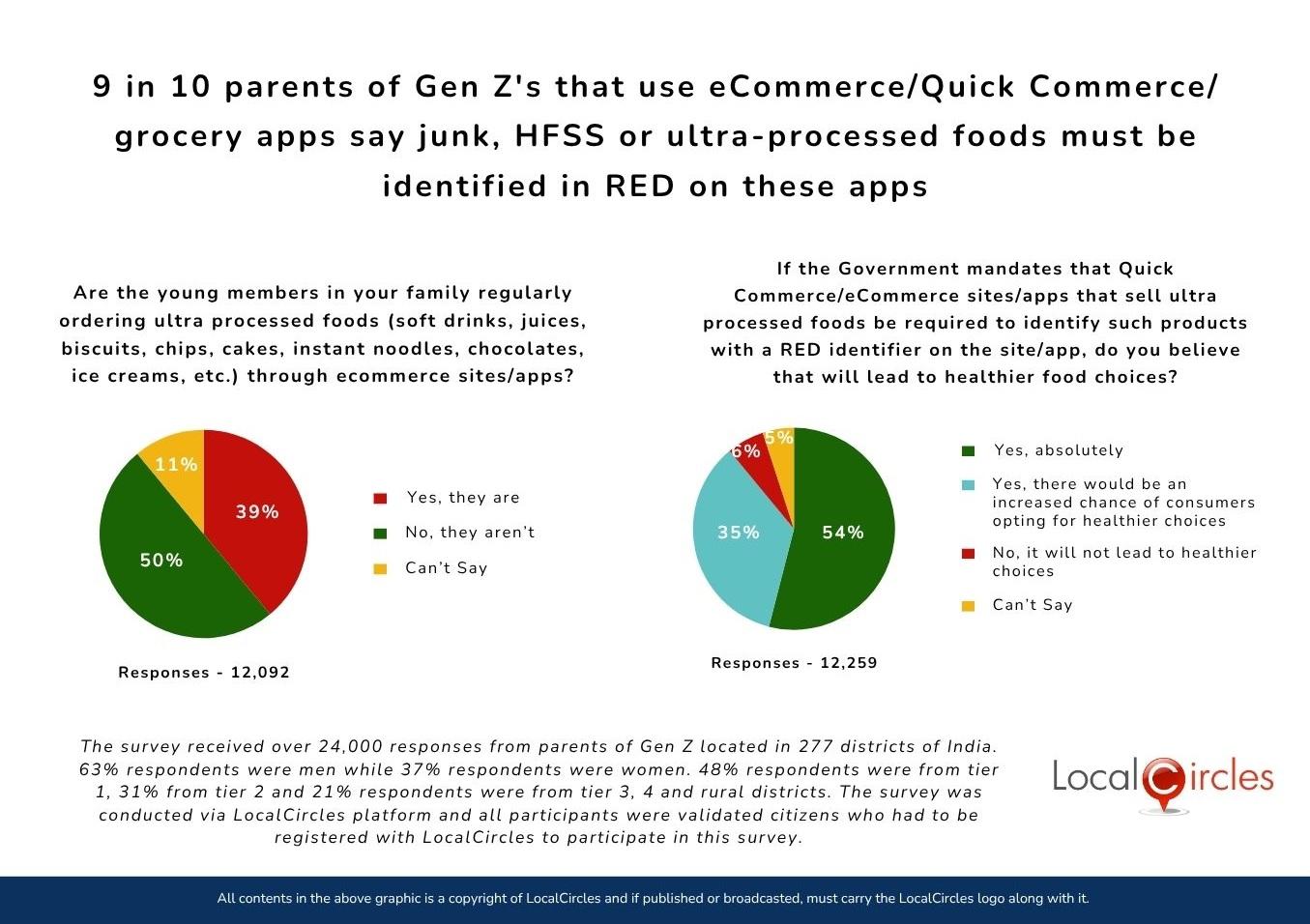
Study Demographics
The survey received over 24,000 responses from parents of Gen Z located in 277 districts of India. 63% respondents were men while 37% respondents were women. 48% respondents were from tier 1, 31% from tier 2 and 21% respondents were from tier 3, 4 and rural districts. The survey was conducted via LocalCircles platform, and all participants were validated citizens who had to be registered with LocalCircles to participate in this survey.
Platform Research
The platform research received inputs from over 3000 users of online grocery apps along with understanding the magnitude of listings of ultra-processed foods on such platforms. The research focused on calculating the packaged ultra-processed food listings as a percentage of the total packaged food listings on each one of the major platforms. It involved creating a master database which identified all packaged ultra-processed or HFSS foods and used that as a reference to calculate the ultra-processed/HFSS percentages for each site/app. The findings were based on the current listings and may be subject to change as listings are dynamic.
About LocalCircles
LocalCircles, India’s leading Community Social Media platform enables citizens and small businesses to escalate issues for policy and enforcement interventions and enables Government to make policies that are citizen and small business centric. LocalCircles is also India’s # 1 pollster on issues of governance, public and consumer interest. More about LocalCircles can be found on https://www.localcircles.com
For more queries - media@localcircles.com, +91-8585909866
All content in this report is a copyright of LocalCircles. Any reproduction or redistribution of the graphics or the data therein requires the LocalCircles logo to be carried along with it. In case any violation is observed LocalCircles reserves the right to take legal action.
Enter your email & mobile number and we will send you the instructions.
Note - The email can sometime gets delivered to the spam folder, so the instruction will be send to your mobile as well


