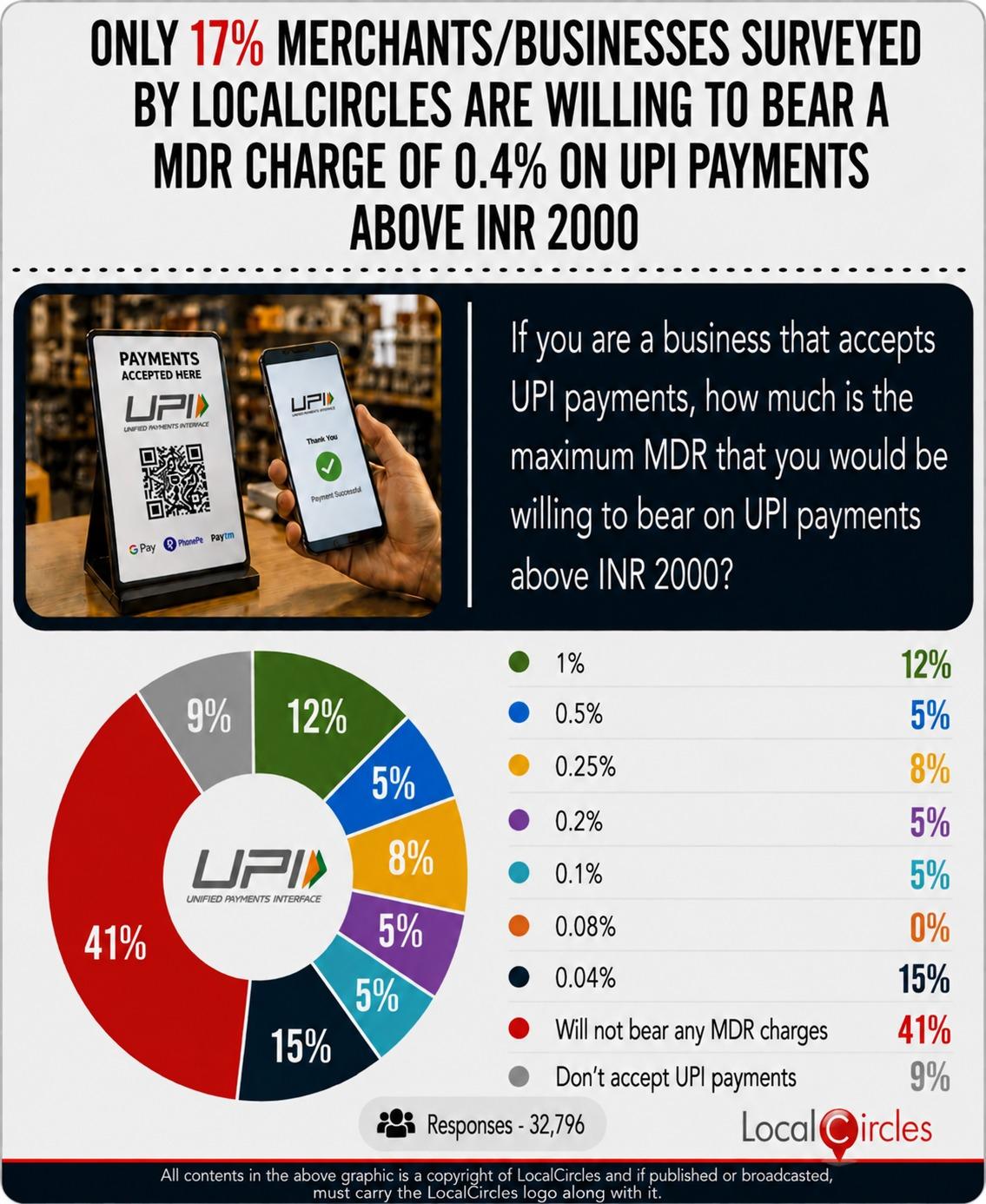
Only 17% merchants/businesses surveyed by LocalCircles are willing to bear a MDR charge of 0.3% or higher on UPI payments above INR 2000
- ● 41% of merchants/businesses surveyed say they will not bear any MDR charge on UPI payments above INR 2,000, and another 9% say they do not accept UPI payments at all
- ● Nationwide LocalCircles study receives over 32,000 responses from businesses and merchants across 242 districts of India

September 3, 2026, New Delhi: After six and a half years of zero merchant discount rate (MDR) on UPI, India is now days away from a decision that will change who pays for the country’s largest payment rail. On August 20, 2026, it was reported that an MDR of 0.3% on UPI transactions of INR 2,000 and above is expected to be announced within two weeks. The Department of Financial Services (DFS) is likely to issue a gazette notification specifying the electronic payment modes that will continue to receive statutory protection from charges, after which the UPI and Services Steering Committee, headed by the National Payments Corporation of India (NPCI), will determine the MDR, its scope and its structure.
MDR is a fee paid by businesses to payment processors for accepting digital payments. An MDR of up to 0.3% of the transaction value applied to UPI person-to-merchant transactions until December 2019. Zero MDR was introduced in January 2020 to accelerate digital payment adoption and encourage a shift from cash to digital payments. The government subsequently introduced an incentive scheme to support banks and other ecosystem participants, providing an incentive equivalent to 0.15% MDR on UPI transactions up to INR 2,000. The legal ground shifted in August 2026. The Taxation and Other Laws (Amendment) Bill, 2026, passed by the Lok Sabha on August 6, 2026, and cleared by the Rajya Sabha on August 11, 2026, amended Section 10A of the Payment and Settlement Systems Act, 2007. Section 10A, read with Section 269SU of the Income-tax Act, 1961, had barred banks and system providers from imposing any charge on RuPay debit card, BHIM-UPI and UPI QR code payments. The amendment removes that blanket statutory protection and instead empowers the Central Government to specify, by notification, which electronic payment modes will remain free of charges. It is an enabling provision, and it is what makes an MDR on UPI legally possible for the first time since January 2020.
The government has been explicit that the consumer is not the target. Finance Minister Nirmala Sitharaman told Parliament that the amendment should not be construed as imposing any charge or tax on UPI transactions, and that “MDR applies only to merchants, not end users”. On August 8, 2026, the Ministry of Finance clarified that “as and when MDR charges are introduced, they will apply only to a limited set of merchant transactions, above a certain threshold, at a nominal rate, far lower than debit or credit card MDRs”. Person-to-person transfers are to remain free, and consumers making payments are not to face any transaction charge.
The case for the change rests on economics. With the jump in UPI transactions since the Covid-19 pandemic, banks and payment intermediaries have ramped up investment in payment infrastructure, and industry estimates place the annual cost of running the UPI rail at INR 5,000–6,000 crore against an incentive pool that covers only a fraction of it. This has led to industry calls for the restoration of charges to make the system sustainable. The Parliamentary Standing Committee on Finance recently called for the early implementation of a tiered MDR framework for UPI transactions, warning that delays could leave payment service providers dependent on inadequate government subsidies and weaken investment in payment infrastructure.
The scale involved is large. UPI is the world’s largest real-time payment system by volume, with a share of nearly 50%, and accounted for 85% of India’s digital payment transactions by volume in 2025-26. UPI processed 241.62 billion transactions worth INR 314.23 lakh crore in FY26. The INR 2,000 cut-off matters because of how that value is distributed: transactions above INR 2,000 are reported to be about 5% of UPI volume but roughly 65% of UPI value. A 0.3% MDR on that slice is therefore a small number of transactions carrying most of the money. It is also well below the prevailing MDR of 1-3% on credit cards and up to 0.9% on debit card transactions.
Two design questions are still open. The first is the rate. Reports have cited a range of 0.25% to 0.4%, with 0.3% now the most widely reported figure. The second is the turnover threshold that will separate a ‘large’ merchant from a small one, on which reported figures have ranged from INR 20 lakh to INR 4 crore of annual turnover. Neither has been notified. A third question has barely been asked at all: whether a merchant who is charged an MDR will be permitted to recover it from the customer at the counter. Nothing in the amendment, and nothing said so far by the Ministry of Finance, bars that.
The payments industry has been asking for exactly this. The Payments Council of India (PCI) has proposed a 0.3% MDR applicable only to large merchants, and has publicly stated that consumers and small merchants will continue to pay nothing under such a structure. Its case is that the cost of authenticating, routing and settling a UPI transaction is real and recurring, and that a rail carrying 85% of India’s digital payment volume cannot indefinitely be funded by an annual incentive allocation that has to be sought afresh each year. The counter-argument, made by merchant bodies, is that UPI acceptance grew precisely because it cost the merchant nothing, and that a charge introduced now will be met by a reduction in acceptance at exactly the transaction sizes the exchequer most wants digitised.
LocalCircles has been escalating citizen and small business feedback on UPI charges since 2024. In a national survey whose findings were released in March 2025, which received over 32,000 responses from UPI users located across 376 districts of India, 73% of UPI users surveyed said there should be no charge on UPI transactions and only 25% were willing to accept a transaction fee, up marginally from 23% a year earlier. In the same survey, 40% of UPI users surveyed reported having been charged a fee on a UPI payment in the preceding 12 months, up from 37% in 2024 — an early indication that charges were already reaching consumers through merchant-side and gateway-side recovery, well before any MDR was permitted in law. That is the gap between what the rule says and what happens at the counter, and it is the gap this survey set out to measure from the merchant side.
It is against this backdrop — an enabling law already passed, a gazette notification days away, a rate and a threshold still unnotified, and no stated rule on pass-through — that LocalCircles surveyed merchants and businesses on what MDR they would actually be willing to bear. The survey received over 32,000 responses from businesses and merchants located across 242 districts of India.
The findings show that half of the merchants surveyed are not willing to bear any MDR at all, and that among those who are, tolerance sits far below the rate now being reported. The key finding is detailed below.
Only 17% merchants/businesses surveyed by LocalCircles are willing to bear a MDR charge of 0.3% or higher on UPI payments above INR 2000
To establish what businesses are actually prepared to pay, the survey asked, “If you are a business that accepts UPI payments, how much is the maximum MDR that you would be willing to bear on UPI payments above INR 2000?” This question received 32,796 responses. In response, the largest group at 41% said they will not bear any MDR charges. 15% said 0.04%, 12% said 1%, 8% said 0.25%, 5% said 0.5%, 5% said 0.2%, 5% said 0.1% and 0% said 0.08%. A further 9% said they do not accept UPI payments. Taken together, only 17% of merchants/businesses surveyed — the 12% willing to bear 1% and the 5% willing to bear 0.5% — are willing to bear an MDR of 0.3% or higher, the rate now reported to be under consideration for UPI transactions above INR 2,000.
The distribution is the finding. Of the 91% of merchants surveyed who accept UPI payments, nearly half will not absorb a charge of any size. Among those who will, the most common ceiling is 0.04%, chosen by 15%, which is roughly one-eighth of the reported rate. Even if the notified rate were 0.25% rather than 0.3%, willingness would rise only to 25%. A rate set at 0.3% therefore sits above the stated tolerance of five in six merchants surveyed. That gap does not mean the charge cannot be levied — an MDR is a cost of acceptance, not a subscription — but it does indicate where the cost is likely to travel next. A merchant unwilling to absorb a charge has three options: stop accepting UPI above the threshold, raise prices, or recover the charge at the counter.
The turnover threshold carries a second-order risk that deserves attention before it is notified. If liability for MDR is triggered by annual turnover, the threshold becomes a cliff edge. A business just above the line pays on every qualifying transaction; a business just below it pays nothing. Wherever a tax or fee has been structured this way in India, a share of businesses near the boundary has responded by managing reported turnover downward rather than by paying. Smaller businesses in particular may under-report turnover, split billing across related entities or family members, steer larger payments to cash or to a personal UPI handle so that the receipt is recorded as person-to-person rather than person-to-merchant, or keep a second QR code for higher-value sales. Each of these responses undermines the very digitisation record that zero MDR was introduced to build, and each one reduces the formalisation gains that UPI has delivered over the last six years. A threshold that is set low, or that is defined by self-declared turnover rather than by data the payment system already holds, will amplify this risk. Merchants surveyed are already close to the edge: with 41% unwilling to bear any charge and a further 9% not accepting UPI at all, the incentive to stay below a turnover line is unlikely to be marginal.
The pass-through question is the one that will decide whether the consumer is affected in practice, whatever the law says on paper. The government has been clear that MDR is a merchant cost and that consumers will not be charged. But there is a well-established set of merchant categories in India where transaction charges have always been passed straight back to the customer as a ‘convenience fee’, ‘payment gateway charge’ or ‘service charge’. Schools and colleges add it to online fee payments. Railway and bus ticketing portals add it at checkout. Utility billers, municipal bodies, government service portals, insurance renewals, fuel outlets and hospitals do the same. In each of these cases the merchant has little competitive reason to absorb the cost, because the consumer has nowhere else to buy the same service.
If pass-through is not expressly restricted in the notification, these are precisely the categories where an MDR on UPI payments above INR 2,000 will show up as a line item on the consumer’s bill — and school fees, ticket bookings, utility bills, tax payments and hospital bills are almost all above INR 2,000. The likely consumer response is not to pay the fee but to route around it. Where a school or a government portal adds 0.3% to a UPI payment but accepts net banking, a cheque, a demand draft or cash without a charge, a share of consumers will simply use those instead. That would move high-value payments off UPI and back to instruments the country has spent a decade moving away from, while leaving UPI carrying the low-value transactions that generate no revenue. The stated objective of the MDR — making the UPI rail financially sustainable — is best served by keeping high-value transactions on it.
A LocalCircles consumer survey released in August 2026, which received over 45,000 responses from UPI users located across 322 districts of India, indicates how consumer behaviour is likely to change if merchants pass on the MDR. The survey found that 53% of UPI users surveyed would move away from UPI for higher-value transactions if an MDR is levied and recovered from them — 27% said they would switch to credit cards, 14% to debit cards and 12% to cash or bank transfers. Only 12% said they would pay the fee and continue using UPI, while another 18% said they would continue only if the merchant absorbed the cost.
On what they would do at the point of sale, nearly 50% of UPI users surveyed said they would avoid UPI for purchases above INR 3,000, 21% said they would switch to other digital payment methods that carry no charge, 14% said they would stop shopping with merchants recovering the fee where alternatives exist, 8% said they would ask the merchant to waive the charge and only 2% said they would pay and continue. Read alongside the merchant findings, the two surveys describe the same outcome from opposite ends of the counter. Five in six merchants surveyed will not absorb a 0.3% charge, and more than five in ten consumers surveyed will not accept it being handed to them. If merchants are permitted to recover the charge, the transaction most likely moves off UPI rather than the fee being paid.
In summary, the survey findings indicate that the rate being reported and the rate merchants are willing to bear are far apart. 41% of merchants/businesses surveyed will not bear any MDR charge on UPI payments above INR 2,000 and 9% do not accept UPI payments at all, leaving 50% willing to bear some charge. Within that half, tolerance is concentrated at the bottom of the scale — 15% at 0.04%, 8% at 0.25%, 5% each at 0.5%, 0.2% and 0.1% — with only 12% willing to bear 1%. Only 17% of merchants/businesses surveyed are willing to bear an MDR of 0.3% or higher. Three consequences follow: a turnover-linked threshold will create an incentive for smaller businesses near the line to under-report turnover or route payments outside the merchant channel; merchant categories that have always passed transaction charges to the customer, such as schools, railway and bus ticketing, utility billers and government service portals, will do so again unless restricted; and consumers, on LocalCircles’ own reading of 45,000 responses, will respond by moving high-value payments to cards, net banking, cheques or cash rather than paying the fee.
LocalCircles will be escalating these findings to the Department of Financial Services under the Ministry of Finance, the National Payments Corporation of India and the Reserve Bank of India ahead of the gazette notification and the decision of the UPI and Services Steering Committee. Based on what merchants and consumers have said, LocalCircles is urging that the MDR framework, when notified, be structured around four safeguards.
First, the notification should expressly bar merchants from recovering the MDR from the consumer as a convenience fee, service charge or surcharge, on the pattern of the surcharge prohibition that already applies to card payments, with the bar applied specifically to schools, educational institutions, railway and transport ticketing, utility billers, hospitals and government service portals where the consumer has no alternative provider. Second, the turnover threshold should be set high enough that only genuinely large merchants are covered, and eligibility should be determined from GST-linked or acquirer-held transaction data rather than self-declaration, so that the threshold does not itself become a reason to under-report turnover or to shift receipts to person-to-person handles.
Third, the rate should be introduced in a tiered and phased manner beginning at the bottom of the reported range rather than at 0.3%, given that only 17% of merchants surveyed are willing to bear 0.3% or more while 25% would bear 0.25% or less, and it should be reviewed after twelve months against actual UPI volume above the threshold. Fourth, the existing incentive scheme for low-value UPI transactions should be retained and funded alongside the MDR rather than withdrawn once merchant revenue begins to flow, so that the small merchant who is exempt from MDR does not become the merchant whose acceptance costs are no longer covered by anyone.
UPI has taken India from a cash economy to 241.62 billion digital transactions a year because it was free at the point of acceptance and free at the point of payment. Making the rail financially sustainable is a legitimate objective, and the survey shows merchants are not uniformly opposed to contributing — half are willing to bear something. What the data indicates is that the rate and the threshold must be set where merchants will absorb the cost rather than pass it on, because the moment the charge reaches the consumer, the transaction leaves UPI.
Survey Demographics
The survey received over 32,000 responses from businesses/merchants located across 242 districts of India. 48% respondents were from tier 1, 33% from tier 2 and 19% respondents were from tier 3 & 4 districts. The survey was conducted via LocalCircles platform, and all participants were validated citizens who had to be registered with LocalCircles to participate in this survey.
About LocalCircles
LocalCircles, India’s leading Community Social Media platform enables citizens and small businesses to escalate issues for policy and enforcement interventions and enables Government to make policies that are citizen and small business centric. LocalCircles is also India’s # 1 pollster on issues of governance, public and consumer interest. More about LocalCircles can be found on https://www.localcircles.com
For more queries - media@localcircles.com, +91-8585909866
All content in this report is a copyright of LocalCircles. Any reproduction or redistribution of the graphics or the data therein requires the LocalCircles logo to be carried along with it. In case any violation is observed LocalCircles reserves the right to take legal action.
Enter your email & mobile number and we will send you the instructions.
Note - The email can sometime gets delivered to the spam folder, so the instruction will be send to your mobile as well