1 in 2 consumers surveyed believe SIM Binding will cause disruption and inconvenience: 7 in 10 of those who travelers internationally concerned about issues when using messaging platforms overseas
- ● 4 in 10 consumers surveyed use messaging and calling apps on multiple devices without a SIM card
- ● 2 in 3 agree though that SIM Binding will reduce misuse and improve user safety
- ● Comprehensive nationwide survey receives over 115,000 responses from consumers in 332 districts
December 9, 2025, New Delhi: In a move that could reshape digital communication in India, the Department of Telecommunications (DoT) has directed that all major over-the-top (OTT) messaging platforms — including WhatsApp, Telegram, Signal, Snapchat and similar services — to implement continuous SIM-binding.
SIM binding traditionally refers to the practice of locking a device or service to a specific SIM card or mobile operator. Once bound, the device or service cannot easily be used with another SIM card without incurring restrictions or extra steps.
In physical devices—such as smartphones, smartwatches, or IoT appliances—this typically prevents consumers from switching their connectivity provider at will. This changes the operational dynamics of these apps, which previously allowed multi-device access with minimal SIM dependency after initial verification. In effect, under this rule, a messaging account must always remain linked to the SIM card used during registration. If the SIM card is removed, replaced or deactivated, the application must stop functioning until the original SIM is restored.
The directive is part of the Telecom Cybersecurity Rules, 2024, and platforms have 90 days from notification to comply, which places operational rollout into early 2026.
Messaging platforms are now required to ensure that communication is not device-agnostic, and multiple-device logins will face tighter scrutiny. Web and desktop versions — previously popular for work environments — must now auto-logout every six hours, forcing users to re-authenticate via QR code from the primary device containing the linked SIM.
According to DoT, SIM-binding is intended to enhance cybersecurity and reduce fraud linked to anonymous or non-traceable accounts. The government believes the measure will improve accountability, combat scams, impersonation, and curb misuse of telecommunication identifiers. The Cellular Operators Association of India (COAI), which represents major telecom operators like Reliance Jio, Airtel, and Vodafone Idea, has backed the government's mandate stating that continuous SIM linkage is crucial for ensuring accountability, national security and helping to trace cross-border cyber fraud and scams.
However, the directive has triggered significant pushback. Digital-rights groups and legal experts argue that forcibly binding identity to SIM-based verification erodes user privacy and could facilitate surveillance. They warn that anonymity — essential for journalists, whistle-blowers and vulnerable communities — may be compromised.
There are also concerns about usability. Multi-device access — tablets, second phones, laptops — becomes restrictive. International travellers, eSIM users and professionals who shift between devices may face repeated login interruptions. Business adoption of WhatsApp/Telegram-based workflows could also suffer. Several OTT platforms have reportedly expressed dissatisfaction with both the implementation timeline and lack of prior stakeholder consultation.
Travellers and migrant workers usually switch to local SIMs abroad to avoid high roaming costs and ensure reliable connectivity. With SIM binding, they must keep their home-country SIM active to access essential apps, which can lead to expensive roaming charges, poor coverage, or complete service loss in countries where the home SIM doesn’t work. If the bound SIM expires, is lost, or cannot connect overseas, users may be locked out of critical communication apps until they return home. This is especially difficult for migrant workers who rely on these apps to stay in touch with family. Those without dual-SIM or eSIM phones face even greater challenges, as they cannot use a local SIM and the required home SIM simultaneously.
SIM-binding represents a watershed moment in India's digital-policy landscape. On one hand, it promises a more traceable and fraud-resistant communication ecosystem. On the other, it raises fundamental questions about user rights, government reach into private devices, and the future of encrypted digital communication.
Across the world, the trend in the smartphone market has moved away from locking and toward openness. Regions such as the European Union and much of Latin America encourage or mandate unlocked devices to promote competition.
However, SIM binding has grown in IoT devices and wearables, where manufacturers often bundle devices with pre-provisioned SIMs or eSIM profiles. This business model ensures simplicity but reduces user choice.
LocalCircles through a new survey has sought to find out how consumers view this new regulation on SIM binding and whether they fear any adverse impact. The survey received over 115,000 responses from consumers located in 332 districts of India. 67% respondents were men while 33% respondents were women. 45% respondents were from tier 1, 32% from tier 2 and 23% respondents were from tier 3, 4, 5 & rural districts.
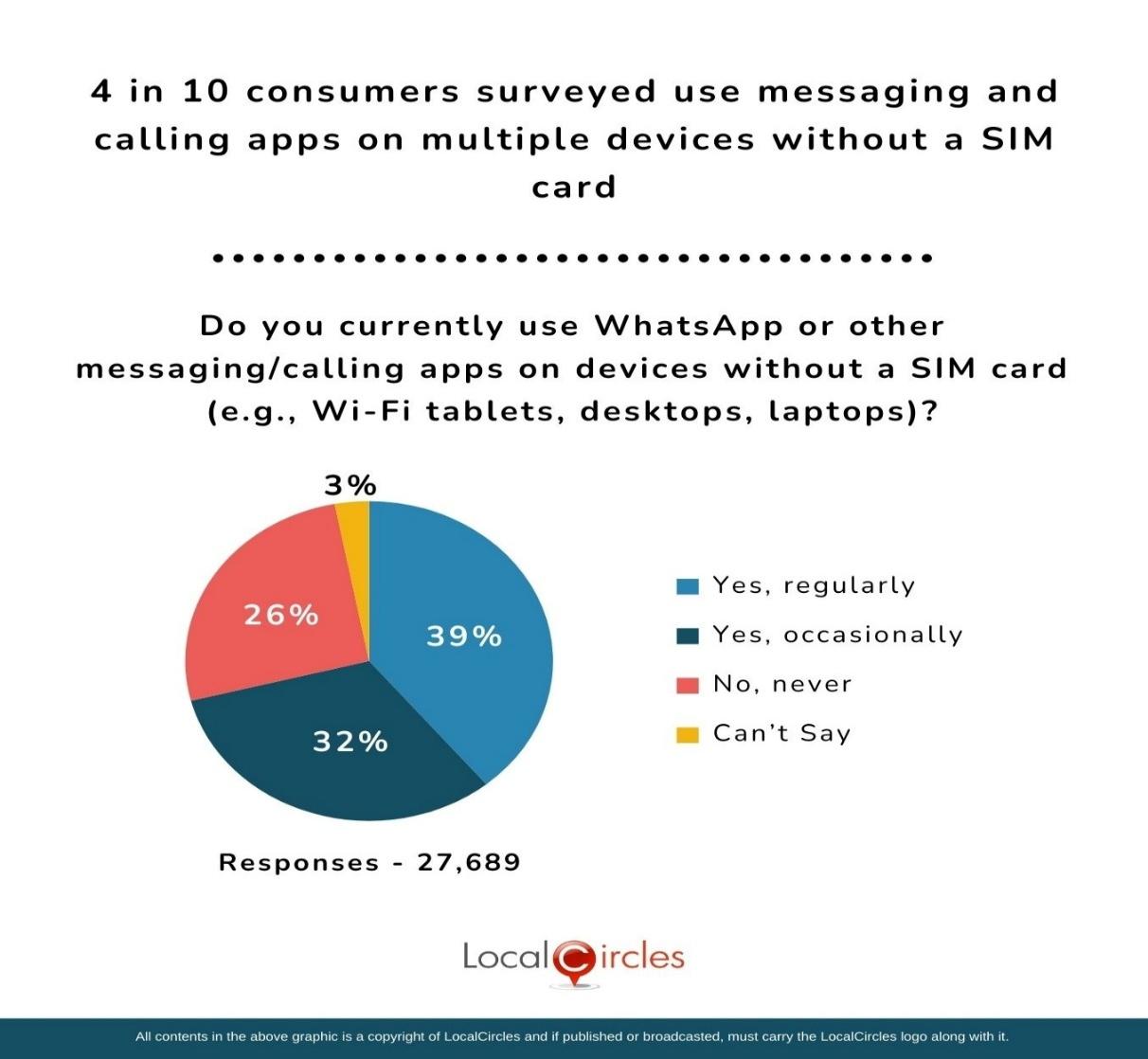
4 in 10 consumers surveyed use messaging and calling apps on multiple devices without a SIM card
The survey first asked consumers, “Do you currently use WhatsApp or other messaging/ calling apps on devices without a SIM card (e.g., Wi-Fi tablets, desktops, laptops)?” Out of 27,689 who responded to the question 39% indicated “yes, regularly” they use messaging and calling apps on devices without a SIM card; 32% of respondents indicated “yes, occasionally”; 26% of respondents indicated “no, never” and 3% of respondents did not give a clear answer. To sum up, 4 in 10 consumers surveyed use messaging and calling apps on multiple devices without a SIM card.
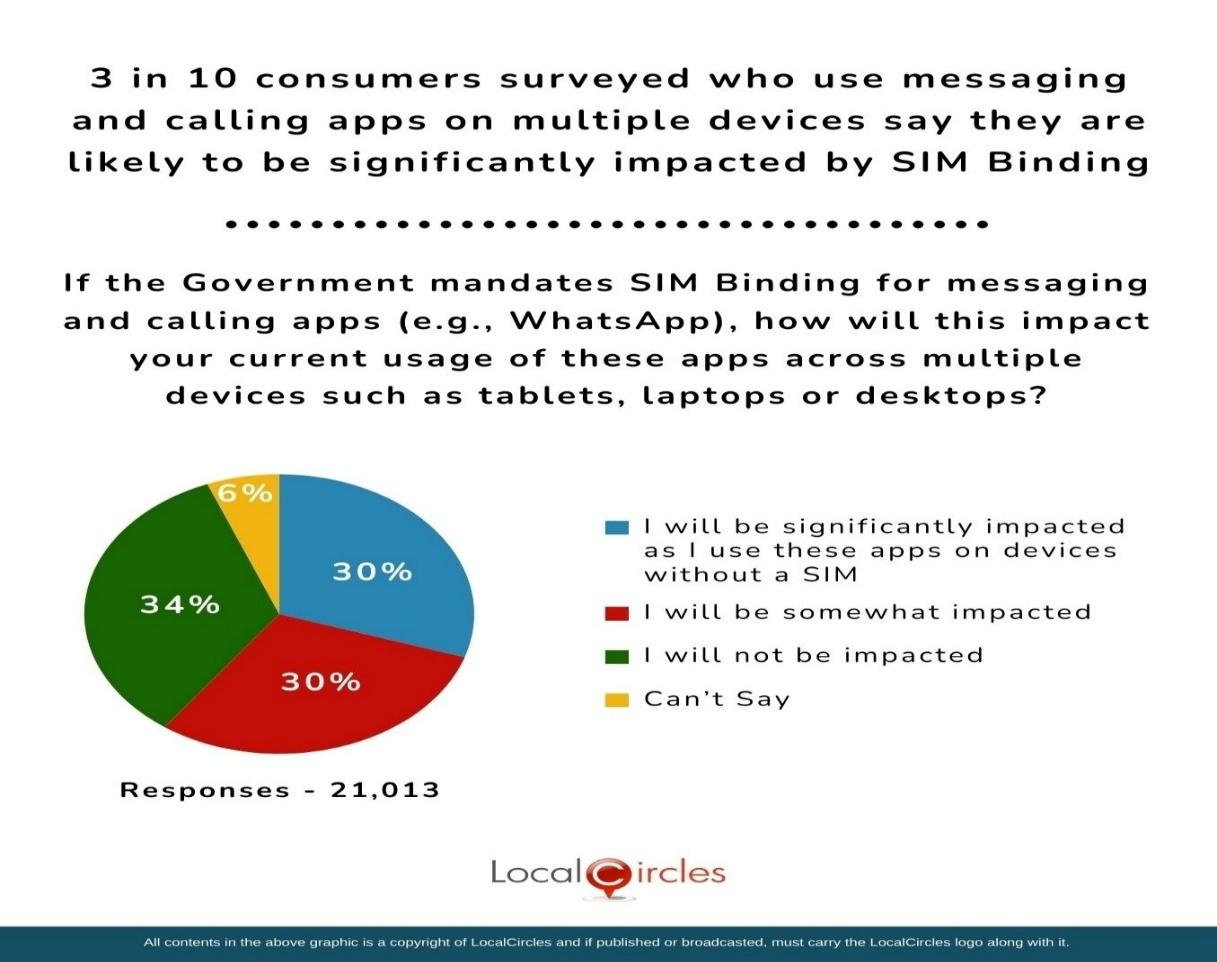
3 in 10 consumers surveyed who use messaging and calling apps on multiple devices say they are likely to be significantly impacted by SIM Binding
As around 40% of consumers have been found to be using messaging and calling apps on multiple devices without a SIM, the survey asked, “If the government mandates SIM binding for messaging and calling apps (e.g., WhatsApp) how will this impact your current usage of these apps across multiple devices such as tablets, laptops or desktops?” Out of 21,013 who responded to the question 30% admitted “I will be significantly impacted as I use these apps on devices without a SIM”; 30% of respondents indicated “I will be somewhat impacted”; 34% of respondents indicated “I will not be impacted”; and 6% of respondents did not give a clear answer. To sum up, 3 in 10 consumers surveyed who use messaging and calling apps on multiple devices say they are likely to be significantly impacted by SIM Binding.
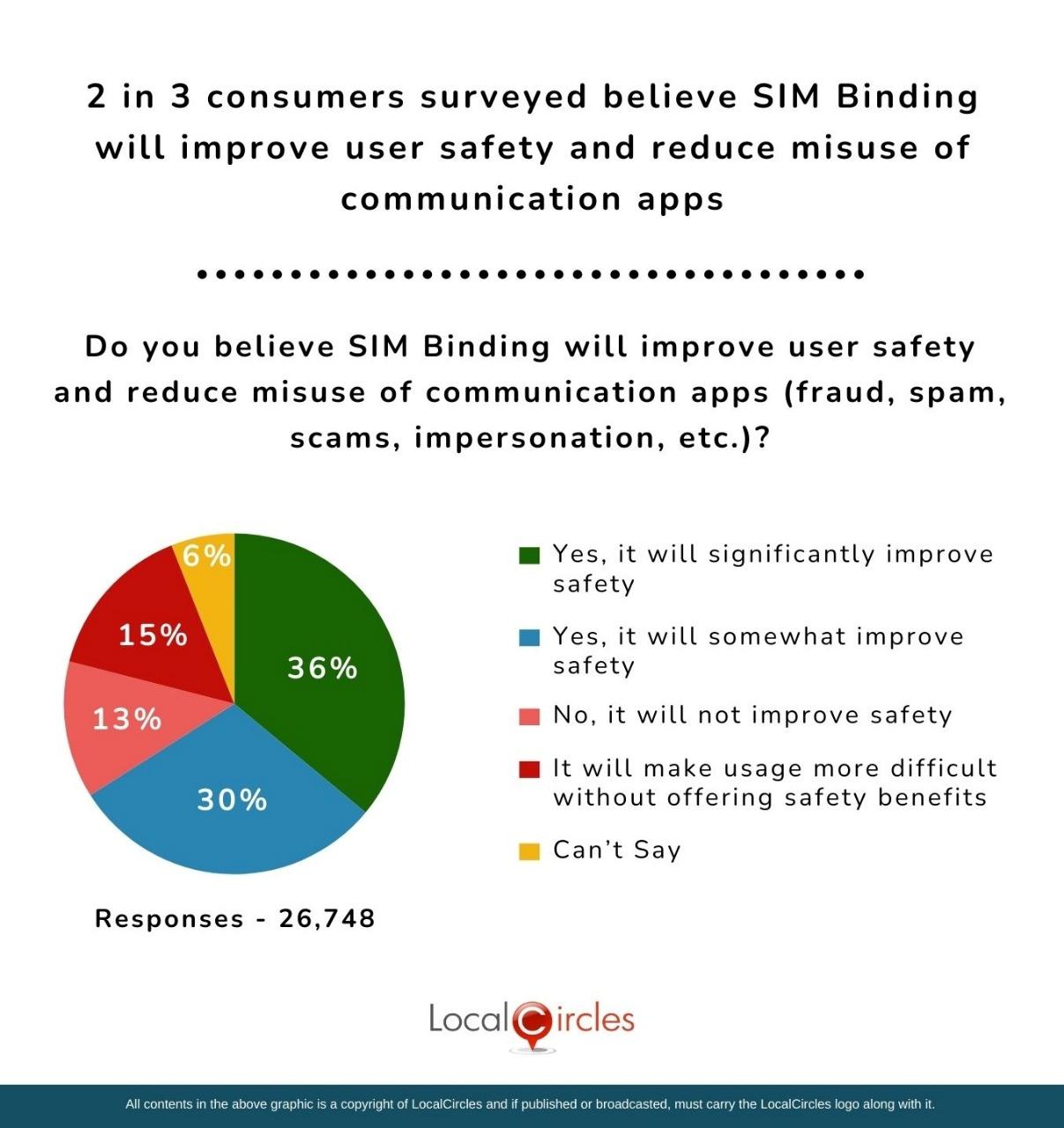
2 in 3 consumers surveyed believe SIM Binding will improve user safety and reduce misuse of communication apps
Seeking to know the consumers’ views on DoT’s directive on SIM Binding, the survey asked, “Do you believe SIM Binding will improve user safety and reduce misuse of communication apps (fraud, spam, scams, impersonation, etc.)?” Out of 26,748 consumers who responded to the question 36% admitted “yes, it will significantly improve safety”; 30% of respondents indicated “yes, it will significantly improve safety”; 30% of respondents indicated "yes, it will somewhat improve safety";” 13% of respondents indicated “no, it will not improve safety”; 15% of respondents indicated “it will make usage more difficult without offering safety benefits” and 6% of respondents did not give a clear answer. To sum up, 2 in 3 consumers surveyed believe SIM Binding will improve user safety and reduce misuse of communication apps.
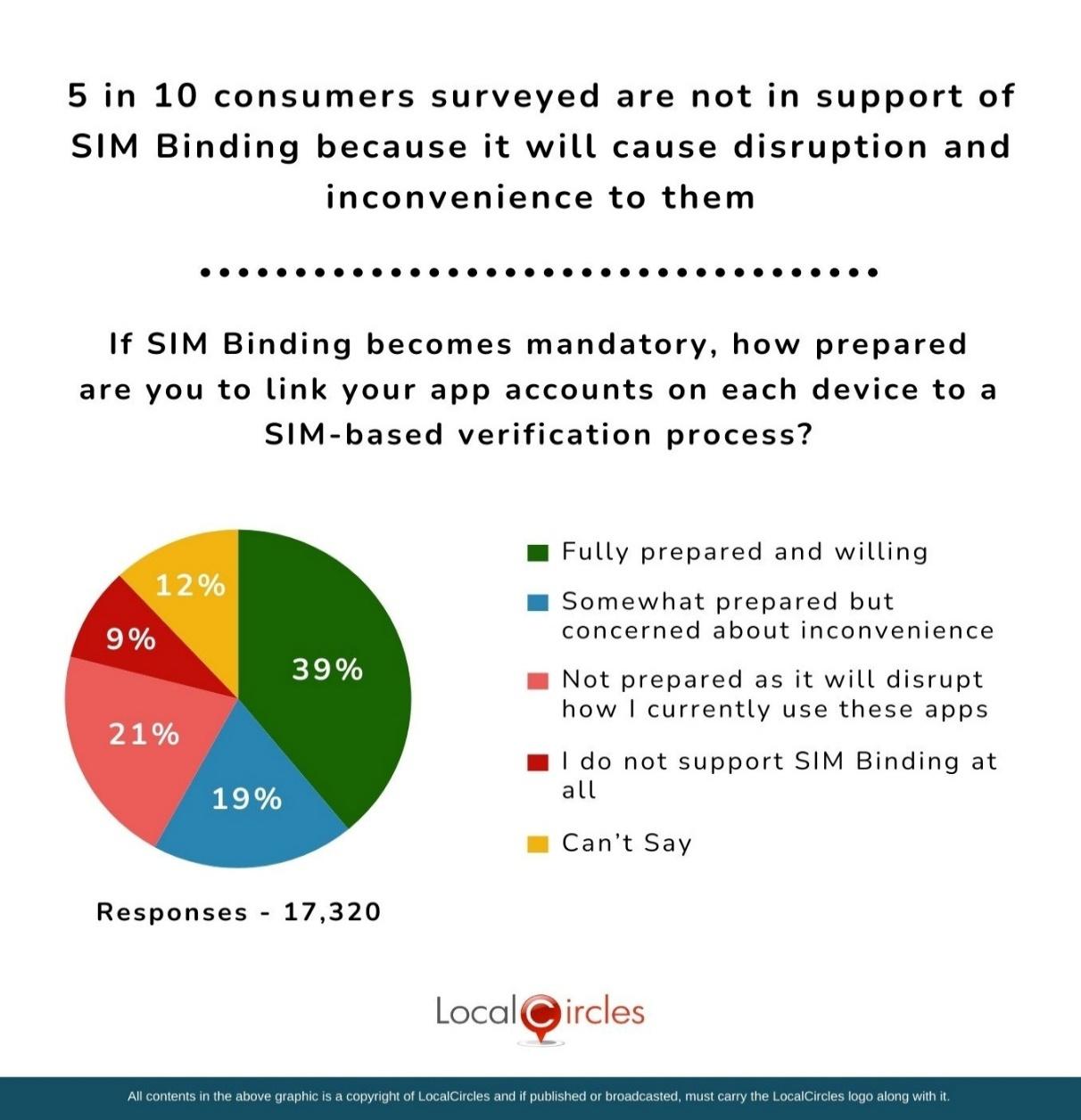
5 in 10 consumers surveyed are not in support of SIM Binding because it will cause disruption and inconvenience to them
As the new rule requires the messaging apps to continuously verify the presence of the SIM linked to the user’s account, the survey asked consumers, “If SIM Binding becomes mandatory, how prepared are you to link your app accounts on each device to a SIM based verification process?” Out of 17,320 consumers who responded to the question 39% indicated “fully prepared and willing”; 19% of respondents indicated that they are “somewhat prepared but concerned about inconvenience”; 21% of respondents indicated that they are “not prepared as it will disrupt how I currently use these apps”; 9% of respondents indicated “I do not support SIM Binding at all” and 12% of respondents did not give a clear answer. In essence, 5 in 10 consumers surveyed are not in support of SIM Binding because it will cause disruption and inconvenience to them.
7 in 10 consumers who travel overseas and surveyed do not support or are concerned about SIM Binding leading to their WhatsApp/other messaging apps not working overseas (with their Indian SIM removed or not on roaming)
As mentioned, SIM binding increases costs, reduces connectivity, and risks account lockouts for travellers and overseas workers, making cross-border communication far more difficult. The survey asked consumers who travel internationally, “With SIM Binding, users may not be able to use their India-registered WhatsApp or other messaging apps abroad if their Indian SIM is inactive, removed, or replaced with a foreign SIM – even if they have Wi-Fi access. Are you okay with this possible disruption while travelling internationally?” Out of 23,027 consumers who responded to the question 16% indicated “yes, I am okay with it”; 16% of respondents indicated “I am somewhat okay but concerned”; 52% of respondents indicated “no, I am not okay with it”; and 16% of respondents did not give a clear answer. To sum up, 7 in 10 consumers who travel overseas and surveyed do not support or are concerned about SIM Binding leading to their WhatsApp/other messaging apps not working overseas (with their Indian SIM removed or not on roaming).
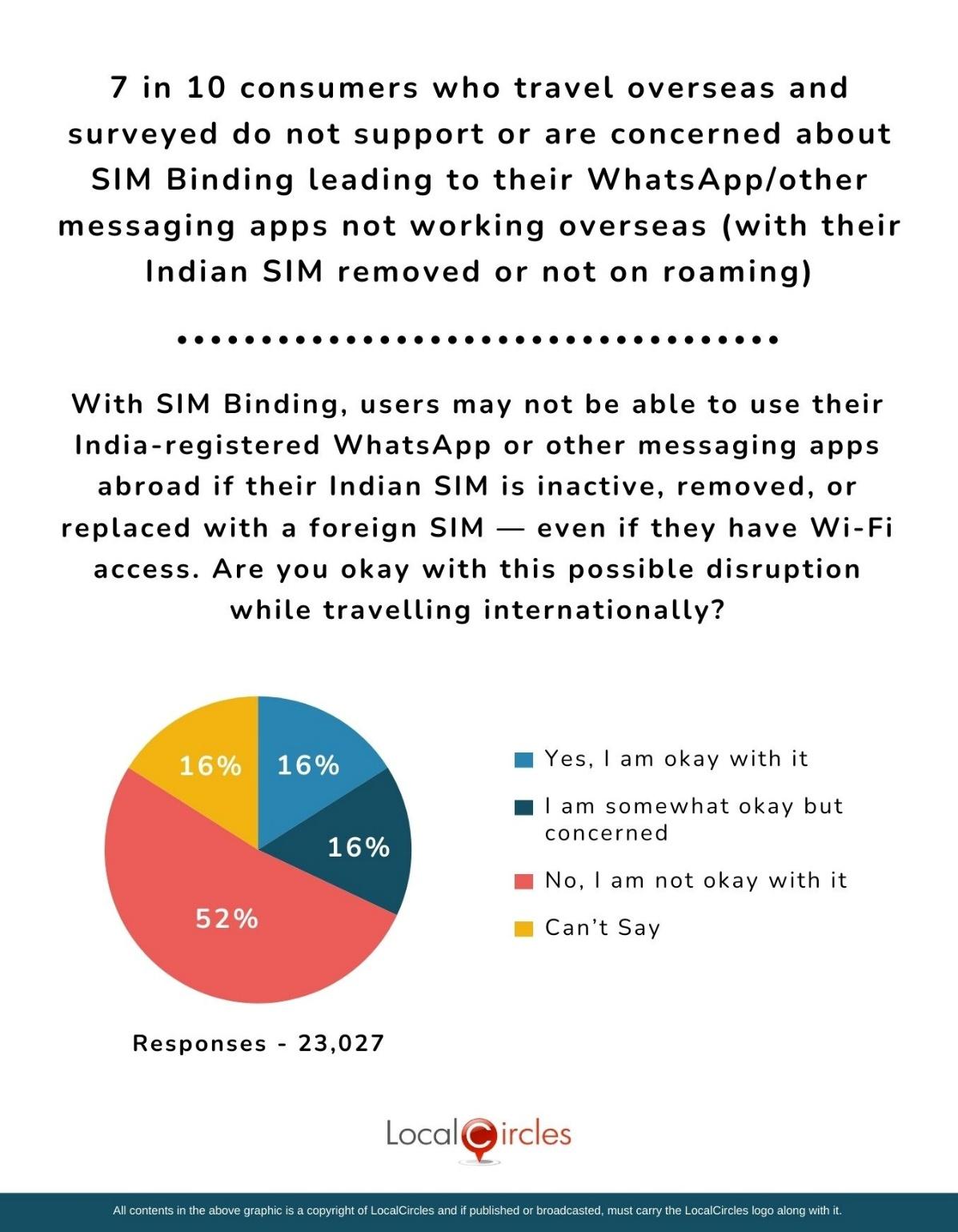
In summary, there appears to be lack of clarity on how DoT’s new directive on SIM Binding will impact consumers including those who do or do not have SIM cards in their mobile devices. The study has revealed that 4 in 10 consumers surveyed use messaging and calling apps on multiple devices without a SIM card. Thus, 3 in 10 consumers surveyed who use messaging and calling apps on multiple devices say they are likely to be significantly impacted by SIM Binding. On the positive side, 2 in 3 consumers surveyed believe SIM Binding will improve user safety and reduce misuse of communication apps. However, 5 in 10 consumers surveyed are not in support of SIM Binding because it will cause disruption and inconvenience to them. In the case of consumers who travel overseas or work abroad, this issue is deeply concerning as 7 in 10 consumers surveyed do not support or are concerned about SIM Binding leading to their WhatsApp/other messaging apps not working overseas (with their Indian SIM removed or not on roaming).
The survey shows that while there are a sizable number of users who believe that SIM Binding will improve user safety and reduce misuse, many are concerned about disruption and inconvenience it will cause for those who use multiple devices. Similarly, 7 in 10 who travel internationally are concerned about the disruption it will cause. The DOT may consider finding ways to implement SIM Binding in India on an optional basis giving users who are willing or want the added security to opt for it.
LocalCircles will escalate the findings of the survey with Department of Telecommunications and any other relevant stakeholders.
Survey Demographics
The survey received over 115,000 responses from consumers located in 332 districts of India. 67% respondents were men while 33% respondents were women. 45% respondents were from tier 1, 32% from tier 2 and 23% respondents were from tier 3, 4, 5 & rural districts. The survey was conducted via LocalCircles platform, and all participants were validated citizens who had to be registered with LocalCircles to participate in this survey.
About LocalCircles
LocalCircles, India’s leading Community Social Media platform enables citizens and small businesses to escalate issues for policy and enforcement interventions and enables Government to make policies that are citizen and small business centric. LocalCircles is also India’s # 1 pollster on issues of governance, public and consumer interest. More about LocalCircles can be found on https://www.localcircles.com
For more queries - media@localcircles.com, +91-8585909866
All content in this report is a copyright of LocalCircles. Any reproduction or redistribution of the graphics or the data therein requires the LocalCircles logo to be carried along with it. In case any violation is observed LocalCircles reserves the right to take legal action.
Enter your email & mobile number and we will send you the instructions.
Note - The email can sometime gets delivered to the spam folder, so the instruction will be send to your mobile as well


