India has a restaurant hygiene issue: 5 in 10 consumers surveyed experienced it in the last 12 months; 7 in 10 want hygiene rating of restaurants displayed publicly & on food delivery apps
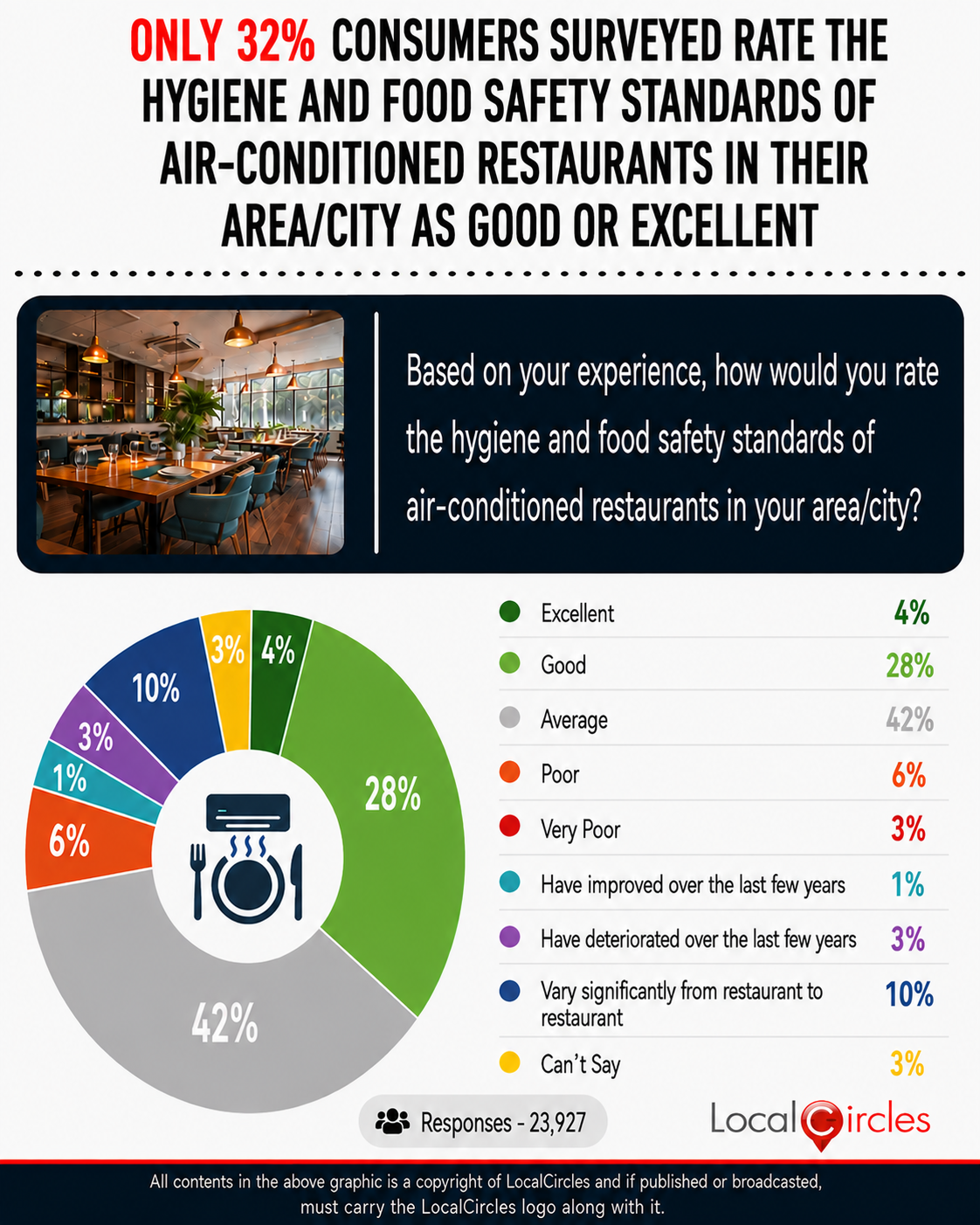
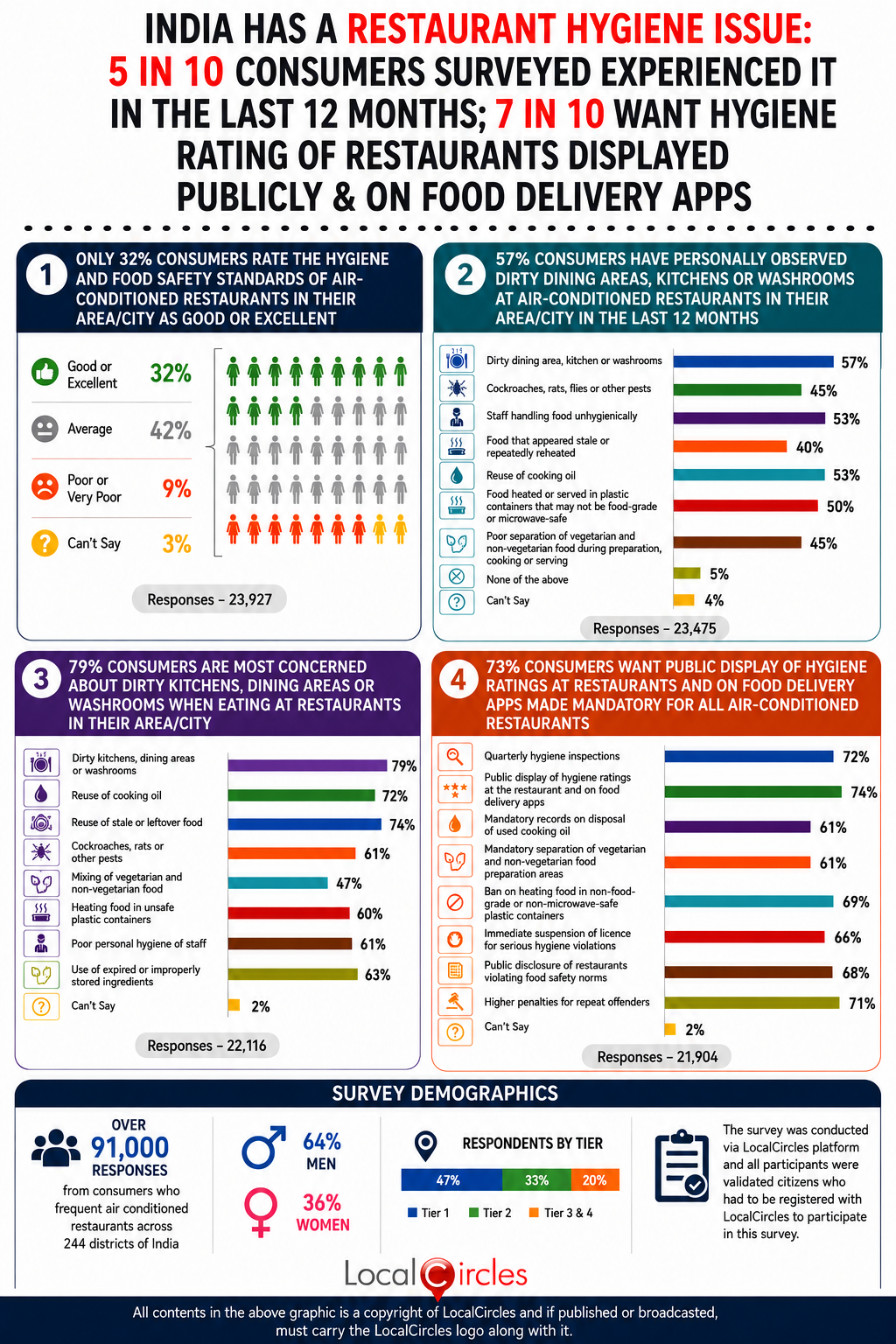
- ● Only 4% consumers surveyed rate these standards as excellent and 28% as good, while 42% rate them average and a combined 9% rate them poor or very poor
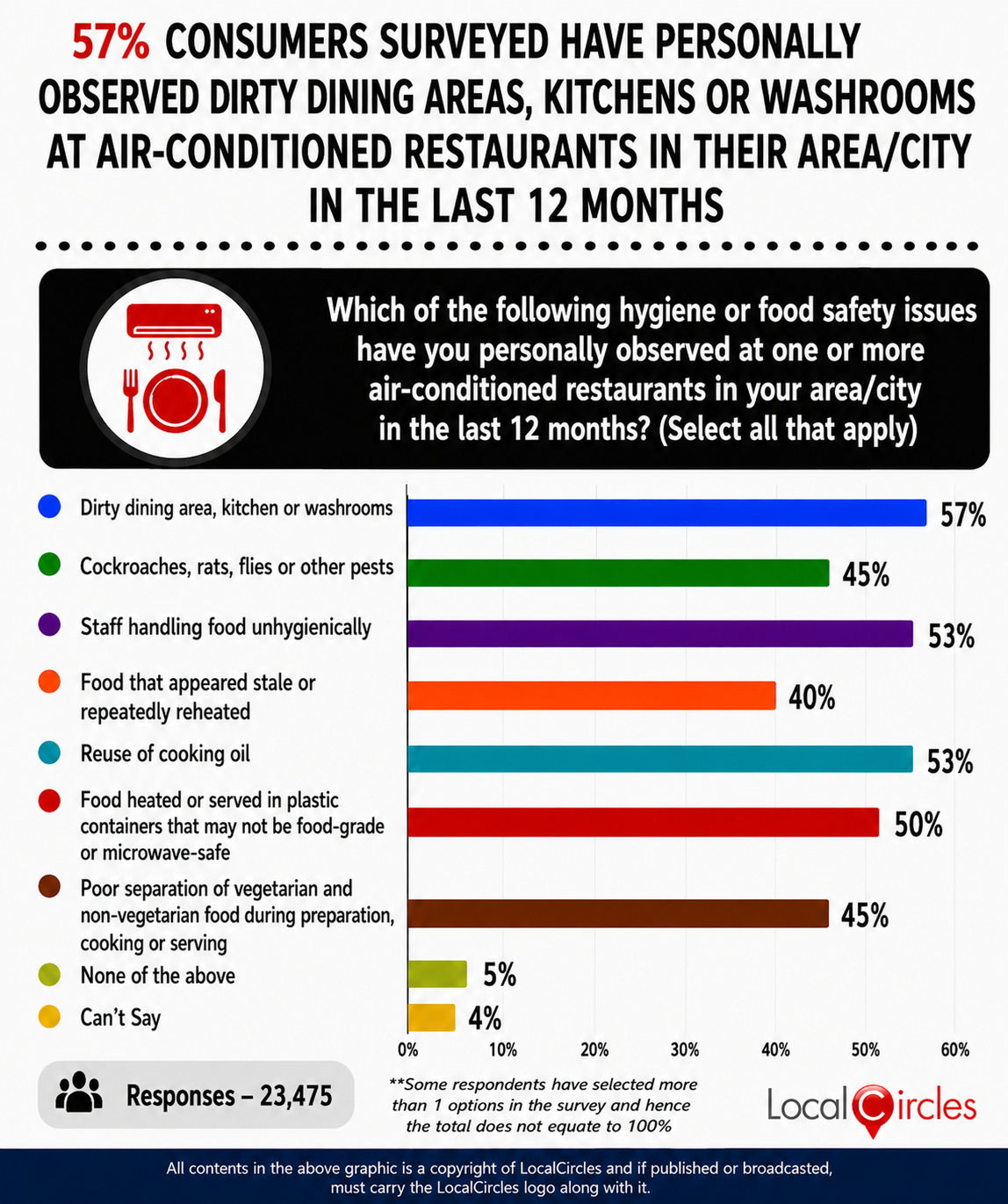
- ● 57% consumers surveyed have personally observed dirty dining areas, kitchens or washrooms in the last 12 months, 53% have seen staff handling food unhygienically and an equal 53% have seen reuse of cooking oil
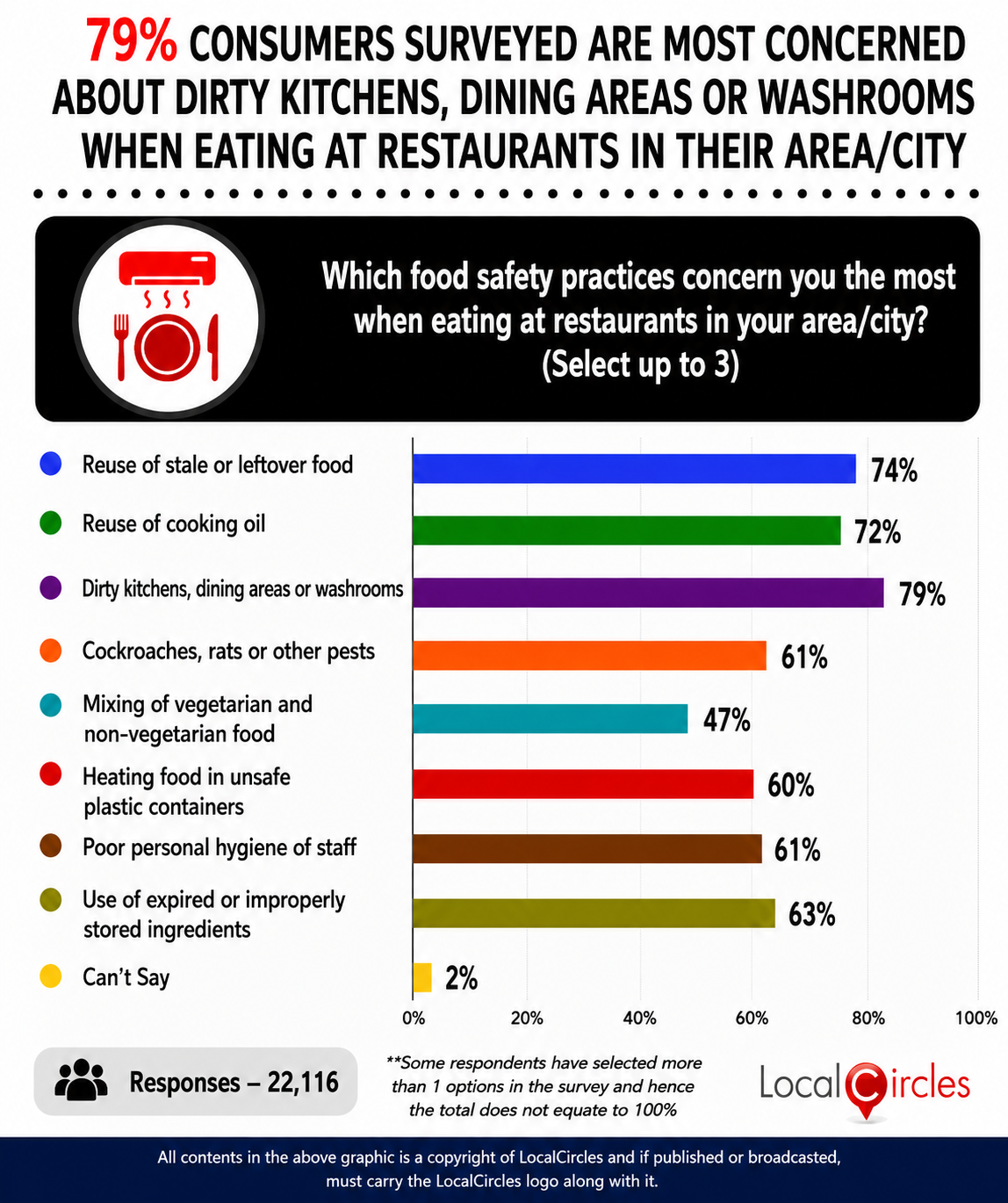
- ● 79% consumers surveyed are most concerned about dirty kitchens, dining areas or washrooms, followed by 74% concerned about reuse of stale or leftover food and 72% about reuse of cooking oil
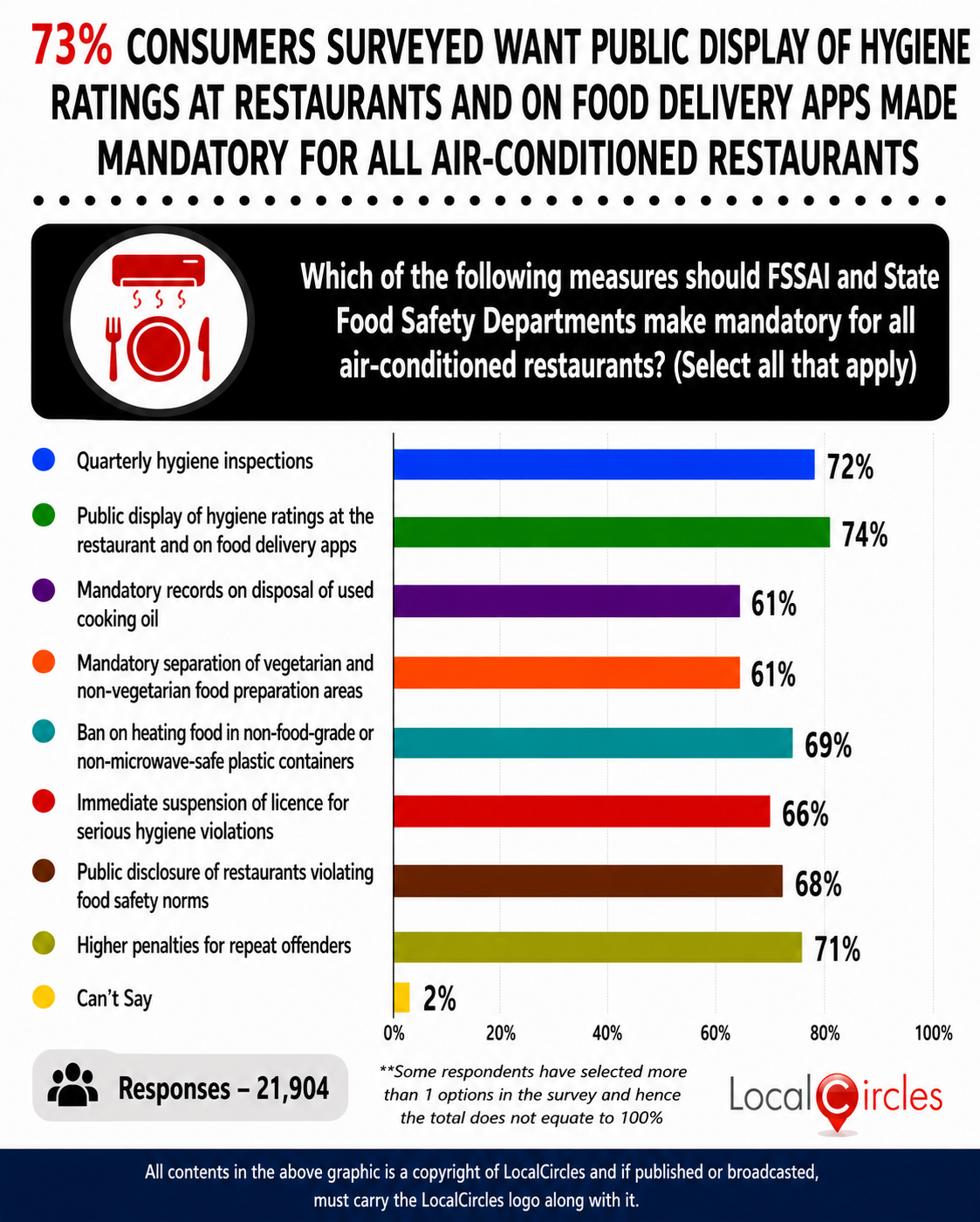
- ● 74% consumers surveyed want public display of hygiene ratings at restaurants and on food delivery apps made mandatory, 72% want quarterly hygiene inspections and 71% want higher penalties for repeat offenders
August 12, 2026, New Delhi: Eating out at air-conditioned restaurants has become a routine part of urban Indian life, but whether what happens behind the kitchen door meets basic hygiene standards has moved to the centre of public debate over the last few months. A sustained enforcement drive by the Maharashtra Food and Drug Administration (FDA) has suspended the food business licences of several of Mumbai’s best-known clubs and restaurants, putting restaurant hygiene under a spotlight the industry has not faced in years.
During surprise inspections carried out between July 24 and 27, 2026, the Maharashtra FDA suspended the FSSAI licences of the Cricket Club of India (CCI), Willingdon Sports Club, MIG Cricket Club, RK Juhu Gymkhana and Aparna Juhu Gymkhana. Inspectors reported cockroach and fly infestations, expired food stock, rotten vegetables, poor sanitation, clogged drains, stagnant water, unhygienic food storage and inadequate segregation of vegetarian and non-vegetarian food preparation areas; at MIG Cricket Club, an unauthorised catering agency was found operating without a valid FSSAI licence. Days earlier, the licence of Mumbai’s iconic Poornima Restaurant in Fort was suspended after an inspection reportedly found fungal growth on food ingredients, flies on the premises, dirty drains, improper storage of cooked and raw food, deteriorating kitchen infrastructure and missing health records for food handlers. In June 2026, six Mumbai eateries faced action over rats, cockroaches and expired food, and on July 14, 2026 the FSSAI licence of the well-known Parsi Dairy Farm was suspended after officials found fungal growth on walls, mosquito infestation, poor housekeeping and gaps in food handling procedures.
These are not isolated cases. Data placed before Parliament in July 2026 shows that of 2,23,808 food samples analysed across India in FY 2025-26, 40,023 — nearly one in five — were found unsafe, substandard or misbranded. Food safety authorities conducted 5,20,566 inspections during the year, up from 4,01,391 in 2024-25, with 31,878 civil cases decided with penalties and 945 recalls initiated, but only 1,918 criminal convictions recorded. In Maharashtra, the FDA under Commissioner Tukaram Mundhe has reported a four-fold rise in food sample testing over the past year and has directed field officers to inspect through the year rather than only around festivals, with a sharper focus on high-risk categories such as milk, edible oils, spices and ready-to-eat foods. Alongside restaurant action, the FDA on July 29, 2026 also barred the sale, advertisement and free distribution of high fat, sugar and salt (HFSS) foods within a 50-metre radius of all schools in the State. The action has since spread beyond Maharashtra. On August 7, 2026, following the Mumbai crackdown, the Karnataka Health and Family Welfare Department deployed 30 special teams that inspected 26 three-star and five-star hotels across Bengaluru — including properties such as The Lalit Ashok, Shangri-La, Taj and Radisson — collecting 35 food samples for testing. Officials reported expired food products, fungal growth on vegetables, rotten meat, expired milk, improper storage, misbranding and labelling violations and inadequate segregation of vegetarian and non-vegetarian food, with unsafe food seized and notices issued to the food business operators; Karnataka has warned of licence suspensions, legal action and FIRs in serious cases.
The crackdown has also triggered pushback. The Hotel and Restaurant Association (Western India), the National Restaurant Association of India and the Indian Hotel and Restaurant Association have jointly sought the intervention of the Prime Minister, the Chief Minister of Maharashtra and FSSAI, arguing that licence suspensions and public naming of establishments should follow the improvement notice and hearing process laid down under Section 32 of the Food Safety and Standards Act, 2006, except where there is an immediate risk to public health; on July 30, 2026 the Bombay High Court quashed one such suspension of a hotel licence by the FDA. At the same time, the tools available to consumers remain weak. FSSAI’s Hygiene Rating Scheme, under which food outlets are scored from one to five and issued a window sticker, is voluntary and rarely displayed, and enforcement on reused cooking oil has stalled in several districts for want of functional Total Polar Compounds (TPC) meters — the instrument used to check whether oil has crossed the 25% TPC limit set by FSSAI. The result is that a consumer walking into an air-conditioned restaurant today has no reliable way of knowing when it was last inspected or what was found.
Against this backdrop, LocalCircles conducted a national survey to understand how consumers rate the hygiene and food safety standards of air-conditioned restaurants in their area/city, what they have personally observed in the last 12 months, which practices worry them the most, and which measures they want made mandatory. The survey received over 91,000 responses from consumers who frequent air-conditioned restaurants located across 244 districts of India. The findings show that only 32% of consumers surveyed rate hygiene and food safety standards at air-conditioned restaurants in their area/city as good or excellent, 57% have personally observed dirty dining areas, kitchens or washrooms in the last 12 months, and 74% want public display of hygiene ratings at restaurants and on food delivery apps made mandatory. The key findings of the survey are detailed below.
Only 32% consumers surveyed rate the hygiene and food safety standards of air-conditioned restaurants in their area/city as good or excellent
To establish a baseline of how consumers perceive standards at the organised end of the eating-out market, the survey asked, “Based on your experience, how would you rate the hygiene and food safety standards of air-conditioned restaurants in your area/city?” This question received 23,927 responses. In response, the largest group at 42% rated these standards as average, while 28% rated them good and only 4% excellent.
Another 10% said standards vary significantly from restaurant to restaurant, 6% rated them poor and 3% very poor. Only 1% said standards have improved over the last few years while 3% said they have deteriorated, and 3% could not say. Taken together, just 32% of consumers surveyed — 28% good and 4% excellent — rate these standards positively, while a combined 9% rate them poor or very poor. That barely one in three consumers is willing to describe standards at air-conditioned restaurants as good or better — at a time when such restaurants command a clear price premium over other eating-out formats — points to a broad-based trust deficit rather than to lapses at a handful of establishments.
57% consumers surveyed have personally observed dirty dining areas, kitchens or washrooms at air-conditioned restaurants in their area/city in the last 12 months
Perception apart, the survey next sought to establish what consumers have actually witnessed first-hand, asking, “Which of the following hygiene or food safety issues have you personally observed at one or more air-conditioned restaurants in your area/city in the last 12 months? (Select all that apply)” This question received 23,475 responses. In response, 57% said they had seen dirty dining areas, kitchens or washrooms, 53% had observed staff handling food unhygienically and an equal 53% had seen reuse of cooking oil. Another 50% reported food heated or served in plastic containers that may not be food-grade or microwave-safe, 45% had seen cockroaches, rats, flies or other pests, and an equal 45% reported poor separation of vegetarian and non-vegetarian food during preparation, cooking or serving, while 40% had come across food that appeared stale or repeatedly reheated. Only 5% said none of the above and 4% could not say. In effect, over 9 in 10 consumers surveyed reported at least one hygiene or food safety violation observed first-hand in the last 12 months, and every one of the seven violations listed was reported by at least 4 in 10 consumers — a pattern that closely mirrors what FDA inspectors have been documenting during the ongoing drive in Maharashtra.
79% consumers surveyed are most concerned about dirty kitchens, dining areas or washrooms when eating at restaurants in their area/city
To identify which practices consumers want regulators to prioritise, the survey asked, “Which food safety practices concern you the most when eating at restaurants in your area/city? (Select up to 3)” This question received 22,116 responses. Dirty kitchens, dining areas or washrooms topped the list at 79%, followed by reuse of stale or leftover food at 74% and reuse of cooking oil at 72%. Use of expired or improperly stored ingredients was cited by 63%, while cockroaches, rats or other pests and poor personal hygiene of staff were each cited by 61%. Heating food in unsafe plastic containers concerned 60% and mixing of vegetarian and non-vegetarian food 47%, with only 2% unable to say. The ranking is instructive: consumers are as worried about what they cannot see — oil reused past its safe life, leftover food served the next day, expired ingredients — as they are about visible dirt, and it is precisely these invisible practices that only inspection and record-keeping can catch. It is also where the regulatory gap is widest, with the FSSAI limit of 25% Total Polar Compounds and the Repurpose Used Cooking Oil (RUCO) framework in place on paper but field enforcement constrained by the shortage of working TPC meters.
73% consumers surveyed want public display of hygiene ratings at restaurants and on food delivery apps made mandatory for all air-conditioned restaurants
The survey finally sought to establish what consumers want done about it, asking, “Which of the following measures should FSSAI and State Food Safety Departments make mandatory for all air-conditioned restaurants? (Select all that apply)” This question received 21,904 responses. The most-supported measure at 74% was public display of hygiene ratings at the restaurant and on food delivery apps, followed by quarterly hygiene inspections at 72% and higher penalties for repeat offenders at 71%. Another 69% want a ban on heating food in non-food-grade or non-microwave-safe plastic containers, 68% want public disclosure of restaurants violating food safety norms and 66% want immediate suspension of licence for serious hygiene violations. Mandatory records on disposal of used cooking oil and mandatory separation of vegetarian and non-vegetarian food preparation areas were each supported by 61%, while only 2% could not say. Two findings stand out. Consumer support for public disclosure of violators at 68% runs directly counter to the hospitality industry’s objection to establishments being named before proceedings are complete. And the demand for mandatory display of hygiene ratings would require FSSAI’s currently voluntary Hygiene Rating Scheme to be converted into a mandatory, publicly visible one — including alongside restaurant listings on food delivery platforms, through which a large and growing share of restaurant food now reaches consumers.
In summary, the survey findings indicate that India does have a restaurant food safety issue, and that it extends well beyond the establishments regulators have named so far. Only 32% of consumers surveyed rate hygiene and food safety standards at air-conditioned restaurants in their area/city as good or excellent, while 57% have personally observed dirty dining areas, kitchens or washrooms in the last 12 months and over half have seen staff handling food unhygienically or cooking oil being reused. What consumers fear most — dirty kitchens at 79%, reuse of stale or leftover food at 74% and reuse of cooking oil at 72% — maps almost exactly onto the violations that FDA inspectors have been recording in Mumbai’s clubs and restaurants, which suggests the enforcement drive is finding what consumers already suspected rather than uncovering something new. Air conditioning, a premium price point and a well-known name, the findings show, are not read by consumers as assurance of a clean kitchen.
These findings carry an important signal for FSSAI, State Food Safety Commissioners and the restaurant industry as the debate over the Maharashtra FDA’s enforcement approach plays out before the Centre, the State Government and the courts. The citizen pulse is clear that consumers want more inspection rather than less and want the outcome of that inspection made visible to them at the point of decision — 74% want hygiene ratings displayed at the restaurant and on food delivery apps, 72% want quarterly inspections, 71% want higher penalties for repeat offenders and 68% want violators publicly disclosed. LocalCircles will be escalating these findings to FSSAI, the Ministry of Health and Family Welfare, the Maharashtra FDA and Food Safety Commissioners of other States so that the citizen pulse can inform how restaurant food safety is regulated and enforced. LocalCircles is also urging that FSSAI’s Hygiene Rating Scheme be made mandatory for all air-conditioned restaurants with the rating displayed at the entrance and against the restaurant listing on every food delivery app, that hygiene inspections be conducted at a defined minimum frequency with findings placed in the public domain, and that State Food Safety Departments be equipped with functional TPC meters and used cooking oil disposal records be audited so that the rules already on the books can actually be enforced.
Survey Demographics
The survey received over 91,000 responses from consumers who frequent air-conditioned restaurants and located across 244 districts of India. 64% respondents were men while 36% respondents were women. 47% respondents were from tier 1, 33% from tier 2 and 20% respondents were from tier 3 & 4 districts. The survey was conducted via LocalCircles platform and all participants were validated citizens who had to be registered with LocalCircles to participate in this survey.
About LocalCircles
LocalCircles, India’s leading Community Social Media platform enables citizens and small businesses to escalate issues for policy and enforcement interventions and enables Government to make policies that are citizen and small business centric. LocalCircles is also India’s # 1 pollster on issues of governance, public and consumer interest. More about LocalCircles can be found on https://www.localcircles.com
For more queries - media@localcircles.com, +91-8585909866
All content in this report is a copyright of LocalCircles. Any reproduction or redistribution of the graphics or the data therein requires the LocalCircles logo to be carried along with it. In case any violation is observed LocalCircles reserves the right to take legal action.
Enter your email & mobile number and we will send you the instructions.
Note - The email can sometime gets delivered to the spam folder, so the instruction will be send to your mobile as well


