As petrol diesel prices increase for fourth time this month, 5 in 10 consumers surveyed say cost of transportation, products and services have increased; 7 in 10 say they will reduce non-essential travel to cope with rising prices
- ● 5 in 10 consumers surveyed say cost of transportation, products and services have increased due to multiple rounds of petrol/diesel price increases impacting household budget
- ● 7 in 10 consumers surveyed say they will reduce non-essential travel and outings to cope with rising petrol/diesel prices
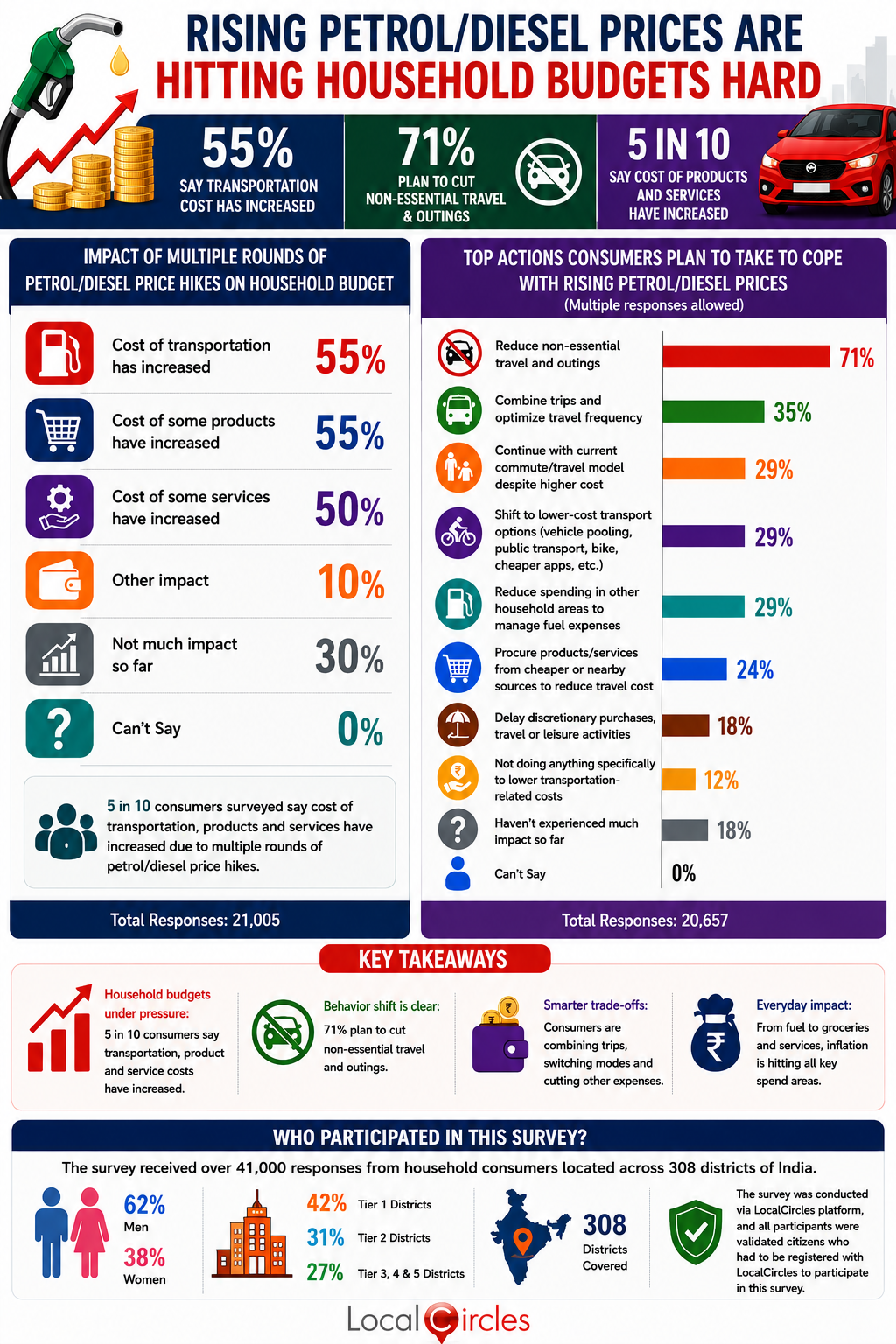
May 25, 2026, New Delhi: After remaining stable for several weeks, petrol and diesel prices have witnessed a sharp upward revision in May 2026. Oil marketing companies have hiked fuel prices four times this month, with the latest revision on May 25, 2026 raising petrol prices by INR 2.61 per litre and diesel by INR 2.71 per litre across major cities. Cumulatively, between May 15, May 19, May 23 and May 25, petrol prices have increased by INR 7.35 per litre and diesel prices by INR 7.53 per litre.
Oil marketing companies have attributed the latest revisions to mounting losses caused by rising international crude oil prices, supply concerns and ongoing geopolitical tensions in the Middle East that have driven global crude markets into a phase of extraordinary turbulence. While India’s cumulative fuel price increase of around 7% between February and May 2026 remains among the lowest globally outside heavily subsidised oil-producing nations, the back-to-back hikes have rekindled concerns of a domino effect on household budgets and consumer prices.
The repeated rise in petrol and diesel prices has a direct bearing on transportation and logistics costs, which often get passed on to consumers through higher prices of daily-use products, food items and essential services. Industry analysts have already warned that if global crude prices continue at elevated levels, further upward revisions in domestic fuel rates cannot be ruled out in the coming weeks, intensifying the pressure on already stretched household finances.
Against the backdrop of these successive fuel price hikes, LocalCircles conducted a survey to understand how household consumers are being impacted by the rising petrol and diesel prices, and how they plan to cope with the increased fuel costs. The survey received over 41,000 responses from household consumers located across 308 districts of India. 62% respondents were men while 38% respondents were women. 42% of respondents were from tier 1, 31% from tier 2 and 27% respondents were from tier 3, 4 & 5 districts.
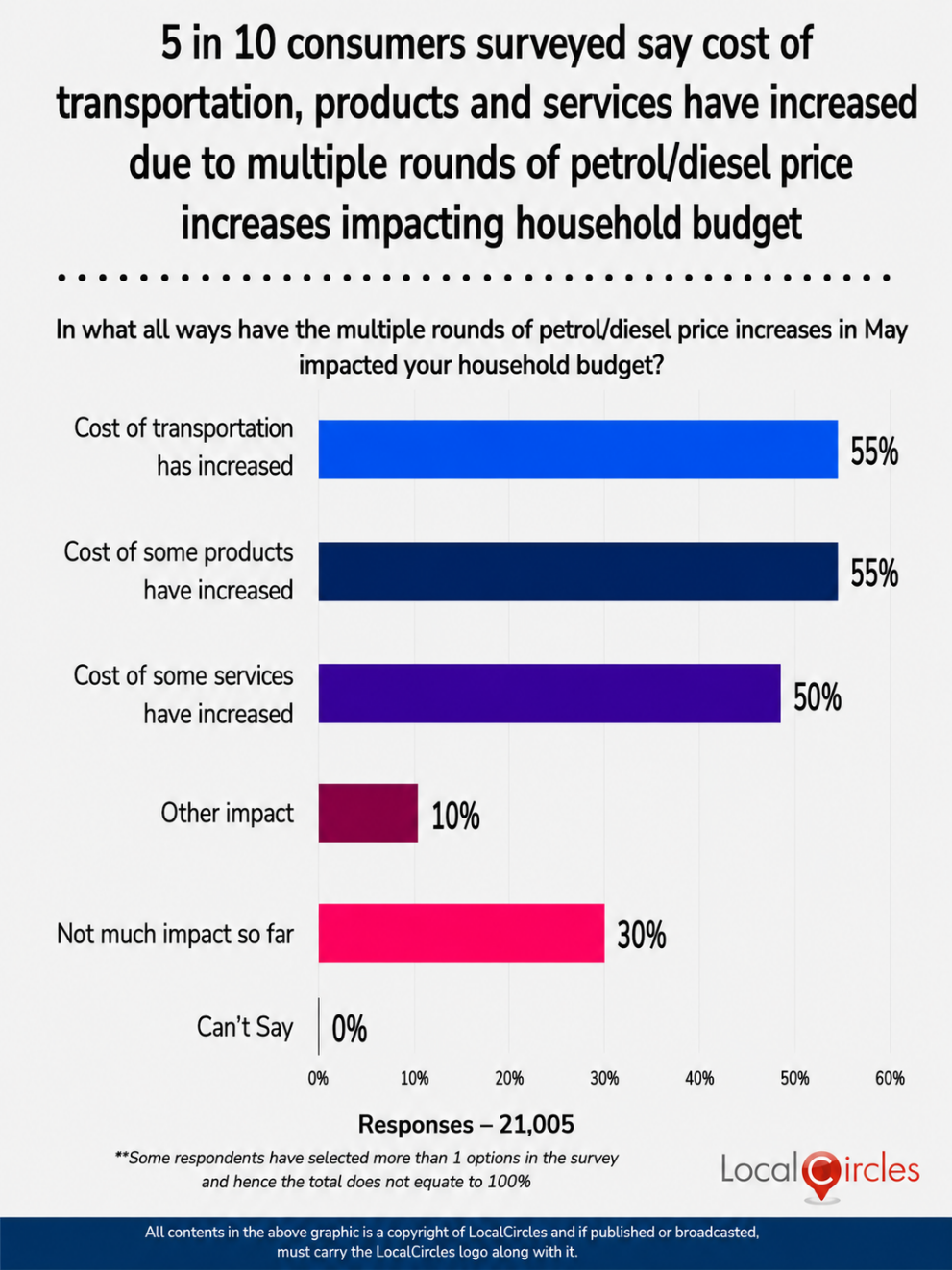
5 in 10 consumers surveyed say cost of transportation, products and services have increased due to multiple rounds of petrol/diesel price increases impacting household budget
Fuel is one of the largest contributors to the running cost of households, both directly through personal transportation and indirectly through the price of goods and services. To gauge the immediate impact of the recent petrol/diesel price hikes, the survey first asked household consumers, “In what all ways have the multiple rounds of petrol/diesel price increases in May impacted your household budget?” Some among 21,005 who responded to the question indicated more than one impact. 55% of respondents indicated that the “cost of transportation has increased”; 55% of respondents indicated that the “cost of some products have increased”; 50% of respondents indicated that the “cost of some services have increased”; 10% of respondents indicated “other impact”; 30% of respondents indicated that there has been “not much impact so far”; and 0% of respondents indicated that they “can’t say”. To sum up, 5 in 10 consumers surveyed say cost of transportation, products and services have increased due to multiple rounds of petrol/diesel price increases impacting household budget.
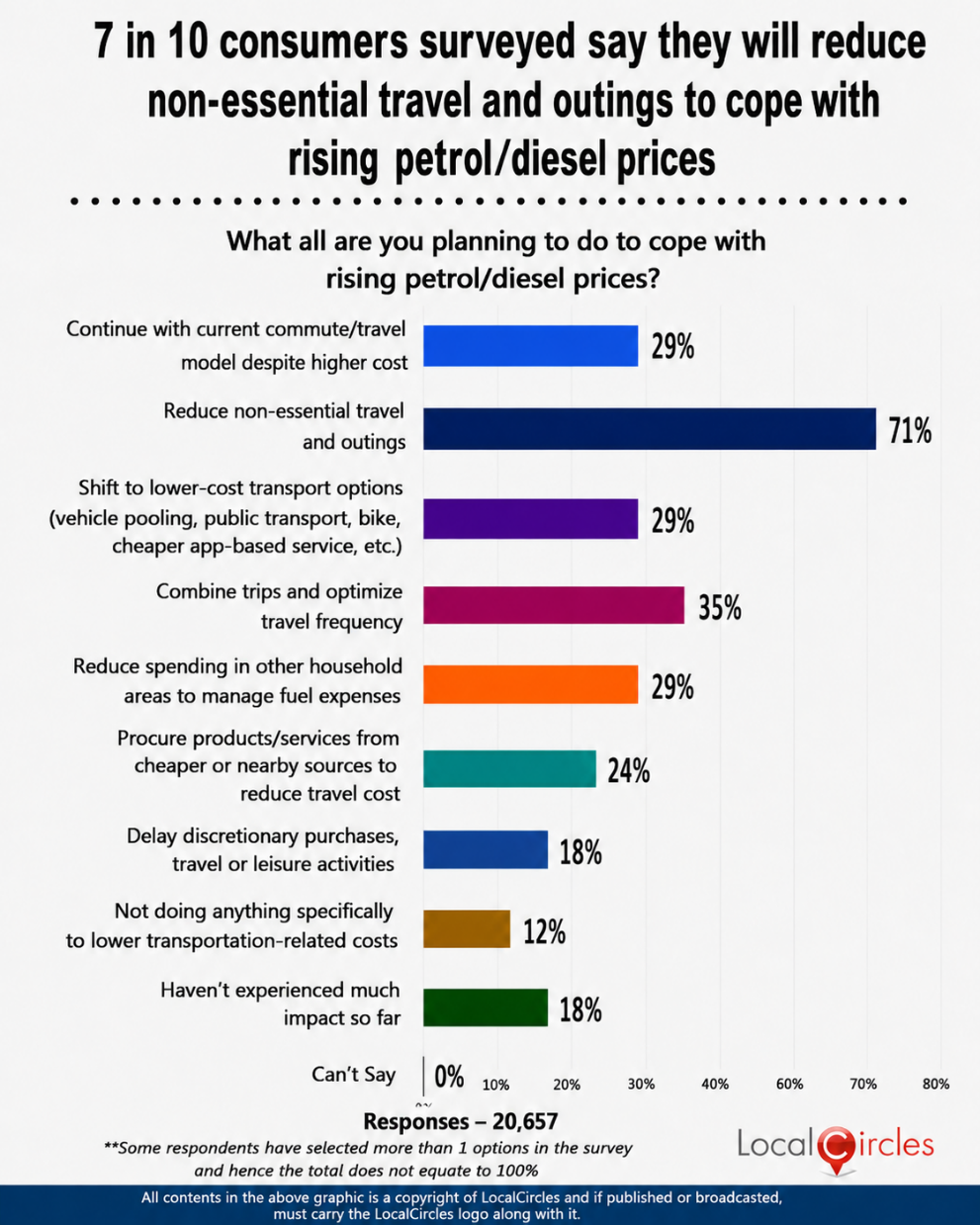
7 in 10 consumers surveyed say they will reduce non-essential travel and outings to cope with rising petrol/diesel prices
As fuel costs squeeze monthly budgets, consumers tend to recalibrate their travel patterns, spending choices and mode of commute to manage the additional burden. The survey next asked household consumers, “What all are you planning to do to cope with rising petrol/diesel prices?” Some among 20,657 who responded to the question indicated more than one option. The largest group of 71% indicated that they will “reduce non-essential travel and outings”; 35% of respondents indicated that they will “combine trips and optimize travel frequency”; 29% of respondents indicated that they will “continue with current commute/travel model despite higher cost”; 29% of respondents indicated that they will “shift to lower-cost transport options (vehicle pooling, public transport, bike, cheaper app-based service, etc.)”; 29% of respondents indicated that they will “reduce spending in other household areas to manage fuel expenses”; 24% of respondents indicated that they will “procure products/services from cheaper or nearby sources to reduce travel cost”; 18% of respondents indicated that they will “delay discretionary purchases, travel or leisure activities”; 12% of respondents indicated that they are “not doing anything specifically to lower transportation-related costs”; 18% of respondents indicated that they “haven’t experienced much impact so far”; and 0% of respondents indicated that they “can’t say”. To sum up, 7 in 10 consumers surveyed say they will reduce non-essential travel and outings to cope with rising petrol/diesel prices.
In summary, the four successive rounds of petrol/diesel price increases in May 2026 are clearly leaving a visible imprint on household budgets across urban and semi-urban India. As many as 5 in 10 consumers surveyed report that the cost of transportation, products and services has increased due to the multiple rounds of fuel price hikes, with 55% specifically pointing to higher transportation costs, 55% to higher prices of products and 50% to higher prices of services. With the rupee impact of every fuel hike eventually getting passed through to logistics, mobility and the broader consumer basket, even households not directly using personal vehicles are feeling the pinch. To cope with rising petrol and diesel prices, 7 in 10 consumers surveyed indicated they will reduce non-essential travel and outings, while 35% plan to combine trips and optimize travel frequency and 29% each plan to either shift to lower-cost transport options or cut back on spending in other household areas. Another 24% intend to procure products and services from cheaper or nearby sources to reduce travel cost, and 18% plan to delay discretionary purchases, travel or leisure activities. The behavioural shift is unmistakable—consumers are combining trips, switching modes of transport, downsizing discretionary spends and re-prioritising household expenses to absorb the fuel price shock. If global crude prices remain elevated and further hikes follow, the cascading effect on inflation, consumption and household sentiment could become more pronounced, making it critical for policymakers and oil marketing companies to closely watch the pass-through of fuel costs to essential goods and services.
Survey Demographics
The survey received over 41,000 responses from household consumers located across 308 districts of India. 62% respondents were men while 38% respondents were women. 42% of respondents were from tier 1, 31% from tier 2 and 27% respondents were from tier 3, 4 & 5 districts. The survey was conducted via LocalCircles platform, and all participants were validated citizens who had to be registered with LocalCircles to participate in this survey.
About LocalCircles
LocalCircles, India’s leading Community Social Media platform enables citizens and small businesses to escalate issues for policy and enforcement interventions and enables Government to make policies that are citizen and small business centric. LocalCircles is also India’s # 1 pollster on issues of governance, public and consumer interest. More about LocalCircles can be found on https://www.localcircles.com
For more queries - media@localcircles.com, +91-8585909866
All content in this report is a copyright of LocalCircles. Any reproduction or redistribution of the graphics or the data therein requires the LocalCircles logo to be carried along with it. In case any violation is observed LocalCircles reserves the right to take legal action.
Enter your email & mobile number and we will send you the instructions.
Note - The email can sometime gets delivered to the spam folder, so the instruction will be send to your mobile as well


