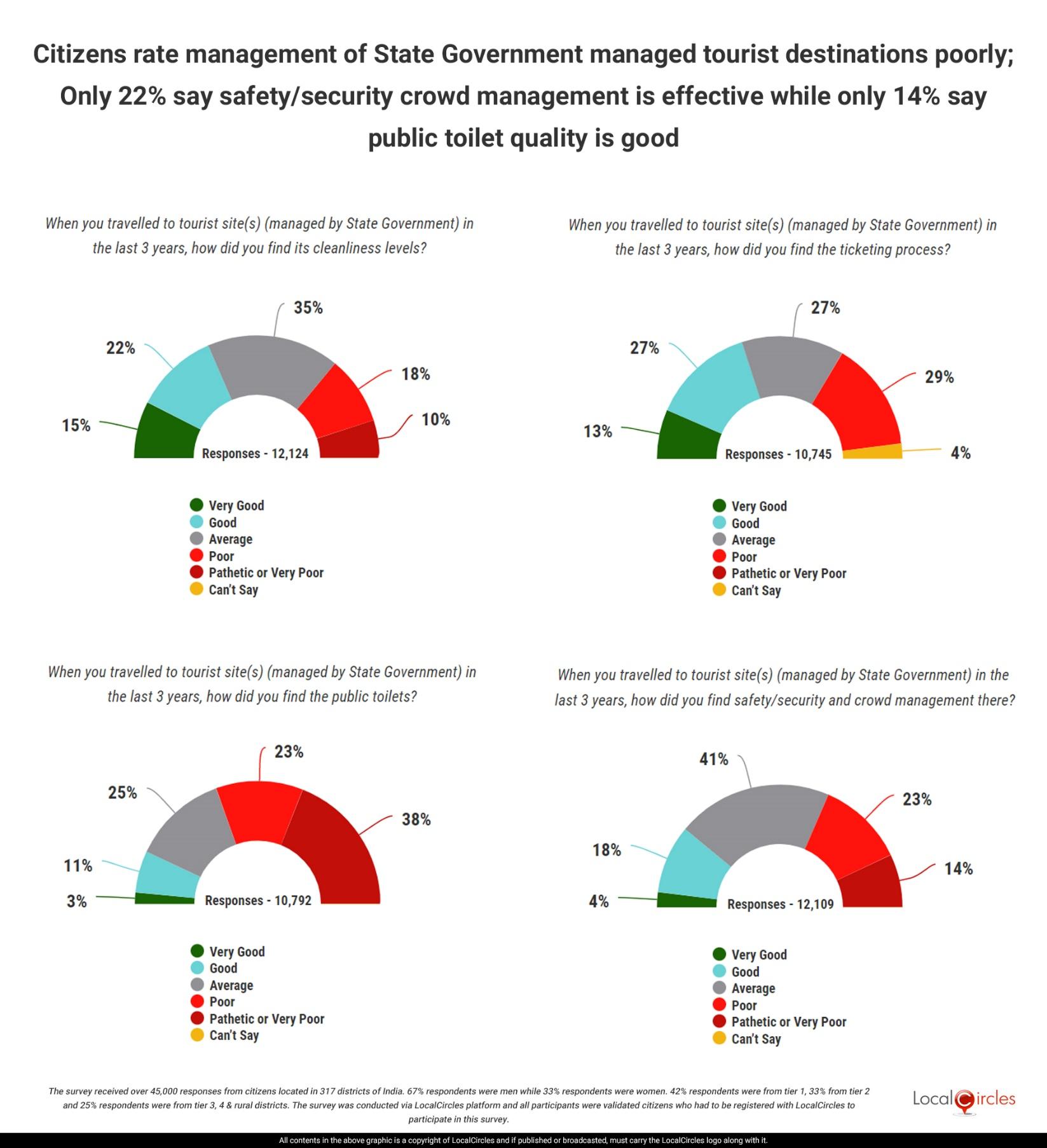
Citizens rate State Government managed destinations poorly; only 22% say safety/ security and crowd management is effective; just 14% find public toilet quality good
- ● Only 37% of respondents indicated that cleanliness in government managed tourist sites was good
- ● Just 40% found the ticketing process at government managed tourist sites to be good
- ● 38% of citizens surveyed found public toilets at tourist sites to “pathetic or very poor”
January 25, 2026, New Delhi: Uttar Pradesh Tourism has launched a creative initiative with a special focus on engaging Gen Z, young creators, poets, writers and art enthusiasts to mark National Tourism Day 2026 on January 25. The initiative aims to raise awareness about the state’s vast tourism potential while encouraging younger generations to take pride in Uttar Pradesh’s growing global recognition.
The state achieved several landmark milestones in 2025. The Mahakumbh 2025 in Prayagraj witnessed the participation of crores of devotees, reinforcing Uttar Pradesh’s prominence in spiritual tourism. Deepotsav 2025 in Ayodhya created history by setting two Guinness World Records, while Lucknow earned international recognition as a UNESCO Creative City of Gastronomy for preserving its rich culinary heritage.
Across India, 2025 saw states intensify efforts to boost tourism through targeted initiatives focusing on infrastructure development, niche tourism segments, major events, and global outreach, in alignment with national tourism goals. Rajasthan, for instance, adopted an ecosystem-based approach by establishing a ₹5,000 crore Tourism Infrastructure and Capacity Building Fund aimed at heritage conservation, improved connectivity, and tech-enabled services. The state also expanded its focus on MICE tourism, film tourism, and cultural festivals to attract both domestic and international travelers.
Gujarat launched the Dharoi Adventure Fest in Mehsana to promote adventure and eco-tourism, combining water sports, aerial activities and cultural engagements, thereby boosting regional economic activity and local employment.
Goa continued diversifying its source markets by expanding international connectivity, including charter services from Russia and Kazakhstan, while implementing a tourism roadmap centred on seven strategic pillars such as eco-tourism, wellness and MICE.
Madhya Pradesh introduced its Tourism Policy 2025 and Film Tourism Policy, offering incentives like capital grants and long-term land leases to attract investments in hospitality and entertainment infrastructure.
These initiatives resulted in increased domestic tourist visits, improved regional connectivity, diversified tourism offerings, and heightened private investment interest. Domestic tourist visits reached approximately 303.6 crore by August 2025, while foreign tourist arrivals stood at about 56 lakh during the same period.
However, challenges persist. Reports of severe air pollution, poor sanitation, tech glitches in bookings, crowd mismanagement, and inadequate facilities at major tourist sites have affected visitor experience. According to Tourism Ministry data, despite a weaker rupee and a global travel boom, foreign tourist inflow declined by 12.3% in the first three quarters of 2025–26.
In December 2024, the Ministry of Tourism released a draft National Tourism Policy aimed at promoting sustainable and responsible tourism, increasing visitor numbers, length of stay, and spending, while creating jobs and entrepreneurial opportunities. Its effective implementation will be crucial in addressing existing gaps and ensuring long-term growth of India’s tourism sector.
Considering that domestic tourists form the bulk of trade in India, LocalCircles has conducted a survey to find out what upsets or pleases domestic travelers, many of whom travel with family, friends or even alone. The survey received over 45,000 responses from citizens located in 317 districts of India. 67% respondents were men while 33% respondents were women. 42% of respondents were from tier 1, 33% from tier 2 and 25% respondents were from tier 3, 4 & rural districts.
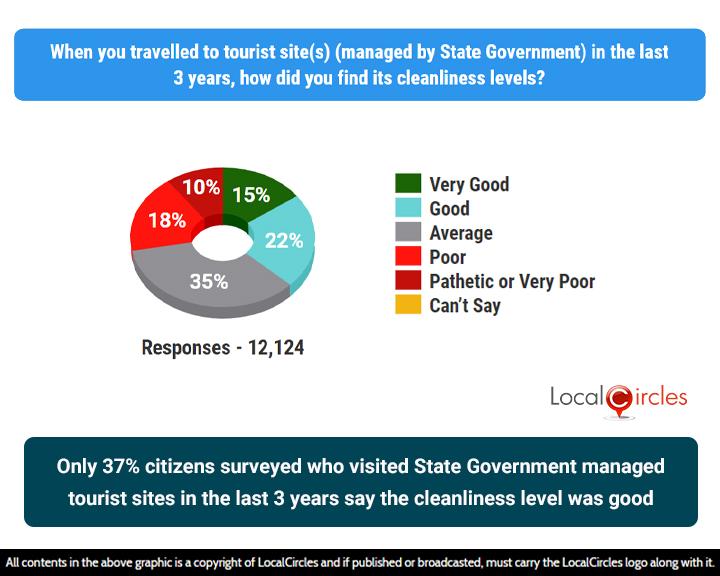
Only 37% indicated that the cleanliness in state government managed tourist sites was good
The survey first asked, “When you travelled to tourist sites managed by the state government in the last 3 years, how did you find its cleanliness levels?” Only 37% out of 12,124 who responded to this query indicated that the cleanliness in state government managed tourist sites was good. The data shows that in the last three years just 15% of citizens who visited these sites found them to be “very good” in terms of cleanliness; 22% found them to be “good” and 35% found the cleanliness “average”. As for the remaining respondents, 18% found these tourists to be “poor” in terms of cleanliness and 10% indicated that they were not clean or “pathetic or very poor” on the yardstick. To sum up, only 37% of those surveyed indicated that the cleanliness in state government managed tourist sites was good.
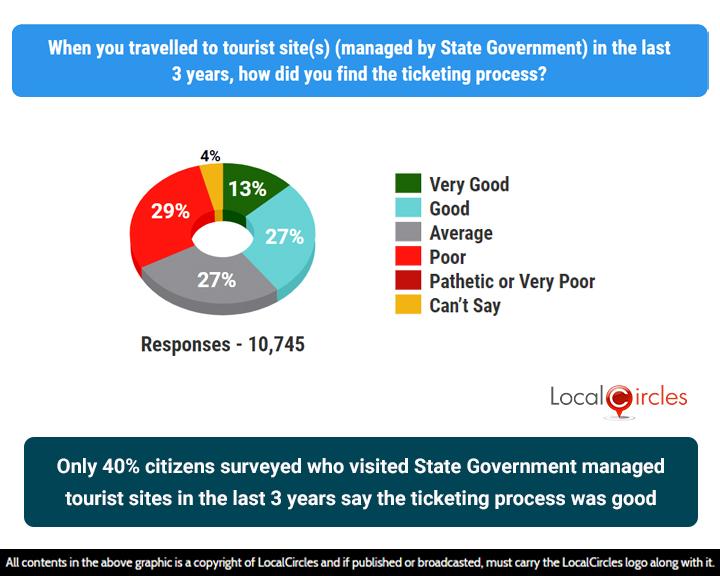
Just 40% of the citizens surveyed found the ticketing process at the tourist sites managed by state governments they visited in the last 3 years was good
The second query sought to know citizens’ experience of “the ticketing process” in state government managed tourist sites over the last 3 years. Again just 40% of the citizens out of 10,745 who responded to the query indicated that the ticketing process at the tourist sites they visited in the last 3 years was good. Data shows that 13% found the ticketing process “very good”; 27% found it “good”; another 27% found it “average” and 29% indicated that it was “poor”. The remaining 4% gave no clear response. A poor ticketing process can well upset the whole experience of visiting a tourist site, something that countries the world takes great pains to address not only to attract more tourists but also for better crowd management. To sum up, just 40% of the citizens surveyed found the ticketing process at the tourist sites managed by state governments they visited in the last 3 years was good.
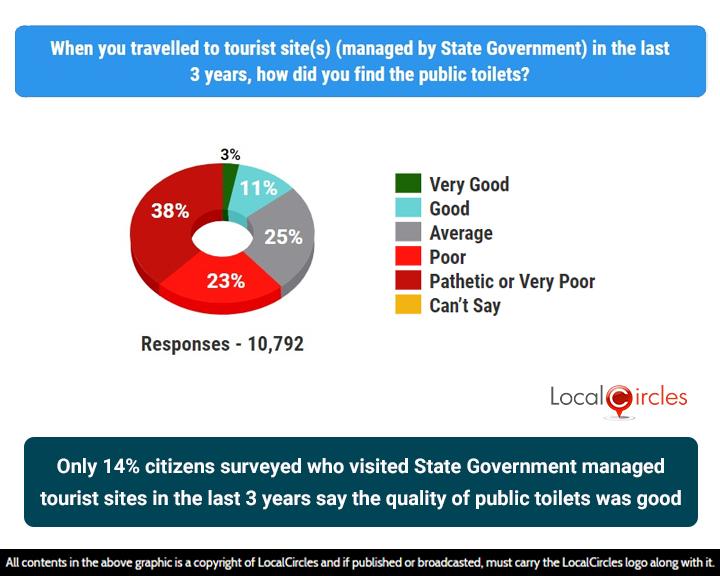
Only 14% of citizens surveyed found public toilets at tourist sites managed by government to be good
Access to clean public convenience or washrooms are another major hassle that most Indian tourist sites lack. At best one can find makeshift facilities, many of which are not clean as they lack water, lighting or even proper doors. The next survey question focused on this vital convenience. “When you travelled to tourist site(s) managed by the state government(s) in the last three years, how did you find the public toilets?” This query received 10,792 responses with only 14% stating that the condition of the public toilets was good. The data shows that just 3% of those surveyed described the quality/ condition of the public toilets at state government managed tourist sites to be “very good” and 11% found them to be “good”. Of the remaining respondents 25% indicated that the facilities were “average”; 23% found them to be “poor” and 38% “pathetic or very poor”. Given that tourists spend a lot of money and time visiting these tourist sites, many off track, this is the basic facility that state governments should provide to attract more tourists and help the local economy. To sum up, only 14% of citizens surveyed found public toilets at tourist sites managed by the government to be good.
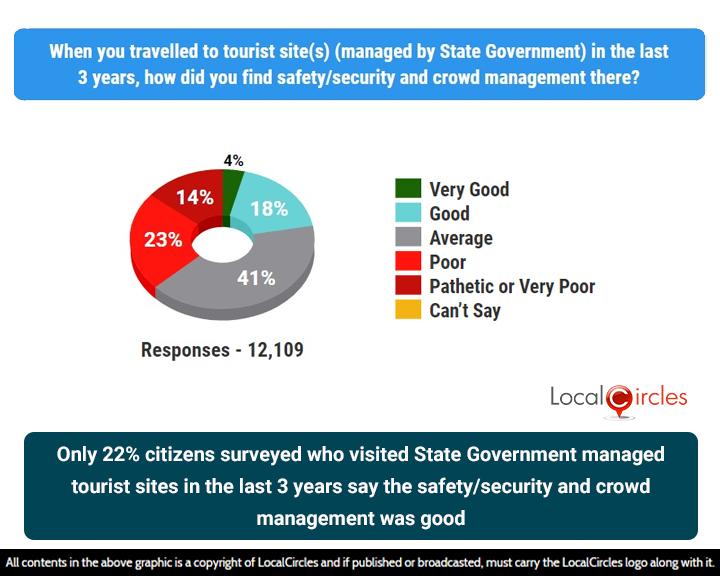
Only 22% of respondents found safety/security and crowd management at government managed tourist sites to be good over the last three years
Every year accidents happen at various temples or pilgrim sites across the country particularly during the festive season or a cultural event associated with them. Yet despite local police security and other arrangements, crowd management remains an issue resulting in injuries and sometimes even death. The survey asked, "When you travelled to tourist site(s) managed by the state government(s) in the last three years, how did you find safety / security and crowd management there?” Out of 12,109 responses received to this query, just 22% found it good. Data shows that while 4% of those surveyed judged it to be “very good” and 18% as “good”, 41% found it “average”; 23% indicated it was “poor” and 14% “pathetic or very poor”. In essence, only 22% of respondents found safety/security and crowd management at government managed tourist sites to be good over the last three years.
In summary, the survey brings to fore the urgency with which state governments need to prioritize facilities and security at tourist sites to ensure not just a visit but also repeat visits by both domestic and foreign tourists and favourable reviews to attract more footfalls. Extra revenue will help the authorities to further improve the facilities. It will help create the desired ambience to promote tourism. Currently, however, the survey reveals that hardly 37% indicated that the cleanliness in state government managed tourist sites was good, 40% found the ticketing process at these tourist sites to be good, only 14% of citizens surveyed found public toilets to be good and what is worse is that only 22% of respondents found safety / security and crowd management at government managed tourist sites to be good over last three years.
It is hoped that the upcoming union budget will continue to boost tourism infrastructure through a comprehensive tourism policy being formulated by the central government in partnership with the state governments and the private sector. Advance bookings, cooperation of local bodies and active participation of tourism promotion boards to the tourist inputs could go a long way in promoting travel -- leisure, cultural, adventure and religious travel -- in the country.
Survey Demographics
The survey received over 45,000 responses from citizens located in 317 districts of India. 67% respondents were men while 33% respondents were women. 42% of respondents were from tier 1, 33% from tier 2 and 25% respondents were from tier 3, 4 & rural districts. The survey was conducted via LocalCircles platform, and all participants were validated citizens who had to be registered with LocalCircles to participate in this survey.
About LocalCircles
LocalCircles, India’s leading Community Social Media platform enables citizens and small businesses to escalate issues for policy and enforcement interventions and enables Government to make policies that are citizen and small business centric. LocalCircles is also India’s # 1 pollster on issues of governance, public and consumer interest. More about LocalCircles can be found on https://www.localcircles.com
For more queries - media@localcircles.com, +91-8585909866
All content in this report is a copyright of LocalCircles. Any reproduction or redistribution of the graphics or the data therein requires the LocalCircles logo to be carried along with it. In case any violation is observed LocalCircles reserves the right to take legal action.
Enter your email & mobile number and we will send you the instructions.
Note - The email can sometime gets delivered to the spam folder, so the instruction will be send to your mobile as well


