Consumers report 6 dark patterns on IRCTC; Forced Action experienced by 7 in 10 users while over 4 in 10 also experienced Nagging, Drip Pricing and Basket Sneaking
- ● Various consumer complaints point to issues where action is forced, charges are hidden or the interface is interfered when they are buying or cancelling tickets
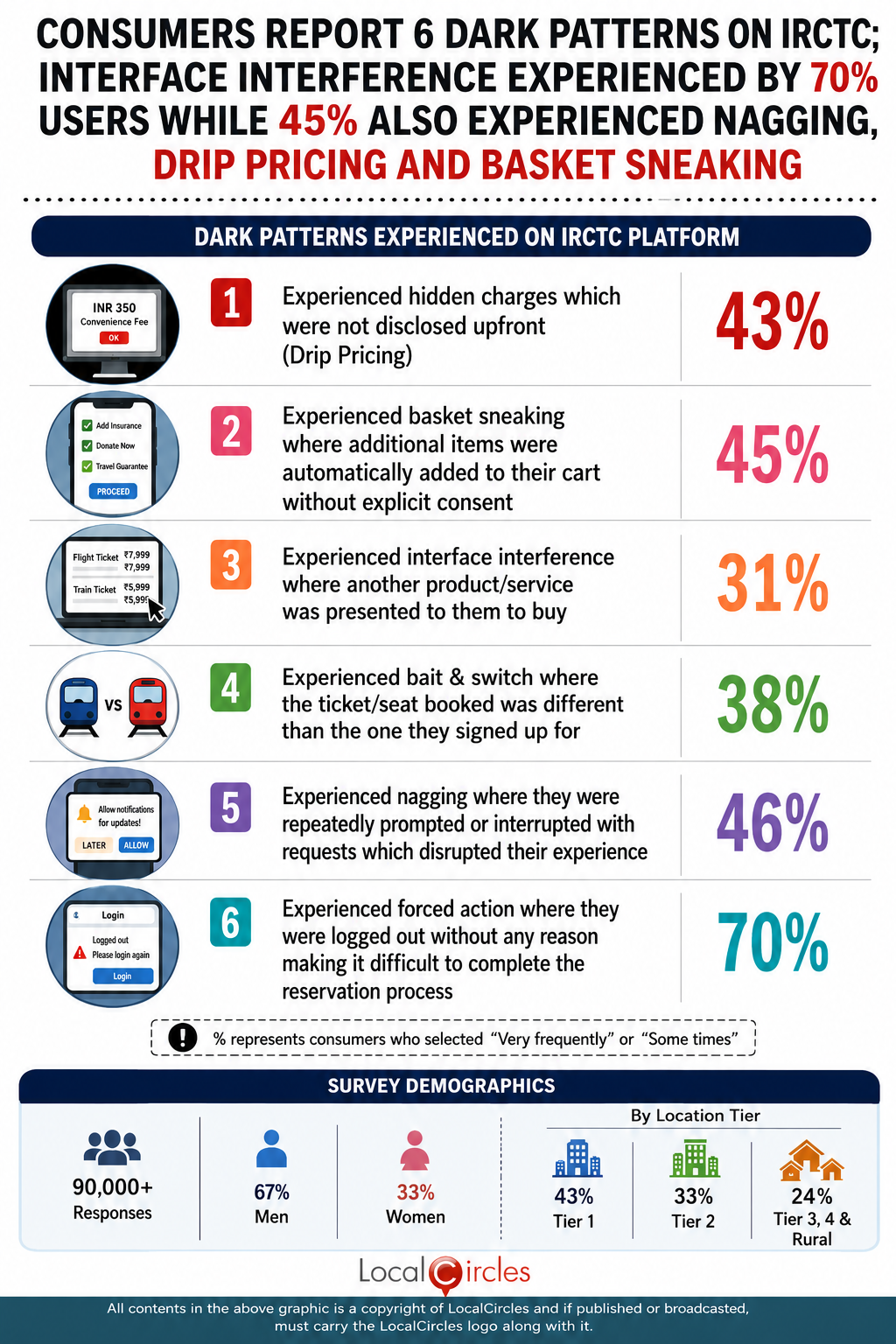
August 26, 2026, New Delhi: The regulatory net around Dark Patterns or digital manipulative designs has tightened sharply over the last year. On August 6, 2026, the Ministry of Consumer Affairs informed the Rajya Sabha that the Central Consumer Protection Authority (CCPA) had penalised nine platforms – among them Zepto, IndiGo, SpiceJet, BookMyShow, FirstCry, PharmaEasy, McAfee and Physics Wallah – a cumulative amount of close to INR 20 lakh for deploying dark patterns such as drip pricing, basket sneaking and confirm shaming.
In June 2026, the Reserve Bank of India barred banks from using 11 specified dark patterns on their apps and websites and ruled that the default consent setting on any add-on product must be ‘No’. In April 2026, the Insurance Regulatory and Development Authority of India (IRDAI), acting on a LocalCircles representation, gave insurers selling through e-platforms 15 days to file a dark pattern self-assessment report. Even as sector regulators move in this manner, what is sadly a well-known fact is that it is not only the private sector but also the public sector entities whether banks or railways, which are impudently using these tools to fleece the consumers.
The website of IRCTC, which is majority (68%) owned by the government, is not without its share of dark patterns including several advertisements that pop up with every search for destinations and trains. Both the website and IRCTC app have been experiencing performance issues, leading to slow response times, frequent crashes, and other usability problems.
Acknowledging long-standing user complaints, IRCTC launched a completely revamped website on July 15, 2026. Railway Minister Ashwini Vaishnaw said the new platform raises booking capacity from 32,000 to 1.5 lakh tickets per minute and enquiry handling from 4 lakh to 40 lakh per minute, and adds a fare calendar, seat preference selection, a single screen showing all classes, Indian language support and a cleaner interface with fewer pop-ups and CAPTCHA interruptions. The findings that follow, however, indicate that the design choices which constitute dark patterns – hidden charges, pre-ticked add-ons, interface interference and repeated prompts – are a separate problem from server capacity and are not resolved by a performance upgrade alone.
The complaints are on the rise on social media. One such complaint states that “it’s impossible to book tatkal ticket through IRCTC android app. Most of the time it’s unable to log in up to 4/5 minutes. And what is the logic of this dynamic charge more than base fare?” Another aggrieved traveler has stated: “A major scam is unfolding with Tatkal booking. If the ticket isn’t confirmed, why is the amount still deducted, and why aren’t passengers receiving a full refund?” Many angry passengers have complained about the IRCTC opening Tatkal bookings late “by then all premium tickets are gone”. Another bone of contention is the automatic travel insurance for passengers though the IRCTC claims there is an option to opt out.
The pressure points have only intensified in the recent past. From July 2025, the Railway Ministry made Aadhaar-based OTP authentication mandatory for online Tatkal booking through the IRCTC website and app, adding a further verification step to an already time-critical process. In April 2026, a Tatkal booking window saw widespread app crashes, loading delays and payment failures, with users reporting that money was debited without a ticket being issued and that seats moved to ‘REGRET’ status within minutes of the window opening. IRCTC attributed the problems to temporary connectivity issues, advised users to force close and restart the app, and pointed them to a newly introduced ‘Resume/Retry Booking’ facility.
One passenger has in fact alleged that “1) IRCTC site is rampant with ‘dark pattern’ design which deceives users into clicking advertisements; 2) payment is processed even when opting out while booking tickets due to unavailability of preferred berths, and the amount is refunded only after 4-5 days”. In fact, due to the interface of IRCTC app and website not being user-friendly, it is reported to be witnessing reduced usage as customers turn to other alternative platforms for bookings and other services.
With the CCPA’s Guidelines for Prevention and Regulation of Dark Patterns, 2023, in force, and its advisory of June 5, 2025, requiring platforms to self-audit and eliminate dark patterns within three months, LocalCircles has conducted a survey to find out consumers experience on IRCTC websites and apps. The survey received over 90,000 responses from users of IRCTC located in 324 districts of India. 67% respondents were men while 33% respondents were women. 43% respondents were from tier 1, 33% from tier 2 and 24% respondents were from tier 3, 4 and rural districts. The findings of the survey, mapped pattern by pattern against the 13 dark patterns notified by the CCPA, are also presented as a consolidated chart in the section titled ‘IRCTC found deploying 6 of the 13 dark patterns notified under the CCPA’s 2023 Guidelines’ later in this release.
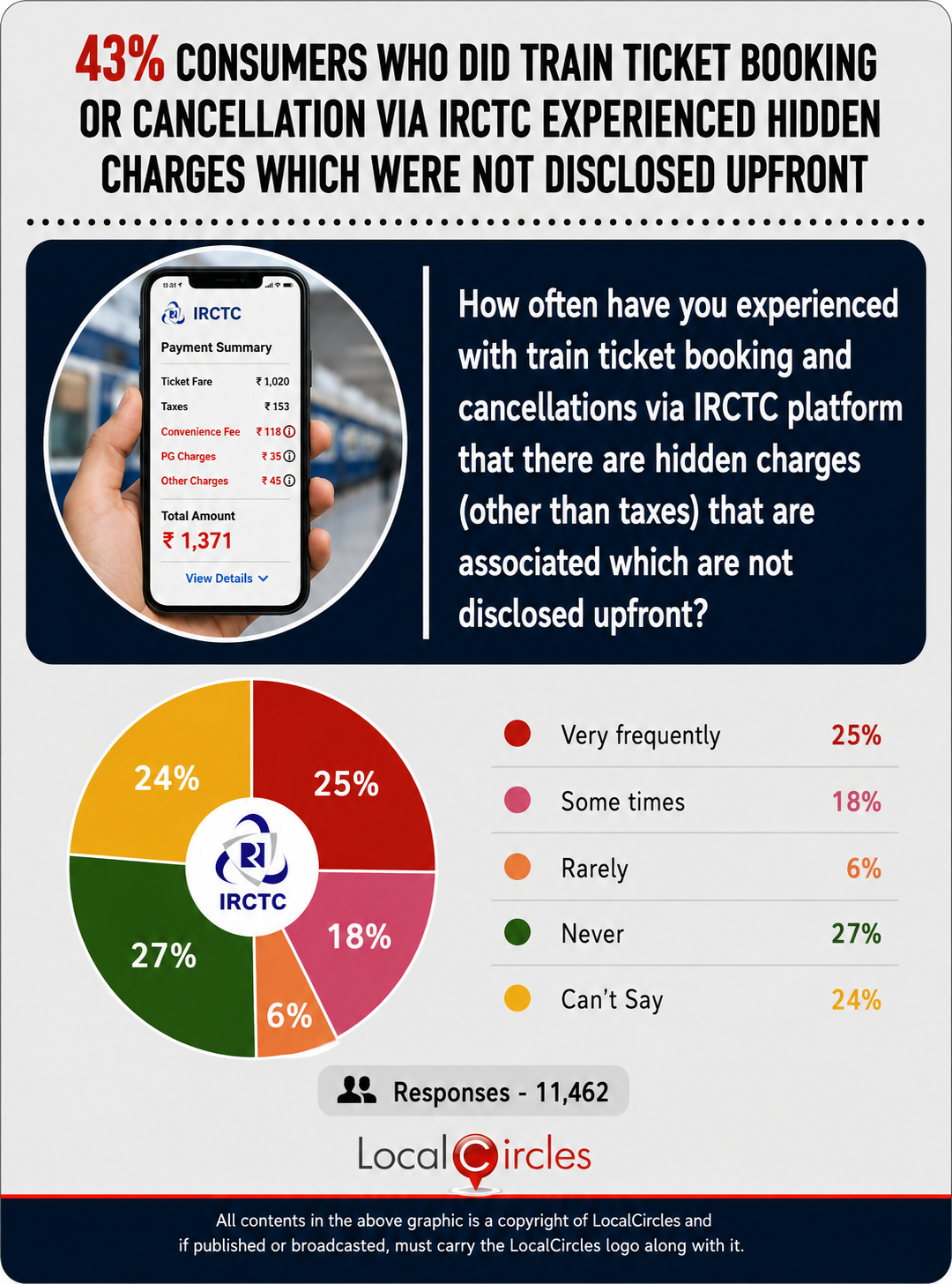
43% of consumers who did train ticket booking or cancellation via IRCTC experienced hidden charges which were not disclosed upfront
Besides the efforts involved in the booking of tickets and sometimes cancellation, the survey asked railway travelers, “How often have you experienced with train ticket booking and cancellations via IRCTC that there are hidden charges (other than taxes) that are associated which are not disclosed upfront?” The query received 11,462 responses with 25% indicating “very frequently”; 18% indicating “sometimes” and 6% stating “rarely”. In addition, 27% of respondents stated “never” and 24% gave no clear response. To sum up, 43% of consumers who did train ticket booking or cancellation via IRCTC experienced hidden charges which were not disclosed upfront.
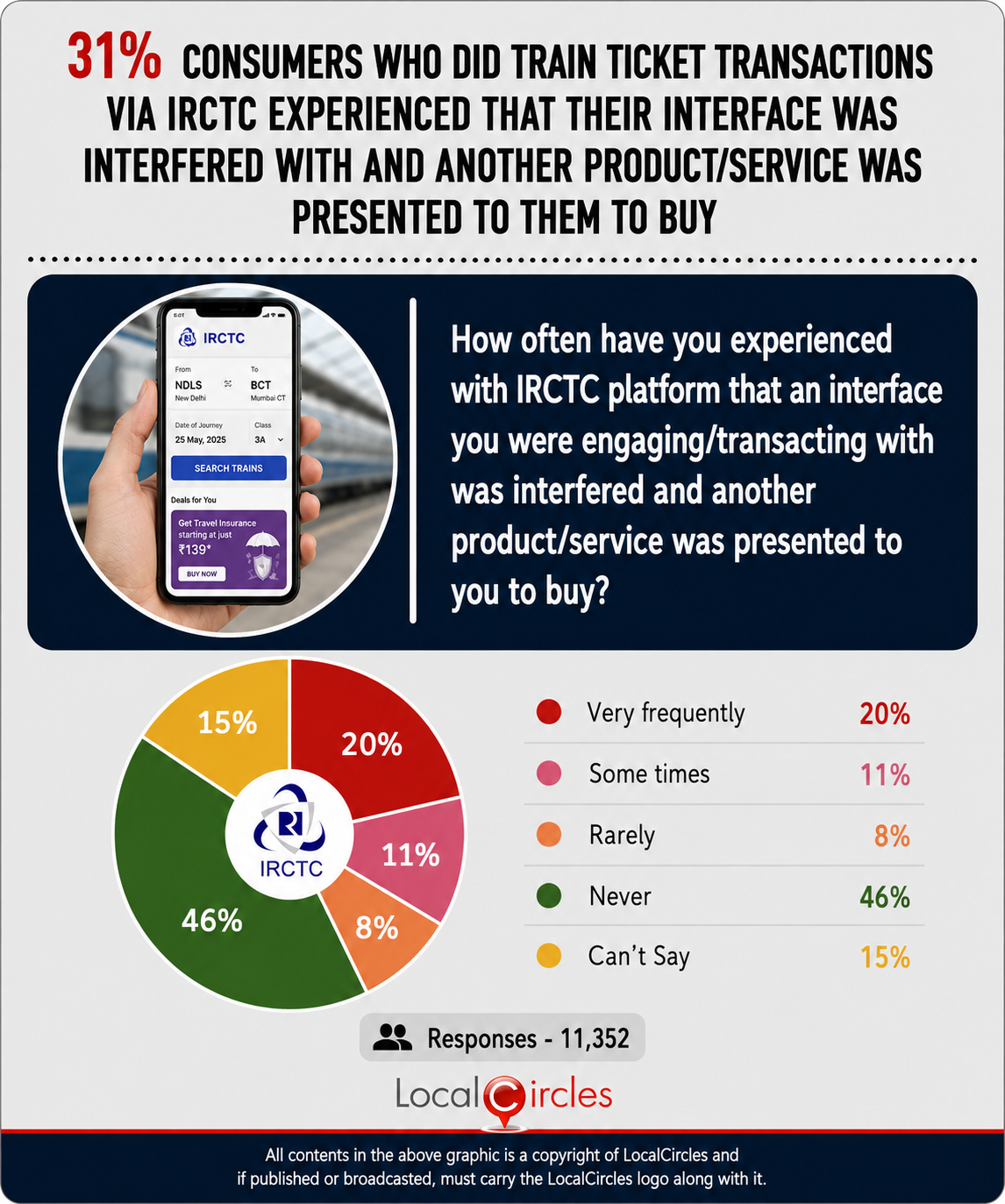
31% of consumers who did train ticket transactions via IRCTC experienced that their interface was interfered with, and another product/ service was presented to them to buy
As has been experienced on many e-platforms, consumers are hijacked into buying a different product/ service from what they had originally intended. The survey asked, “How often have you experienced with IRCTC that an interface you were engaging/transacting with was interfered and another product/ service was presented to you to buy?” The query received 11,352 responses with 20% indicating that they have experienced such a pattern “very frequently”; 11% indicated “sometimes” and 8% of respondents indicated “rarely”. Of the remaining respondents 46% stated that they have “never” had such an experience and 15% of the respondents did not give a clear response. To sum up, 31% of consumers who did train ticket transactions via IRCTC experienced that their interface was interfered with and another product/ service was presented to them to buy.
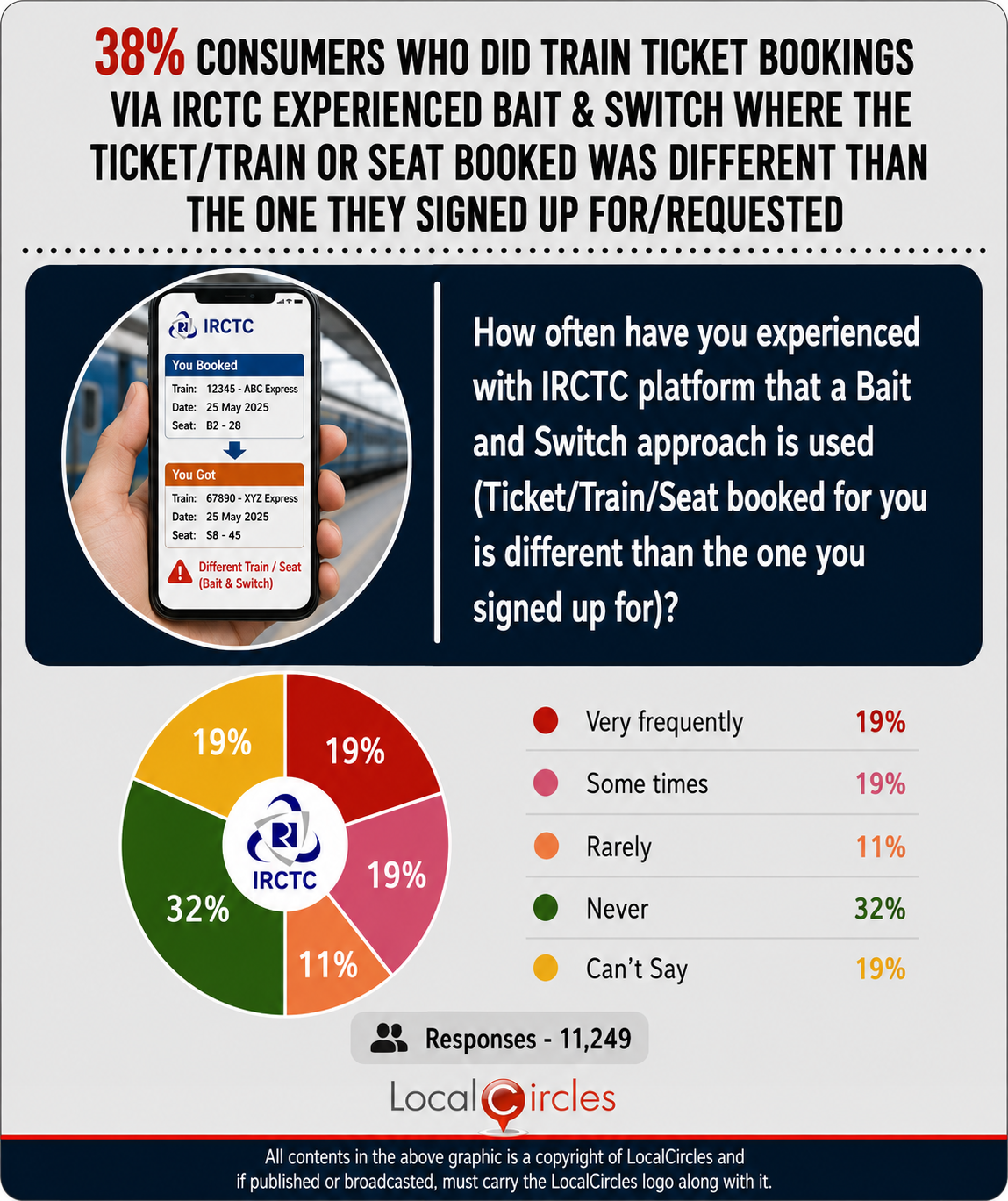
38% of consumers surveyed experienced Bait & Switch where the ticket/ train or seat booked was different than the one they signed up for/ requested
The survey next asked, “How often have you experienced with IRCTC platform that a Bait & Switch approach is used (ticket/ train/ seat booked for you is different than the one you signed up for)?” Out of 11,249 who responded to this query 19% indicated “very frequently”; 19% indicated “sometimes” and 11% indicated “rarely”. However, 32% of respondents indicated that such an incident has “never” happened with them and 19% of respondents failed to give a clear reply. To sum up, 38% of consumers surveyed who did train ticket booking via IRCTC experienced Bait & Switch where the ticket/ train or seat booked was different than the one they signed up for/ requested.
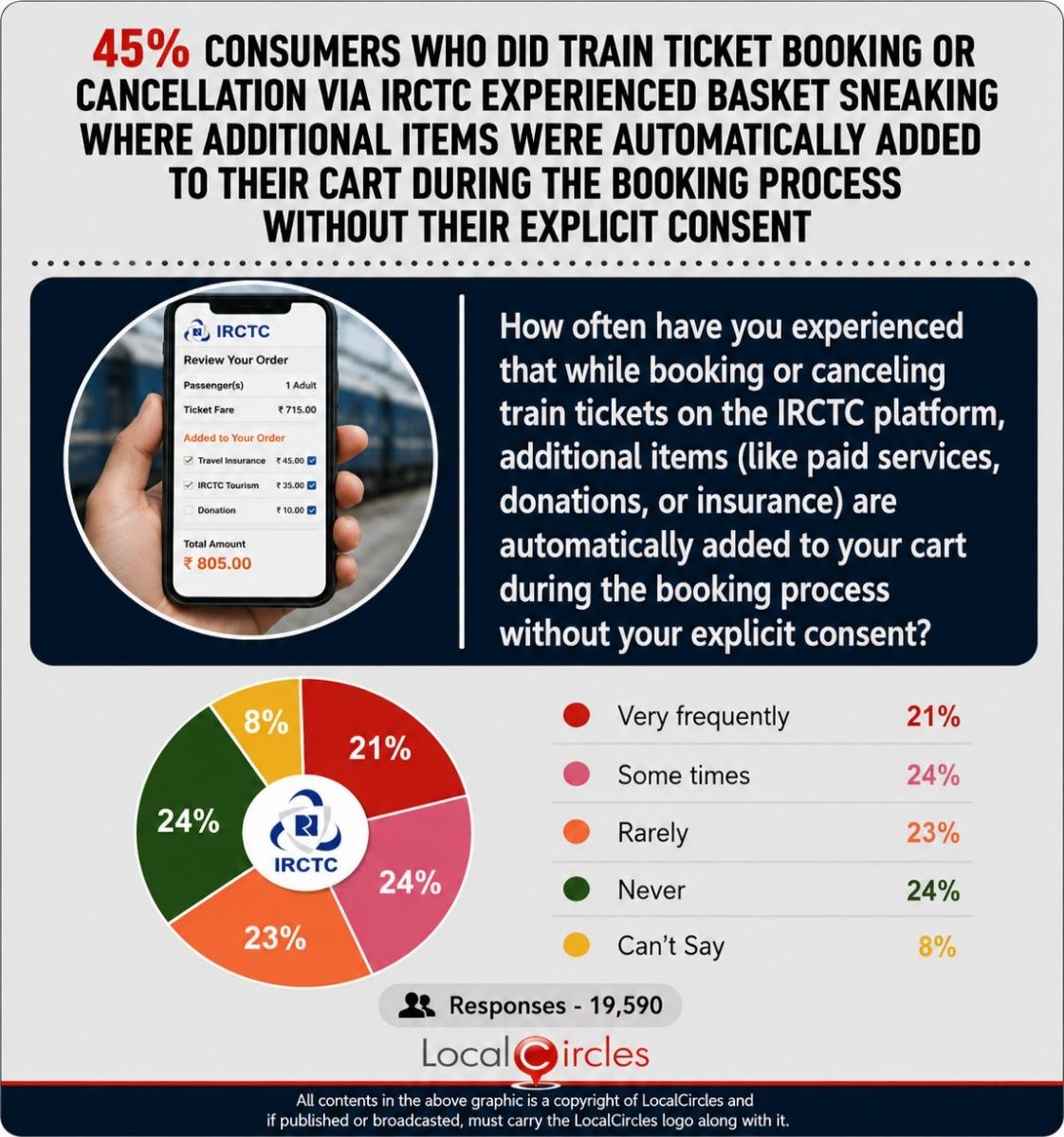
45% of consumers who did train ticket booking or cancellation via IRCTC experienced basket sneaking where additional items were automatically added to their cart during the booking process without their explicit consent
Travel insurance, meals, and an agreement to upgrade to an upper class are some of the facilities that are often sneaked into the total fare by IRCTC. The survey asked consumers, “How often have you experienced that while booking or canceling train tickets on the IRCTC platform, additional items (like paid services, donations or insurance) are automatically added to your cart during the booking process without your explicit consent?” Out of 19,590 who responded to the question 21% indicated they have experienced it “very frequently”; 24% of respondents indicated they have “sometimes” experienced it; 23% of respondents stated they have “rarely” experienced it; 24% of respondents stated they have “never” experienced it; and 8% of respondents did not give a clear answer. To sum up, 45% of consumers who did train ticket booking or cancellation via IRCTC experienced basket sneaking where additional items were automatically added to their cart during the booking process without their explicit consent. This finding is directly relevant to the RBI’s June 2026 direction to banks that the default consent setting on any add-on must be ‘No’; the same principle, applied to IRCTC, would mean travel insurance and every other paid add-on stays unticked until the passenger actively chooses it.
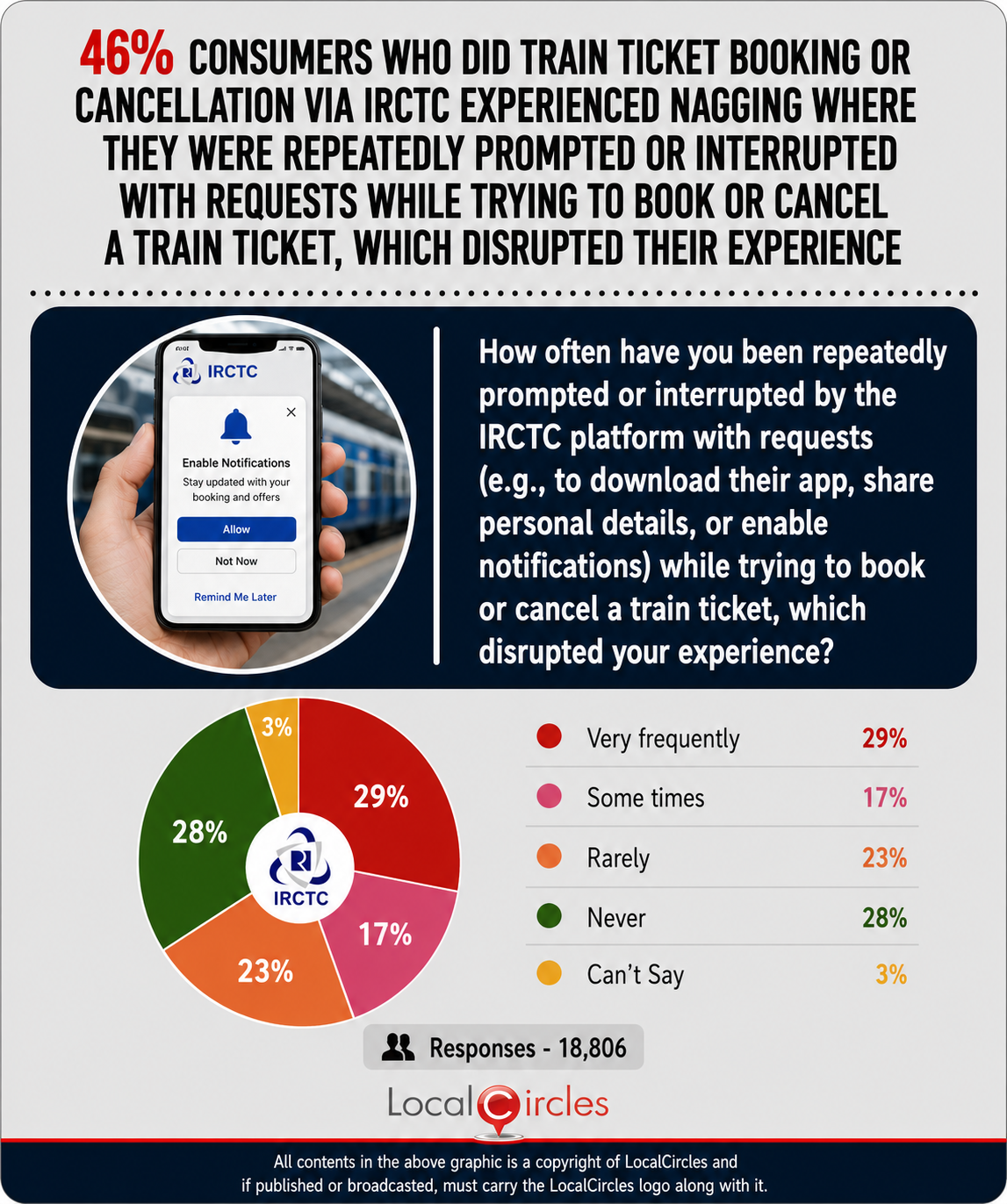
46% of consumers who did train ticket booking or cancellation via IRCTC experienced nagging where they were repeatedly prompted or interrupted with requests while trying to book or cancel a train ticket, which disrupted their experience
If you are new to the IRCTC system or have used their platform, it is very likely that you will be bombarded with messages via email or WhatsApp with repeat requests to download their app, take their bank-linked credit / debit card, promotional offers, etc. The survey asked consumers, “How often have you been repeatedly prompted or interrupted by the IRCTC platform with requests (e.g., to download their app, share personal details, or enable notifications) while trying to book or cancel a train ticket, which disrupted your experience?” Out of 18,806 who responded to the question 29% stated they have “very frequently” experienced the nagging dark pattern; 17% stated they have “sometimes” experienced it; 23% of respondents stated they have “rarely” experienced nagging; 28% of respondents stated they have “never” experienced nagging dark pattern; and 3% of respondents did not give a clear answer. In essence, 46% of consumers who did train ticket booking or cancellation via IRCTC experienced nagging where they were repeatedly prompted or interrupted with requests while trying to book or cancel a train ticket, which disrupted their experience.
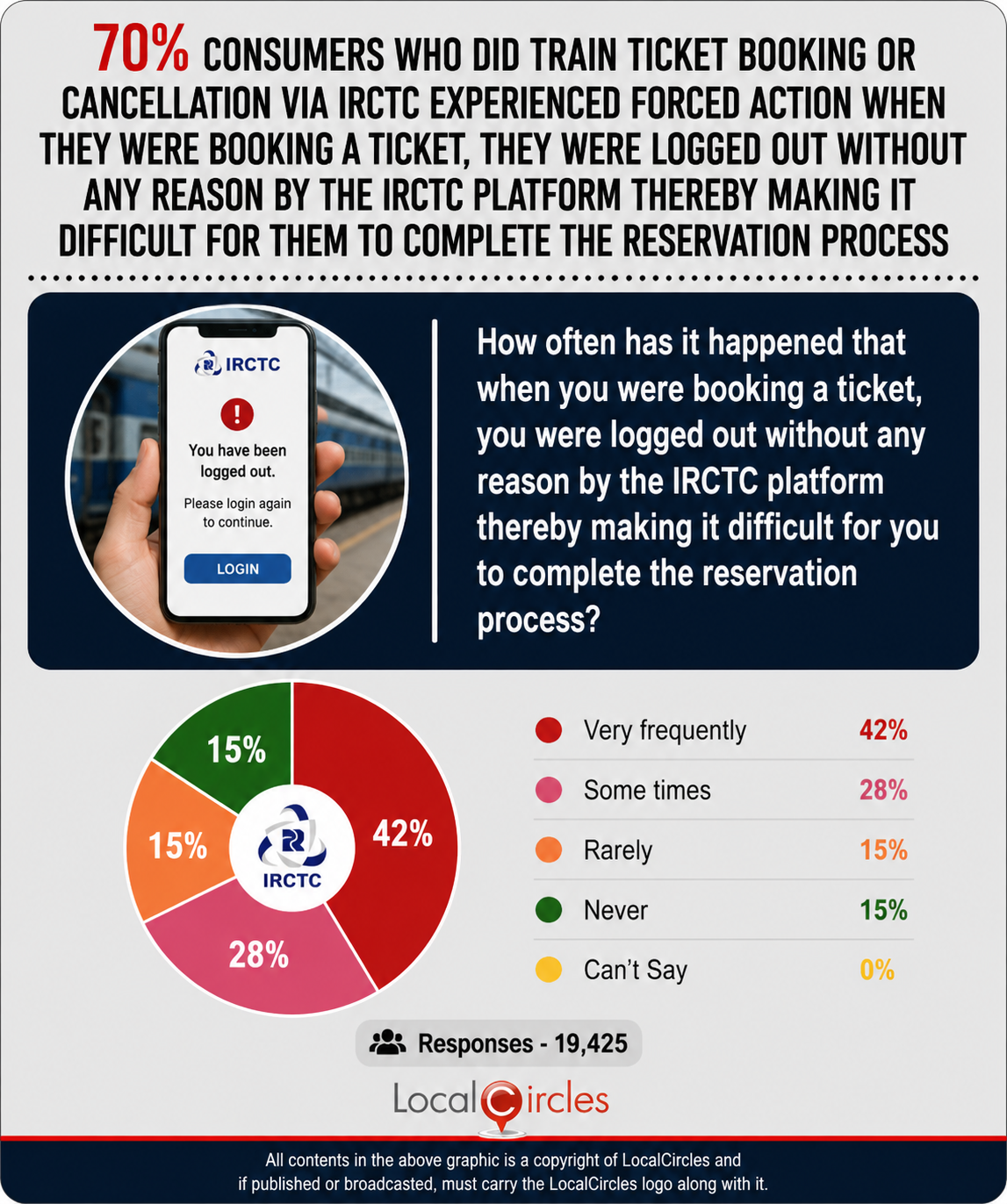
70% of consumers who did train ticket booking or cancellation via IRCTC experienced forced action when they were booking a ticket, they were logged out without any reason by the IRCTC platform thereby making it difficult for them to complete the reservation process
When booking or cancelling a ticket on IRCTC, some consumers have shared on social media about facing various hurdles while trying to complete the process, which can necessitate repeat attempts to do so. The survey asked consumers, “How often has it happened that when you were booking a ticket, you were logged out without any reason by the IRCTC platform thereby making it difficult for you to complete the reservation process?” Out of 19,425 who responded to the question 42% stated they have faced Forced Action dark pattern “very frequently”; 28% of respondents stated they have “sometimes” faced this dark pattern; 15% of respondents stated they have “rarely” experienced it and 15% of respondents stated they have “never” encountered it. To sum up, 70% of consumers who did train ticket booking or cancellation via IRCTC experienced forced action when they were booking a ticket, they were logged out without any reason by the IRCTC platform thereby making it difficult for them to complete the reservation process.
Consumer report six dark patterns on IRCTC (validated by LocalCircles)
The chart that follows consolidates the entire survey into a single view. The Central Consumer Protection Authority’s Guidelines for Prevention and Regulation of Dark Patterns, 2023, notify 13 specified dark patterns – false urgency, basket sneaking, confirm shaming, forced action, nagging, interface interference, bait & switch, drip pricing, subscription trap, disguised advertisement, trick question, SaaS billing and rogue malware. LocalCircles via its proprietary dark pattern detection engine validated the dark patterns reported by consumers and ones that were identified in the survey. Six of the 13 dark patterns are found on IRCTC.
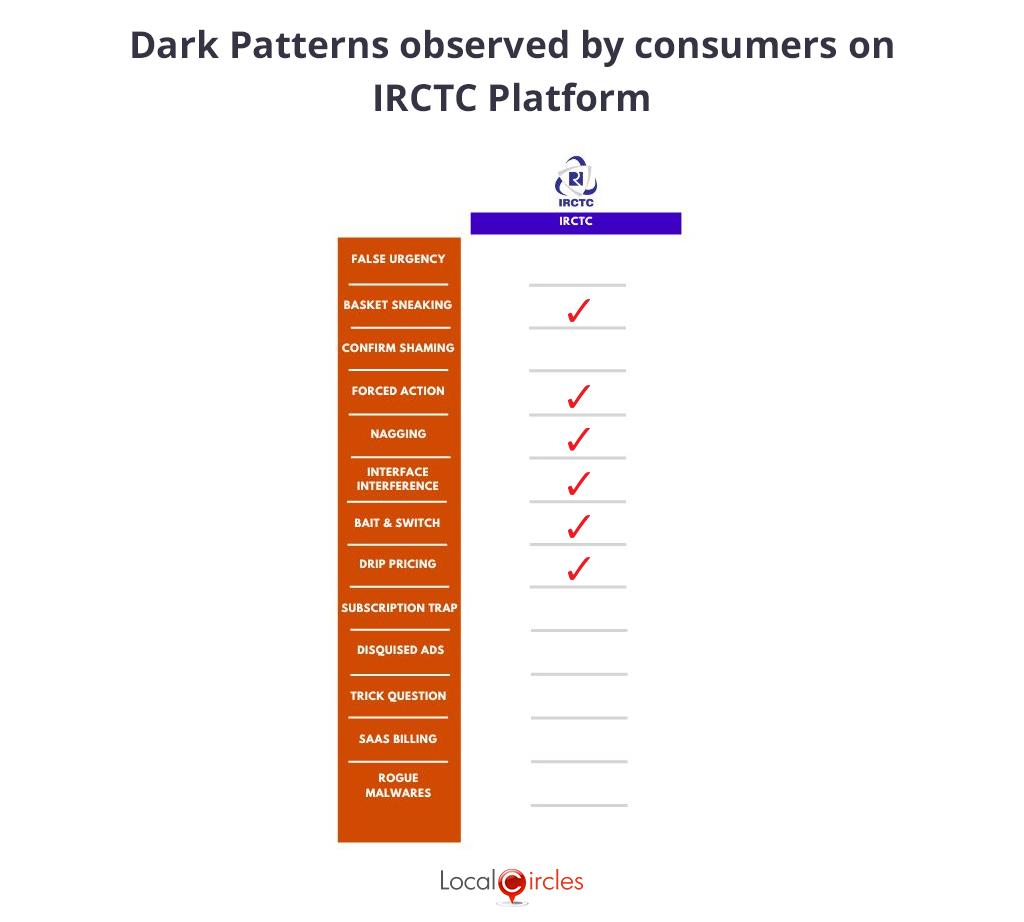
The six dark patterns ticked against IRCTC are drip pricing, reported by the 43% of consumers who encountered hidden charges that were not disclosed upfront; interface interference, reported by 31% who found the screen they were transacting on interfered with and another product or service presented to them to buy; bait & switch, reported by 38% who were given a ticket, train or seat different from the one they had signed up for; basket sneaking, reported by 45% whose carts had insurance, donations or other paid services added without their explicit consent; nagging, reported by 46% who were repeatedly prompted or interrupted while trying to book or cancel a ticket; and forced action, reported by 70% who were logged out mid-booking without any reason and had to begin the reservation process again. Read down the ticked column, forced action at 70% is the most widely experienced of the six, followed by nagging at 46% and basket sneaking at 45%, while the three remaining ticks sit in a band of 31% to 43%. Not one of the six is a marginal finding.
The seven rows that remain unticked – false urgency, confirm shaming, subscription trap, disguised advertisement, trick question, SaaS billing and rogue malware – are those this survey did not establish on the platform, either because they fell outside the scope of the questions asked or because consumers did not report them in numbers that would warrant a mark. The chart makes no claim on those categories either way. What it does establish is a specific and measurable compliance gap is that ( on a platform that is 68% government owned and that runs what is, for crores of Indians, an essential public service rather than a discretionary marketplace) 6 of the 13 dark patterns the CCPA has expressly notified are in active use. Every ticked row is a category for which the 2023 Guidelines already prescribe a remedy – what is absent is enforcement, and the fact that the entity in question sits in the public sector should make that easier rather than harder.
In summary, the survey reveals that railway travelers are often a victim of dark patterns like Forced Action, Nagging and Basket Sneaking when they book tickets on IRCTC platform. It highlights that all is not well with the functioning of IRCTC website or app as 43% of consumers who did train ticket booking or cancellation through the platform experienced hidden charges; 31% of consumers indicated that their interface was interfered with and another product/ service was presented to them to buy; and 38% of consumers surveyed experienced Bait & Switch dark pattern as the ticket/ train or seat booked by them was different than the one they signed up for/ requested. During train ticket booking via IRCTC, 45% of consumers experienced basket sneaking where additional items were automatically added to their cart during the process without their explicit consent. The survey also revealed that 46% of consumers experienced nagging where they were repeatedly prompted or interrupted with requests while trying to book or cancel a train ticket via IRCTC, which disrupted their experience. In addition, 70% of consumers experienced forced action when they were booking a ticket as they were logged out without any reason by the IRCTC platform thereby making it difficult for them to complete the reservation process.
This is a stark reminder of dark patterns on a platform closely linked with the Indian Railways and Government of India and indicates that consumer centric design is an afterthought in India. Even though the intentions here may not be wrong, it is just how the platform has evolved over the years, no one has paid attention to protecting consumer interest. The evidence is available on social media platforms where every month lakhs of consumers complain about various issues related to booking, refund, forced charges, etc.
LocalCircles will be submitting the findings of this survey to the Ministry of Railways, IRCTC and the CCPA, with the recommendation that – on the lines of the RBI’s June 2026 directions for banks and IRDAI’s April 2026 directive for insurers – the Ministry of Railways should direct IRCTC to carry out an independent third-party dark pattern audit of its website and app within a defined timeline and publish the findings. It should ensure that travel insurance and every other add-on carries a default consent setting of ‘No’ instead of requiring the consumer to opt out. It should disclose the full payable amount, including convenience fee and any dynamic or flexi-fare component, on the first fare screen itself; and end the advertising interstitials that interrupt a booking journey on what is an essential public service rather than a discretionary marketplace. The consumer journey should be such that they do not feel being forced to taken action or levied with a hidden charge.
LocalCircles has separately requested the CCPA to notify ‘privacy zuckering’ – interface design that manipulates a consumer into parting with more personal, health or financial data than they intend – as an additional dark pattern, since the 13 categories notified in the 2023 Guidelines do not presently cover it. This dark pattern is also evident on the IRCTC platform.
Survey Demographics
The survey received over 90,000 responses from users of IRCTC located in 324 districts of India. 67% respondents were men while 33% respondents were women. 43% respondents were from tier 1, 33% from tier 2 and 24% respondents were from tier 3, 4 and rural districts. The survey was conducted via LocalCircles platform, and all participants were validated citizens who had to be registered with LocalCircles to participate in this survey.
About LocalCircles
LocalCircles, India’s leading Community Social Media platform enables citizens and small businesses to escalate issues for policy and enforcement interventions and enables Government to make policies that are citizen and small business centric. LocalCircles is also India’s # 1 pollster on issues of governance, public and consumer interest. More about LocalCircles can be found on https://www.localcircles.com
For more queries - media@localcircles.com, +91-8585909866
All content in this report is a copyright of LocalCircles. Any reproduction or redistribution of the graphics or the data therein requires the LocalCircles logo to be carried along with it. In case any violation is observed LocalCircles reserves the right to take legal action.
Enter your email & mobile number and we will send you the instructions.
Note - The email can sometime gets delivered to the spam folder, so the instruction will be send to your mobile as well


