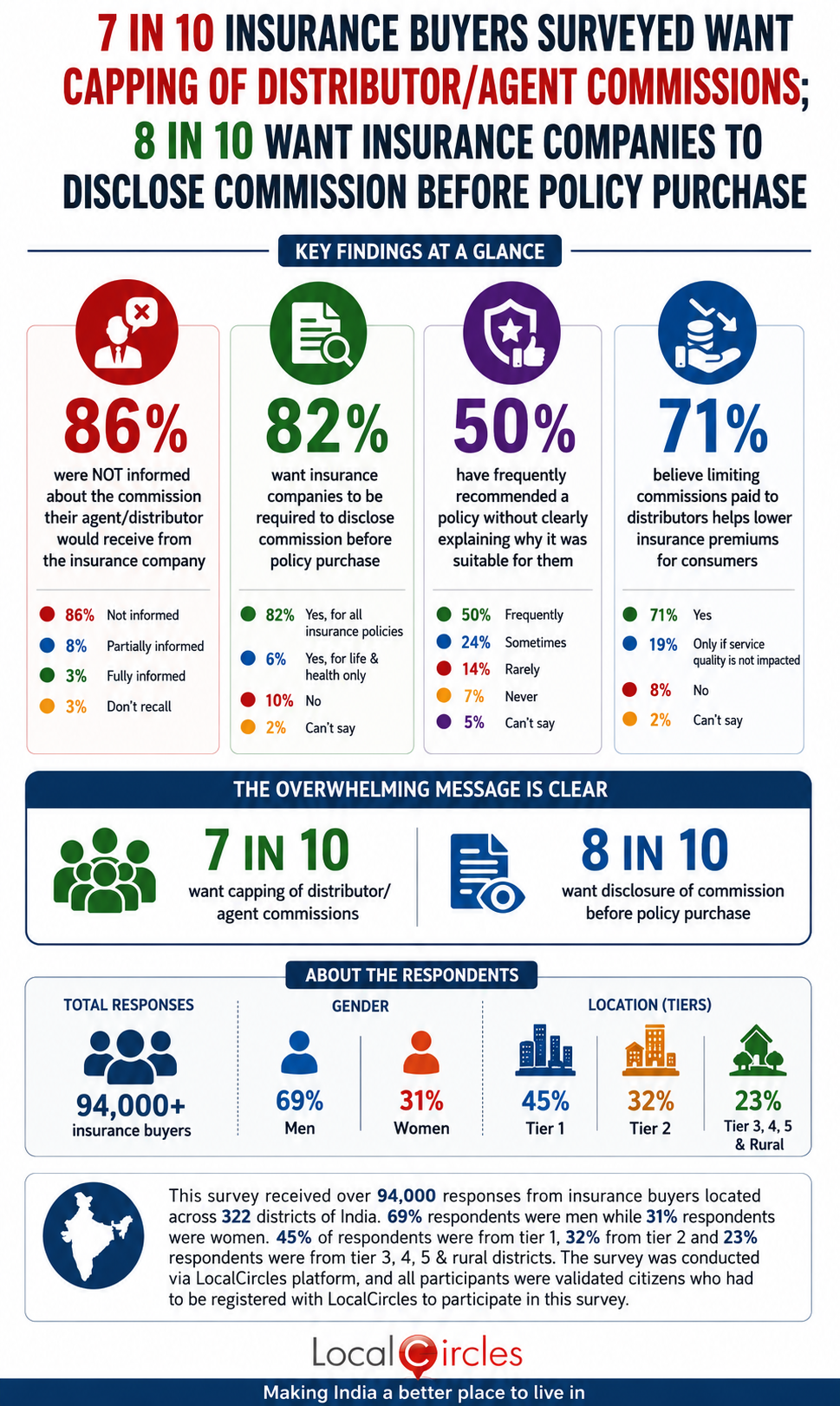
As IRDAI proposes commission caps and seeks public inputs, 7 in 10 insurance buyers surveyed back capping of distributor/agent commissions; 8 in 10 want the commission on their policy disclosed before purchase
- ● 86% of insurance buyers surveyed say they were not informed about the commission their agent/distributor would receive from the insurance company; 50% say agents/distributors have frequently recommended a policy without clearly explaining why it was suitable for them
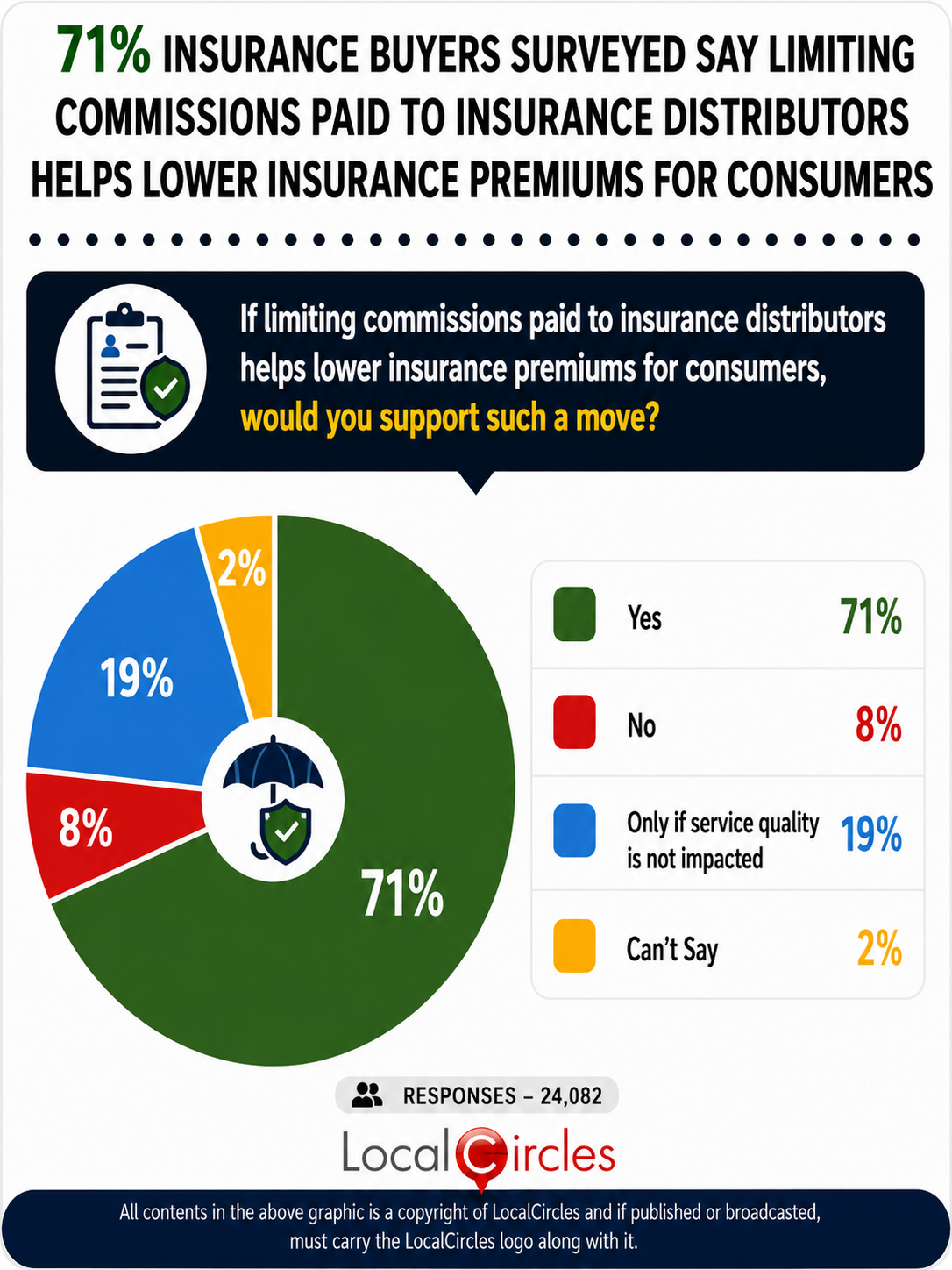
- ● 82% of insurance buyers surveyed want insurance companies to disclose, before policy purchase, the commission being paid to the agent/distributor; 71% say limiting distributor commissions helps lower insurance premiums for consumers
September 25, 2026, New Delhi: The Insurance Regulatory and Development Authority of India (IRDAI) on September 23, 2026, released its consultation paper on distribution reforms, proposing caps on commissions paid to agents and intermediaries, a phased reduction in insurers’ Expenses of Management (EoM) limits and a series of measures to curb mis-selling.
The regulator has invited comments from stakeholders and the public by October 25, 2026. As the consultation opens, a LocalCircles survey of insurance buyers, which received over 94,000 responses, finds that 7 in 10 support capping distributor commissions and 8 in 10 want insurance companies to disclose the commission being paid on a policy before it is purchased.
What IRDAI has proposed
Under the proposed framework, commission limits would be set based on the segment, line of business, distribution channel, product complexity and the effort involved in selling and servicing a product. For individual linked and non-linked life products, commissions are proposed at 5-20% for intermediaries and 6.25-25% for agents, depending on the premium payment term.
For individual pure-term policies, first-year commission is proposed at 25% for intermediaries and 30% for agents, with renewal commissions of 7.5% and 10% respectively, while single-premium savings products would carry around 1-2%. In individual health insurance, first-year commissions are proposed at around 15% for distribution entities and 20% for agents, with renewal commissions of 5% and 10% respectively.
In motor insurance, the paper proposes zero commission for distributors on third-party cover and 2.5% for agents and associates. Products sold in underserved areas may qualify for rewards over and above these limits.
The paper also proposes that life insurers bring company-level EoM down to 15% of gross direct premium income within two years and 12.5% within five years, with 10% described as the long-term goal for the sector, while general insurers would see their EoM limit reduced from 30% to 20% over five years. According to IRDAI, the reduction is aimed at lowering the overall cost of insurance and enhancing returns to policyholders in life savings products.
On transparency and mis-selling, the paper proposes that insurers and large distributors disclose their commission policies and structures in simple language. Other proposals include prohibiting compulsory bundling of insurance with loans; barring volume-linked or reward-linked incentives for bank and NBFC staff selling insurance; linking the identity of the individual seller to each policy sold; placing information on mis-selling incidents in the public domain; clawback of commissions in cases of mis-selling; and mandatory cost audits of insurer expenses, including intermediary payouts and non-monetary incentives, as well as of distribution entities with insurance-related revenue above ₹100 crore. The paper further proposes Market Infrastructure Institutions such as Bima Sugam as digital, pull-based alternatives for insurance distribution.
Based on the proposals reported so far, the disclosure requirement covers commission policies and structures. It is, however, not yet clear whether the commission payable on a specific policy would have to be disclosed to the buyer before purchase – the form of transparency that 8 in 10 insurance buyers surveyed by LocalCircles are seeking.
The proposals mark a significant shift from IRDAI’s 2023 approach. In 2023, IRDAI removed most product-level commission caps, allowing insurers greater flexibility in determining intermediary remuneration, subject to overall Expenses of Management (EOM) limits. While the move was intended to provide insurers greater flexibility and encourage innovation, commission payouts have subsequently risen significantly. In FY2025, life insurers reportedly paid a record ₹60,800 crore in commissions, an 18% increase over the previous year, even as total premium grew by under 7% over the same period. The non-life insurance industry paid around ₹47,266 crore in commissions during the year, and IRDAI reportedly pulled up 23 insurers for exceeding permissible expense limits. Commission expenses were around 6.9% of premiums, adding to concerns over acquisition costs and the potential impact on policy pricing.
The reforms have gained additional significance following the enactment of the Sabka Bima, Sabki Raksha (Amendment of Insurance Laws) Act, 2025, which strengthens IRDAI’s authority to cap commissions, mandate commission disclosure and manage conflicts of interest in distribution. The regulator has already begun acting on these powers. In June 2026, IRDAI floated the draft IRDAI (Insurance Intermediaries) (Amendment) Regulations, 2026—the first time it has sought detailed public disclosures from intermediaries—under which corporate agents, brokers, insurance marketing firms and web aggregators crossing a ₹10 crore commission threshold would have to disclose their commission income, related-party transactions, profits and dividends annually and publish these on their websites.
At its 28th board meeting in July 2026, IRDAI further approved changes requiring the name of the authorised salesperson to appear on all insurance documents, including proposals, policies and certificates, to improve traceability and accountability at the point of sale. The push is being reinforced by parallel action from other regulators: in June 2026, the Reserve Bank of India barred the bundling of insurance with loans and mandated explicit, separate consent for each product, with the framework taking effect from January 1, 2027, while Finance Minister Nirmala Sitharaman and the RBI Governor have publicly flagged the mis-selling of insurance through banks. The consultation paper’s proposed prohibition on compulsory bundling of insurance with loans would align IRDAI’s approach with the RBI framework.
However, insurers have warned that a uniform or sharply lower commission structure could have unintended consequences. Group insurance and credit-life products, distributed through banks, NBFCs and microfinance institutions, often involve relatively small premiums but require substantial distribution and servicing effort. If commissions fall below commercially viable levels, distributors could withdraw from these segments, potentially reducing insurance coverage among low-income borrowers. The consultation paper partly recognises this concern by proposing that products sold in underserved areas may qualify for rewards over and above the normal commission limits.
The central policy challenge is therefore to balance consumer protection with insurance accessibility. Excessive commissions can encourage mis-selling and inflate costs, but excessively low commissions could weaken distribution and undermine financial inclusion. IRDAI’s final framework, to be notified after the consultation, should consequently focus on transparent disclosure, product- and channel-specific economics, long-term servicing incentives and proportionate remuneration rather than a one-size-fits-all approach. A calibrated framework can curb commission-driven mis-selling while ensuring that insurance remains affordable and accessible to underserved consumers.
To bring the voice of insurance buyers into this consultation, LocalCircles conducted a large survey seeking their direct experience and opinion on commission transparency, mis-selling and the capping of distributor payouts.
The survey received over 94,000 responses and found that an overwhelming majority of insurance buyers want greater transparency and tighter control over distributor commissions. 86% of buyers said they were never informed about the commission their agent/distributor would earn, 82% want such commissions disclosed before policy purchase, 50% said agents have frequently recommended policies without clearly explaining their suitability, and 71% said limiting distributor commissions helps lower premiums for consumers. In short, 7 in 10 buyers want commissions capped, and 8 in 10 want them disclosed before purchase. The detailed findings are summarised below.
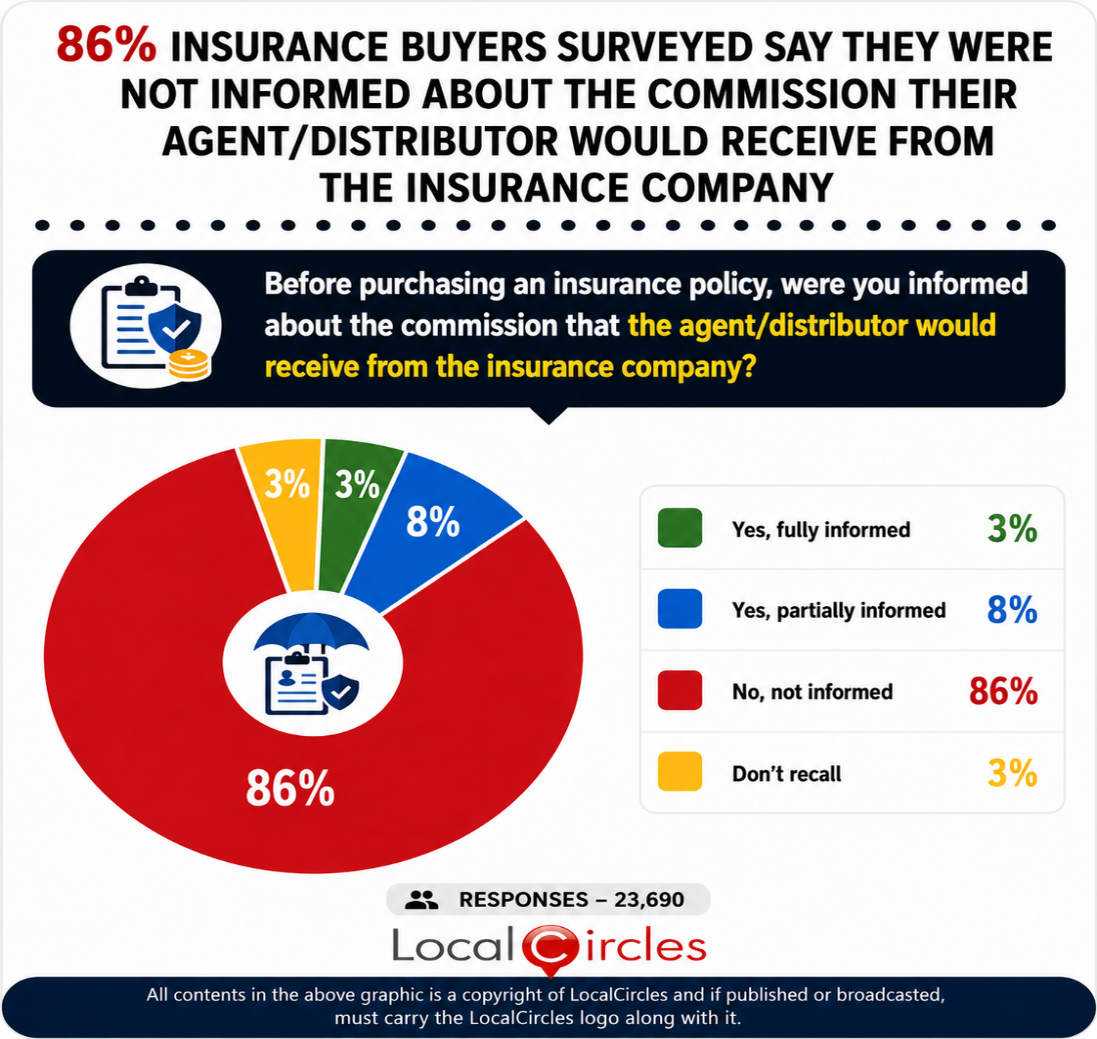
86% insurance buyers surveyed say they were not informed about the commission their agent/distributor would receive from the insurance company
The survey first sought to understand whether insurance buyers are made aware of the commission their agent or distributor earns. Asked whether, before purchasing an insurance policy, they were informed about the commission the agent/distributor would receive from the insurance company, an overwhelming 86% said they were not informed. Only 8% said they were partially informed and just 3% said they were fully informed, while 3% could not recall. This points to a near-complete lack of transparency around distributor remuneration at the point of sale, leaving consumers largely unaware of the incentives that may be shaping the advice they receive. This question in the survey received 23,690 responses.
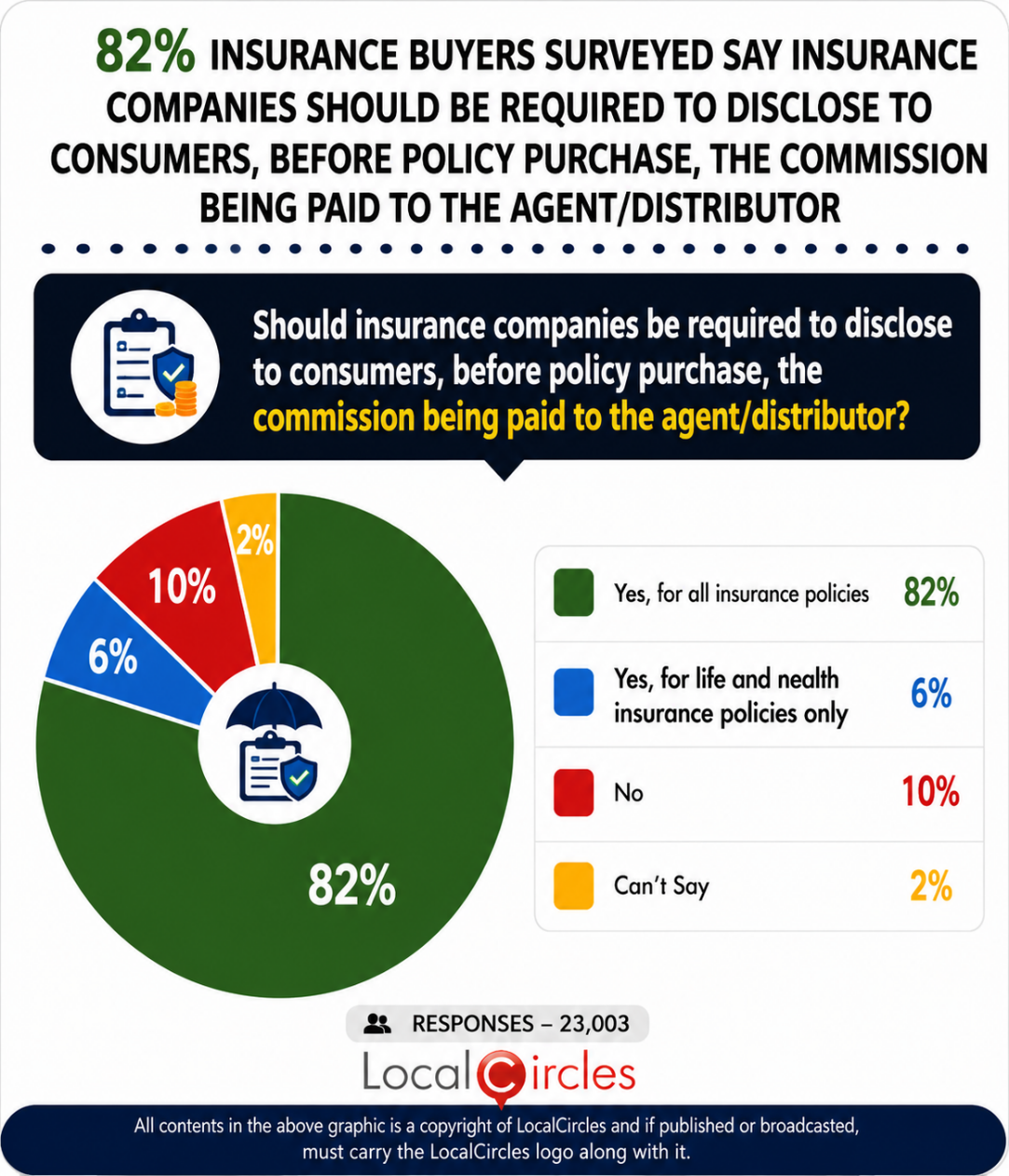
82% insurance buyers surveyed say insurance companies should be required to disclose to consumers, before policy purchase, the commission being paid to the agent/distributor
With awareness of commissions found to be low, the survey next asked whether insurance companies should be required to disclose to consumers, before policy purchase, the commission being paid to the agent/distributor. In response, 82% said yes, for all insurance policies, and a further 6% said yes, but only for life and health insurance policies – taking the share favouring mandatory disclosure to 88%. Only 10% said no and 2% could not say. The findings indicate a strong consumer demand for upfront commission disclosure as a standard practice across the insurance industry – going beyond the disclosure of commission policies and structures proposed in IRDAI’s consultation paper. This question in the survey received 23,003 responses.
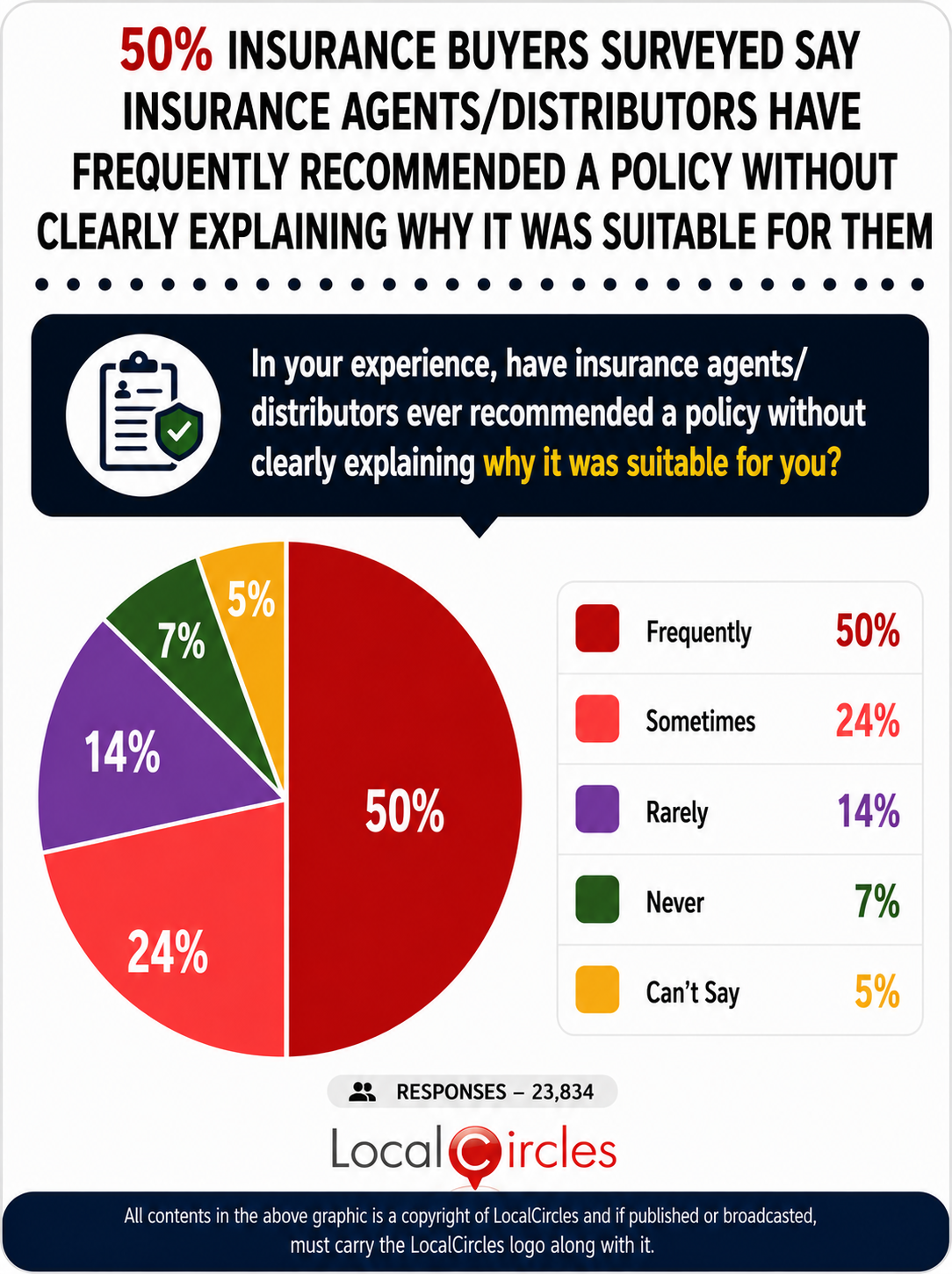
50% insurance buyers surveyed say insurance agents/distributors have frequently recommended a policy without clearly explaining why it was suitable for them
The survey then explored the issue of mis-selling by asking buyers about their direct experience. Asked whether, in their experience, insurance agents/distributors have ever recommended a policy without clearly explaining why it was suitable for them, 50% said this had happened frequently and another 24% said it had happened sometimes – meaning nearly three in four buyers have encountered recommendations being made without an adequate explanation of suitability. Only 14% said it happened rarely, 7% said never and 5% could not say. This reinforces long-standing concerns that commission-linked incentives can drive product recommendations that are not always aligned with the consumer's actual needs. This question in the survey received 23,834 responses.
71% insurance buyers surveyed say limiting commissions paid to insurance distributors helps lower insurance premiums for consumers
Finally, the survey sought views on the core policy question at the heart of the IRDAI's consultation paper. Asked whether they would support limiting commissions paid to insurance distributors if it helps lower insurance premiums for consumers, 71% said yes. Another 19% said they would support such a move only if service quality is not impacted, while just 8% said no and 2% could not say. Taken together, 90% of buyers are open to commission caps in some form, signaling broad consumer backing for the direction of the proposed reforms. This question in the survey received 24,082 responses.
In summary, the survey makes it clear that insurance buyers want far greater transparency and tighter control over the commissions paid to agents and distributors. With 86% saying they were never informed about the commission their distributor would earn and 82% wanting such commissions disclosed before purchase, the message from consumers is that the current opacity around distributor remuneration is no longer acceptable. The finding that 50% of buyers have frequently been recommended policies without a clear explanation of suitability underlines how commission-driven incentives can work against the very people insurance is meant to protect.
On the central reform question, 71% of buyers support limiting distributor commissions if it lowers premiums, and a total of 90% back such caps in some form – directly aligning with the IRDAI's stated objective of reining in payouts, curbing mis-selling and making insurance more affordable. LocalCircles will be submitting these findings to IRDAI as part of the public consultation, which is open until October 25, 2026. The survey suggests that the proposed commission caps would enjoy strong consumer support, provided service quality to policyholders is preserved. It also indicates that the final framework should go beyond disclosure of commission policies and structures and require that the commission payable on each policy – in rupees and as a percentage of premium – is disclosed to the buyer before purchase.
Survey Demographics
This survey received over 94,000 responses from insurance buyers located across 322 districts of India. 69% respondents were men while 31% respondents were women. 45% of respondents were from tier 1, 32% from tier 2 and 23% respondents were from tier 3, 4, 5 & rural districts. The survey was conducted via LocalCircles platform, and all participants were validated citizens who had to be registered with LocalCircles to participate in this survey.
About LocalCircles
LocalCircles, India’s leading Community Social Media platform enables citizens and small businesses to escalate issues for policy and enforcement interventions and enables Government to make policies that are citizen and small business centric. LocalCircles is also India’s # 1 pollster on issues of governance, public and consumer interest. More about LocalCircles can be found on https://www.localcircles.com
For more queries - media@localcircles.com, +91-8585909866
All content in this report is a copyright of LocalCircles. Any reproduction or redistribution of the graphics or the data therein requires the LocalCircles logo to be carried along with it. In case any violation is observed LocalCircles reserves the right to take legal action.
Enter your email & mobile number and we will send you the instructions.
Note - The email can sometime gets delivered to the spam folder, so the instruction will be send to your mobile as well


