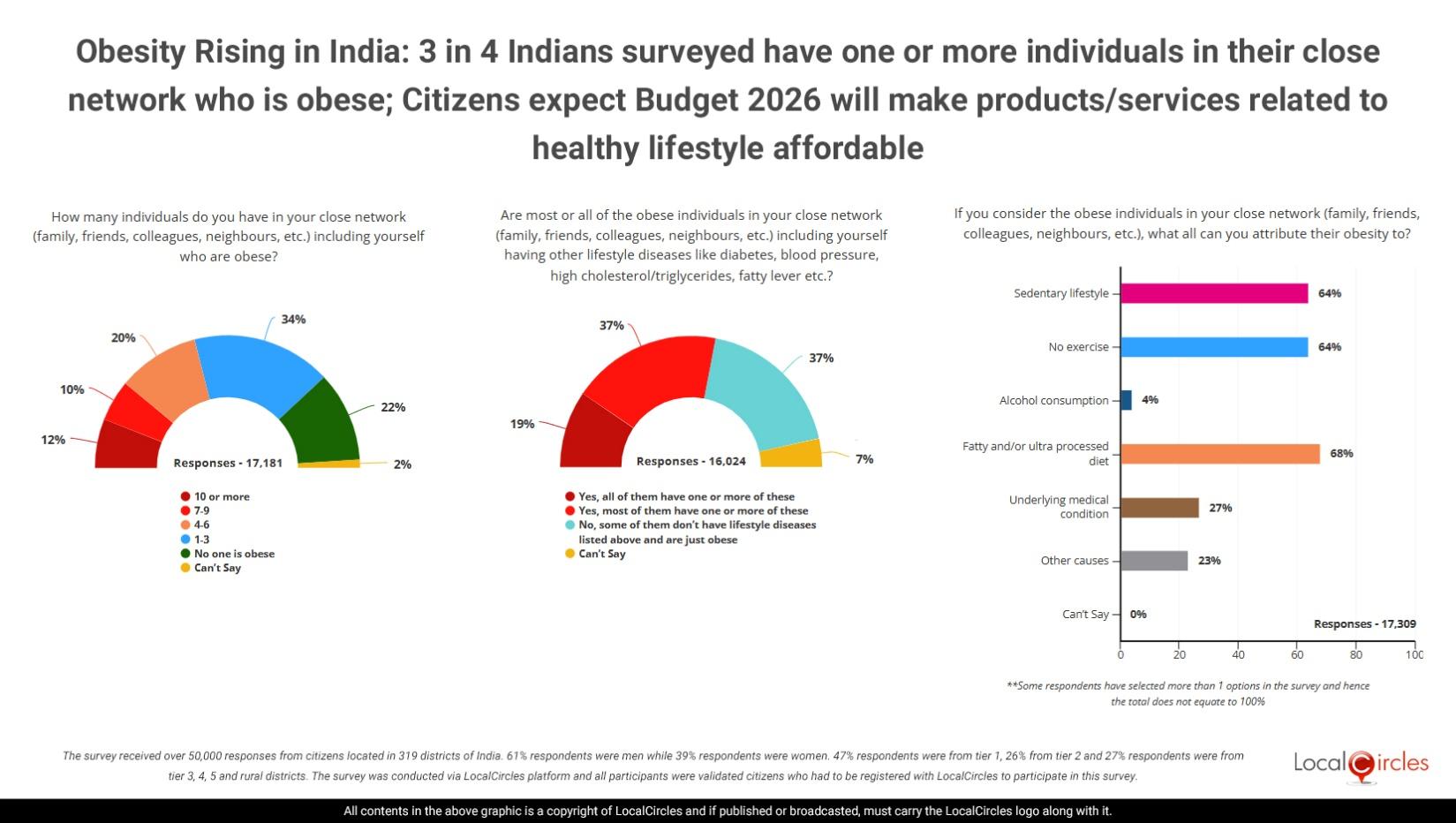
Obesity Rising in India: 3 in 4 Indians surveyed have one or more individuals in their close network who is obese; Citizens expect Budget 2026 will make products/services related to healthy lifestyle affordable
- ● 56% of Indians surveyed say obese individuals in their close network have lifestyle diseases like diabetes, high blood pressure, high cholesterol/triglycerides, fatty liver. etc.
- ● 64% Indians surveyed say obese individuals in their close network have sedentary lifestyle, no exercise and consume fatty and/or ultra-processed food
- ● Solution to obesity does not lie in expensive drugs but improving lifestyle with exercise and diet
- ● With Economic Survey also pointing to the obesity crisis, citizens expect that Budget 2026 will make products and services related to healthy lifestyle affordable
January 30, 2026, New Delhi: Obesity is rising at an alarming rate in India and has emerged as a major public health challenge, the Economic Survey 2026, tabled in Parliament on January 29 has warned.
Driven by unhealthy diets and lifestyle changes—including sedentary behaviour and increased consumption of ultra-processed foods (UPFs)—obesity is affecting people across all age groups and significantly increasing the risk of non-communicable diseases (NCDs) such as diabetes, heart disease, and hypertension.
The survey highlights that ultra-processed foods are rapidly displacing traditional dietary patterns, worsening overall diet quality and contributing to a higher risk of multiple chronic diseases. It stresses that dietary reform must be treated as a public health priority.
According to the National Family Health Survey (NFHS) 2019–21, 24% of Indian women and 23% of Indian men are overweight or obese. Of particular concern is the rise in childhood obesity: the prevalence of excess weight among children under five increased from 2.1% in 2015–16 to 3.4% in 2019–21.
Recognising obesity as a critical public health issue, the government has adopted a holistic approach integrating health, nutrition, physical activity, food safety, and lifestyle modification. Key initiatives include POSHAN Abhiyaan and Poshan 2.0, Fit India Movement, Khelo India, Eat Right India, and the nationwide awareness campaign ‘Aaj Se Thoda Kam’. Additionally, the Food Safety and Standards Authority of India (FSSAI) has launched the ‘Stop Obesity & Fight Obesity’ awareness initiative.
Even as obesity rates climb, demand for pharmaceutical weight management solutions has surged. Several weight-loss drugs entered the Indian market last year. Novo Nordisk led with Wegovy (semaglutide), followed by Eli Lilly’s Mounjaro (tirzepatide), both approved for chronic weight management in obese or overweight adults. Later in the year, Novo Nordisk launched Ozempic, primarily for Type 2 diabetes but widely known for its weight-loss effects.
Health and drug experts, however, have cautioned against indiscriminate use. While Ozempic helps reduce appetite, control cravings, improve blood sugar, and support fat loss, experts warn that very low-calorie intake over extended periods can cause fatigue, weakness, constipation, nutrient deficiencies, muscle loss, and facial sagging (“Ozempic face”). Rapid weight loss without adequate protein intake and strength training may reduce muscle mass and slow metabolism. There is also a risk of rebound weight gain once the drug is discontinued. The drug is not recommended during pregnancy or breastfeeding and may be unsafe for individuals with certain thyroid disorders, severe gastrointestinal issues, or those taking interacting medications.
According to the World Obesity Federation, India is now the third most obese country in the world, after the United States and China. Obesity is defined as excessive body fat accumulation, with individuals classified as obese when their BMI exceeds 27.5. Over the past decade, India’s obesity rate has nearly tripled, affecting both urban and rural populations.
Childhood obesity has also risen sharply. A study by the Indian Council of Medical Research (ICMR) estimates that 14.4 million children in India are obese. Poor dietary habits, physical inactivity, and sedentary lifestyles—fuelled by increased consumption of processed snacks and fast food—are cited as key drivers. Childhood obesity carries long-term consequences, including a higher risk of Type 2 diabetes, hypertension, heart disease, respiratory problems, and mental health issues such as low self-esteem and depression. All India Institute of Medical Sciences (AIIMS) has warned that obesity can lead to multiple complications, including heart disease, diabetes, hypertension, hormonal imbalances, and infertility. It recommends lifestyle interventions such as improved sleep and dietary habits, regular physical activity, yoga, meditation, and engagement in creative pursuits.
Instead of adopting sustainable lifestyle changes through balanced diets and regular exercise, some affluent individuals are increasingly opting for bariatric surgery or weight-loss drugs to reduce body fat.
With rapid economic growth and changing lifestyles, over 100 million people in India are estimated to be living with obesity. Obesity typically presents as either gynecoid (pear-shaped) fat distribution around the hips and thighs, or android (apple-shaped) fat accumulation in the abdominal region. Central or visceral obesity, considered the most dangerous form, is strongly associated with metabolic disorders and chronic diseases, notes a blog titled “Obesity in India: A Growing Health Concern” published by Sir Ganga Ram Hospital.
India’s obesity rates rose sharply during the COVID-19 period due to lifestyle disruptions, reduced physical activity and limited access to healthy food choices. In this context, LocalCircles conducted a nationwide survey to understand how widespread obesity is within the close social networks of Indians and the associated health concerns. The survey received over 50,000 responses from citizens across 319 districts in India. Of the respondents, 61% were men and 39% were women, with 47% from tier 1, 26% from tier 2 and 27% from tier 3, 4, 5 and rural districts.
76% Indians surveyed have one or more obese individuals in their close network i.e. family, friends, colleagues and neighbours; 42% have 4 or more individuals
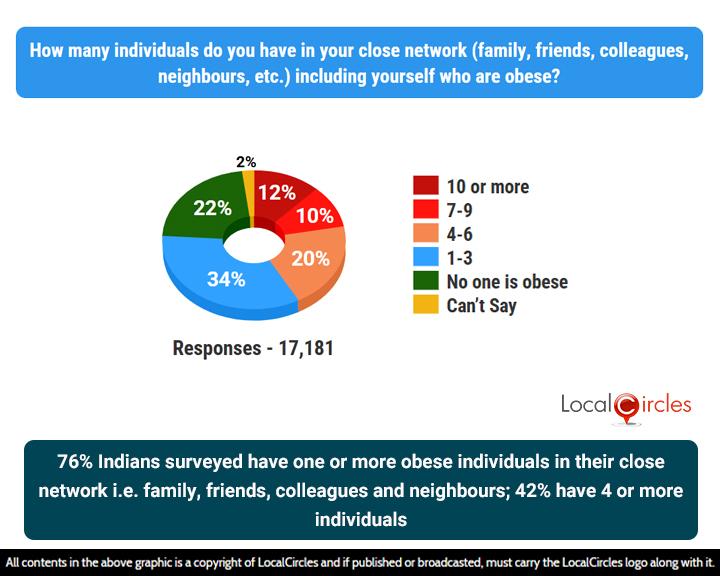
Being fat or obese generally does not concern many people these days unless they are or become health conscious. In fact, drawing attention to obesity has become an unaccepted fact as people tend to call it ‘body shaming’ and thus unacceptable. Things change when the obese person, an adult or child, has health issues. The survey first asked, “How many individuals do you have in your close network (family, friends, colleagues, neighbors, etc.,) including yourself who are obese?” Out of 17,181 who responded to the question 12% stated that “10 or more” people in their family, friends, colleagues, neighbours, etc., are obese; 10% of respondents indicated “7-9” people; 20% of respondents indicated "4-6” people; 34% indicated "1-3” people; 22% of respondents, however, stated “no one is obese” and 2% of respondents did not give a clear answer. To sum up, 76% Indians surveyed have one or more obese individuals in their close network i.e. family, friends, colleagues and neighbours; 42% have 4 or more individuals.
56% Indians surveyed who have one or more obese individuals in their close network say these individuals also have other lifestyle diseases like diabetes, high blood pressure, high cholesterol/triglycerides, fatty liver etc.
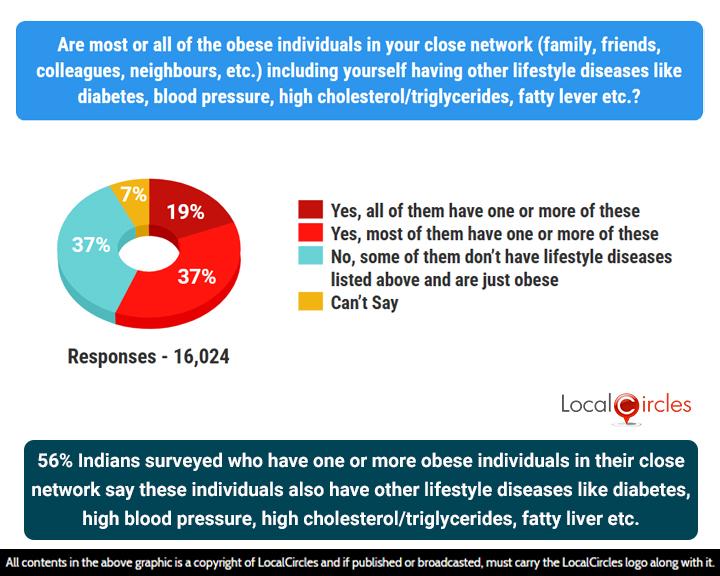
Given the likelihood of obesity impacting the health of individuals, the survey asked, “Are most or all of the obese individuals in your close network (family, friends, colleagues, neighbours, etc.) including yourself having other lifestyle diseases like diabetes, blood pressure, high cholesterol/triglycerides, fatty lever etc.?” Out of 16,024 who responded to the question 19% stated “Yes, all of them have one or more of these” health issues; 37% of respondents stated “Yes, most of them have one or more of these” health issues; 37% of respondents stated “No, some of them don’t have lifestyle diseases listed above and are just obese” while 7% of respondents did not give a clear answer. To sum up, 56% Indians surveyed who have one or more obese individuals in their close network say these individuals also have other lifestyle diseases like diabetes, high blood pressure, high cholesterol/triglycerides, fatty liver, etc.
64% Indians surveyed who have one or more obese individuals in their close network attribute their obesity to sedentary lifestyle, no exercise and fatty and/or ultra processed diet
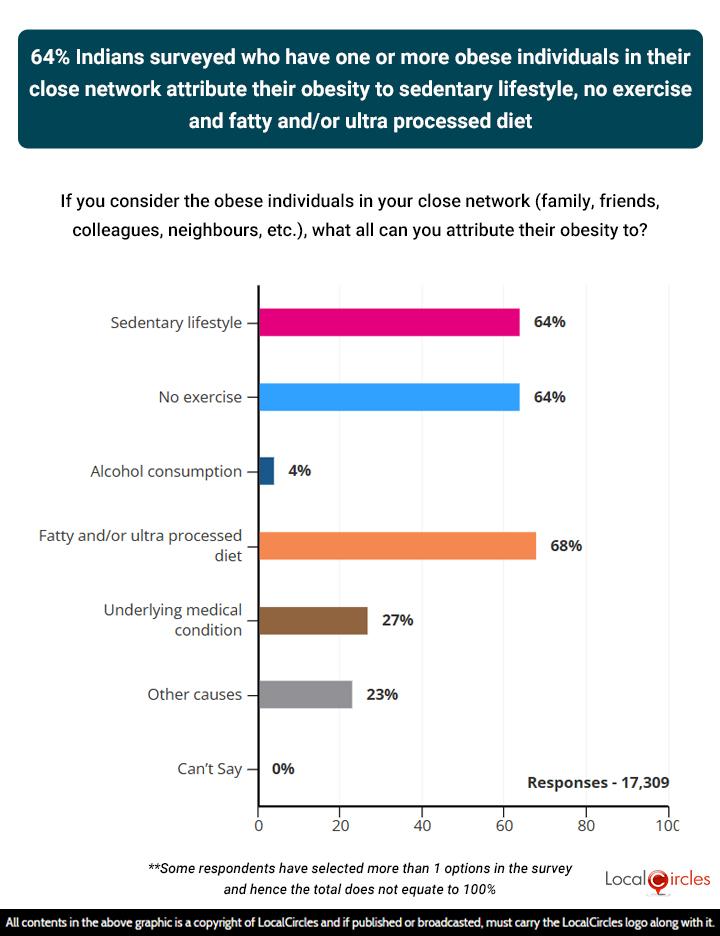
Rise in obesity in India is caused by several variables, such as alterations in lifestyle, restricted availability of healthful food selections, and decreased physical activity. To tackle obesity, it is essential to encourage a nutritious diet by creating awareness about healthy food choices, regular physical exercise, reducing or stopping unhealthy, high-calorie meals, panic shopping, and food stockpiling of ultra-processed foods. Given the lack of awareness or adoption of a healthy lifestyle among many people, the survey asked, “If you consider the obese individuals in your close network (family, friends, colleagues, neighbors, etc.,), what all can you attribute their obesity to?” Some among the 17,309 respondents to the question indicated more than one reason with 64% attributing it to “sedentary lifestyle”; 64% attributing it to lack or “no exercise”; 68% attributing it to “fatty and/ or ultra processed food diet”; 27% attributing it to “underlying medical condition”; 4% to “alcohol consumption” and 23% attributing it to “other causes” not mentioned earlier. In essence, 64% Indians surveyed who have one or more obese individuals in their close network attribute their obesity to sedentary lifestyle, no exercise and fatty and/or ultra processed diet.
In summary, 76% of Indians surveyed have one or more obese individuals in their close network i.e. family, friends, colleagues and neighbours, with 42% reporting four or more such individuals. Further, 56% of respondents who have obese individuals in their close network acknowledge that these individuals are already living with lifestyle diseases such as diabetes, high blood pressure, high cholesterol/triglycerides and fatty liver. Importantly, the survey highlights strong public awareness of the root causes, with 64% of respondents attributing obesity in their close circles to sedentary lifestyles, lack of physical activity and consumption of fatty and ultra-processed diets.
These findings underline that India’s obesity challenge cannot be solved through widespread reliance on weight-loss drugs. Medical experts caution that such drugs should be used only in rare cases involving severe obesity or serious co-morbidities, and strictly under medical supervision, given their known side effects and long-term risks. For majority of citizens, sustainable solutions lie in preventive and corrective lifestyle changes. The need of the hour is for schools, colleges, workplaces and communities to actively promote daily physical activity, balanced diets, reduced intake of ultra-processed foods and healthier routines, so that obesity and its related diseases can be prevented rather than medically managed later. Citizens expect that Budget 2026 will reduce taxes on any products and services that make people avoid obesity and stay healthy.
Survey Demographics
The survey received over 50,000 responses from citizens located in 319 districts of India. 61% respondents were men while 39% respondents were women. 47% respondents were from tier 1, 26% from tier 2 and 27% respondents were from tier 3, 4, 5 and rural districts. The survey was conducted via LocalCircles platform, and all participants were validated citizens who had to be registered with LocalCircles to participate in this survey.
About LocalCircles
LocalCircles, India’s leading Community Social Media platform enables citizens and small businesses to escalate issues for policy and enforcement interventions and enables Government to make policies that are citizen and small business centric. LocalCircles is also India’s # 1 pollster on issues of governance, public and consumer interest. More about LocalCircles can be found on https://www.localcircles.com
For more queries - media@localcircles.com, +91-8585909866
All content in this report is a copyright of LocalCircles. Any reproduction or redistribution of the graphics or the data therein requires the LocalCircles logo to be carried along with it. In case any violation is observed LocalCircles reserves the right to take legal action.
Enter your email & mobile number and we will send you the instructions.
Note - The email can sometime gets delivered to the spam folder, so the instruction will be send to your mobile as well


