India has a food safety enforcement trust deficit: Only 1 in 10 consumers surveyed trust their District/State Food & Drug Administration department to effectively ensure hygiene and food safety at vendors, restaurants and warehouses; 8 in 10 do not
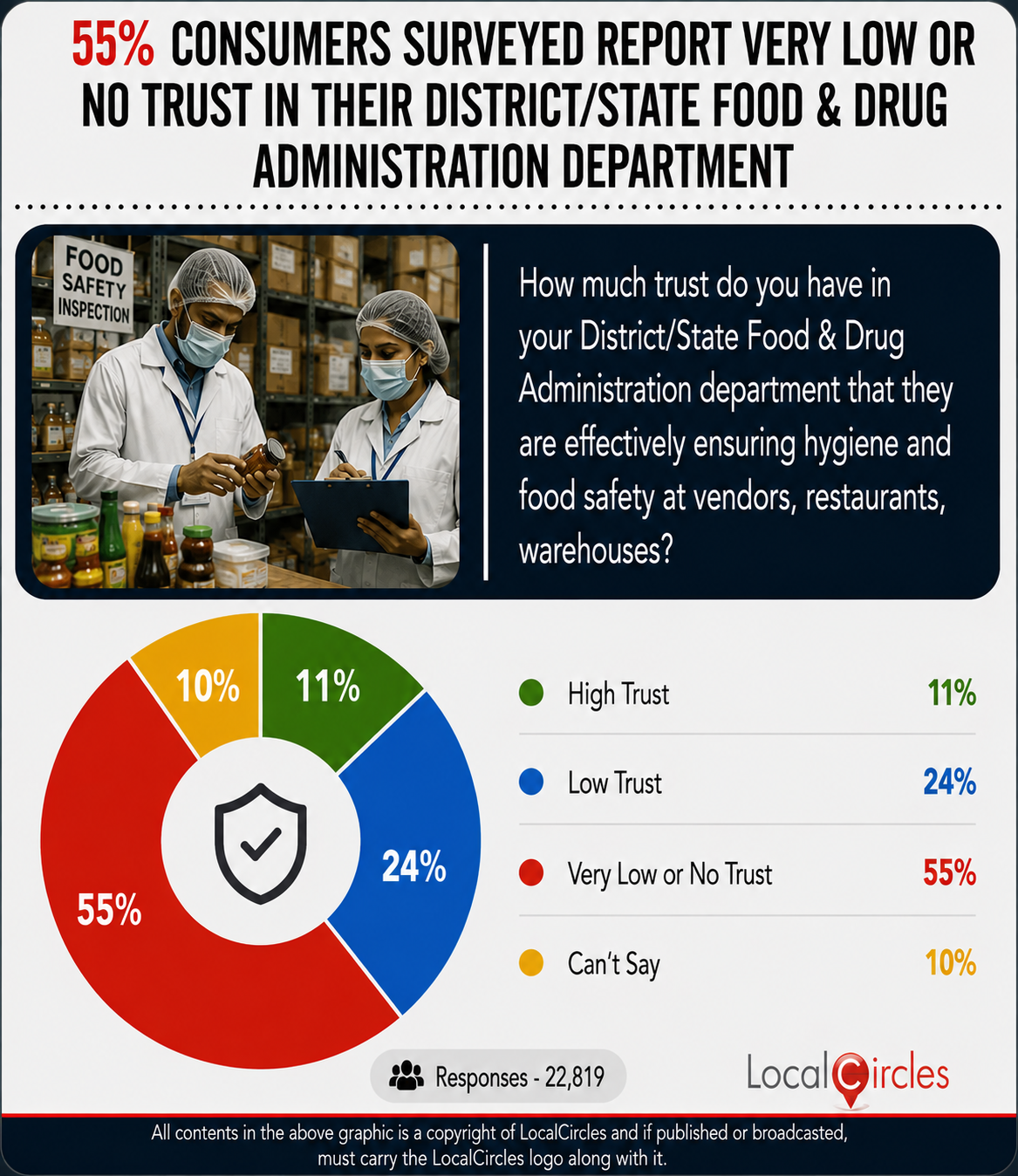
- ● Only 11% consumers surveyed report high trust in their District/State Food & Drug Administration (FDA) department effectively ensuring hygiene and food safety at vendors, restaurants and warehouses
- ● 55% consumers surveyed report very low or no trust and another 24% report low trust, taking the combined low trust number to 79%, while only 10% could not say
- ● The trust deficit comes despite an unprecedented enforcement drive in which State FDAs have in the last two months suspended licences of clubs, standalone restaurants, national pizza and burger chains, quick-commerce dark stores, warehouses and edible oil units across Maharashtra and Karnataka
- ● LocalCircles will escalate these findings to FSSAI, the Ministry of Health & Family Welfare and Food Safety Commissioners of States/UTs, urging that district-wise inspection and enforcement data be published, that hygiene ratings be made mandatory and publicly displayed, and that enforcement follow due process so that action survives judicial scrutiny
August 21, 2026, New Delhi: Food safety enforcement in India is having its most visible moment in years. Over the last two months State Food and Drug Administration (FDA) departments, led by Maharashtra and followed by Karnataka, have suspended food business licences of some of the country’s best-known clubs, restaurants, hotels, food chains, quick-commerce dark stores and warehouses. Yet the very consumer the drive is meant to protect appears unconvinced that the machinery on the ground works. LocalCircles conducted a national survey to assess how much trust consumers place in their District/State Food & Drug Administration department to effectively ensure hygiene and food safety at vendors, restaurants and warehouses, and the findings point to a deep and widespread trust deficit.
The scale of recent enforcement has been striking. Between July 10 and August 11, 2026, the Maharashtra FDA under Commissioner Tukaram Mundhe inspected 104 establishments of national quick service restaurant brands including Domino’s Pizza, KFC, Pizza Hut, McDonald’s, Subway, Burger King, Starbucks and Monginis, halting operations at two outlets immediately, issuing 95 improvement notices and suspending five food business licences. On August 13, 2026, the licences of four Domino’s Pizza outlets operated by Jubilant FoodWorks — at Vile Parle, Borivali and Ghatkopar in Mumbai and one in Karad — were suspended over pest infestation, gaps in pest control records, food storage, temperature monitoring and hygiene facility violations. In a separate three-day drive between August 4 and 6, 2026, the FDA inspected 63 food establishments, issued 38 improvement notices and suspended seven licences, ordering the closure of two hostel mess facilities at IIT Bombay and acting against Punjab Grill in Navi Mumbai over cockroach infestation and record-keeping failures, besides eateries in Kurla and Dadar. This followed the late-July suspensions of the FSSAI licences of the Cricket Club of India, Willingdon Sports Club, MIG Cricket Club, RK Juhu Gymkhana and Aparna Juhu Gymkhana, and of Mumbai’s iconic Poornima Restaurant and Parsi Dairy Farm.
The drive has extended well beyond restaurants into the wider food supply chain that consumers rarely see. The Maharashtra FDA suspended the food licence of Blink Commerce Pvt Ltd’s dark store in Malad West after inspectors found cockroaches on stored fruits and vegetables along with expired stock and sanitation lapses, and barred the facility from food-related activity until further orders. Action against Amazon Retail India’s Bhiwandi warehouse related to allegations that expired and deteriorated food products were diverted towards sale rather than destroyed, with the Bombay High Court subsequently directing the company to inventory all expired and perished goods and hand them to the FDA for disposal. On August 6 and 7, 2026, the FDA seized 1,19,187.5 kg of edible oil worth ₹1.54 crore from five manufacturing and repacking units in Beed after allegedly finding reused tins and oil from the same tank being packed and sold under different labels. Elsewhere in the State, officials seized 87,320 litres of packaged drinking water in Jalgaon, 9,827 kg of rusk in Nagpur over labelling violations, jaggery and sugar in Kolhapur over suspected adulteration and low-fat paneer in Ulhasnagar, destroyed 13,866 kg of curd and cheese analogue in Nagpur, and banned the manufacture, storage, transport, distribution and sale of unstandardised analogue and non-dairy paneer across Maharashtra for one year. In Karnataka, 26 three-star and five-star hotels in Bengaluru — including Radisson Blu Atrium, The Lalit Ashok, Shangri-La, Four Seasons, Vivanta Whitefield and Taj Yeshwantpur — were inspected on August 7, 2026, with expired chicken, meat, fish, milk and bakery products, fungal-affected vegetables and unhygienic storage reported, 35 samples lifted for testing and the kitchen of Skyye Lounge at UB City shut over rotten meat.
Two things, however, temper the impression that enforcement has turned a corner. The first is due process. On August 11, 2026, the Bombay High Court again pulled up the Maharashtra FDA, observing that “you have the power to use a sword, but the problem is you are using it to kill a mosquito” and that the regulator “shoots first” before asking questions, having earlier used the same phrase over the Amazon warehouse suspension issued a day after inspection without an improvement notice; the Court has warned of heavy costs and, on July 30, 2026, quashed one hotel licence suspension. The Hotel and Restaurant Association (Western India), the National Restaurant Association of India and the Indian Hotel and Restaurant Association have jointly sought the intervention of the Prime Minister, the Chief Minister of Maharashtra and FSSAI, arguing that suspensions and public naming should follow the improvement notice and hearing process under Section 32 of the Food Safety and Standards Act, 2006 except where there is immediate risk to public health. The second is the thinness of routine, everyday oversight. Data placed before Parliament in July 2026 shows that of 2,23,808 food samples analysed across India in FY 2025-26, 40,023 — nearly one in five — were found unsafe, substandard or misbranded, and while 5,20,566 inspections were conducted, up from 4,01,391 in 2024-25, and 31,878 civil cases were decided with penalties, only 1,918 criminal convictions were recorded. FSSAI has moved to a technology-enabled, risk-based inspection system that prioritises businesses by food type, compliance history and third-party audit performance, and on April 16, 2026 advised Commissioners of Food Safety of all States/UTs to intensify vigilance over mandis, storage facilities, wholesalers and distributors. But its Hygiene Rating Scheme remains voluntary and rarely displayed, and a consumer walking into a restaurant, buying from a street vendor or ordering from a dark store still has no way of knowing when the establishment was last inspected or what was found.
It is against this backdrop — high-profile action at the top, weak visibility at the bottom — that LocalCircles surveyed consumers on how much trust they place in the District/State FDA department that regulates food safety where they live. The survey received over 22,000 responses from consumers located across 322 districts of India. The findings show that only 11% of consumers surveyed have high trust in their District/State Food & Drug Administration department, while 55% report very low or no trust and another 24% report low trust. The key findings of the survey are detailed below.
55% consumers surveyed report very low or no trust in their District/State food & drug administration department
To establish how much confidence consumers have in the machinery that is meant to keep their food safe on an everyday basis, the survey asked, “How much trust do you have in your District/State Food & Drug Administration department that they are effectively ensuring hygiene and food safety at vendors, restaurants, warehouses?” This question received 22,819 responses. In response, the largest group at 55% said they have very low or no trust in their District/State FDA department, while 24% said they have low trust and only 11% said they have high trust. Another 10% could not say. Taken together, 79% of consumers surveyed — nearly 8 in 10 — report low, very low or no trust in the food safety regulator in their district or State, against just 11% who report high trust, a ratio of over seven to one. The finding is notable for when it has been recorded. Consumers are not being asked this in a quiet period; they are being asked at the peak of the most visible food safety enforcement drive in recent memory, with licence suspensions of well-known clubs, restaurants, hotel chains, dark stores and warehouses reported almost daily. That trust has still not moved suggests consumers read the current drive as episodic and concentrated in a few cities rather than as evidence of a system that inspects consistently, everywhere, through the year — and that in most of India’s 700-plus districts, the local food safety apparatus remains invisible to the citizen it serves.
In summary, the survey findings indicate that India’s food safety problem is not only one of unsafe food but also one of unconvinced citizens. Only 11% of consumers surveyed trust their District/State Food & Drug Administration department to effectively ensure hygiene and food safety at vendors, restaurants and warehouses, while a combined 79% report low, very low or no trust. This sits alongside LocalCircles’ findings from earlier this month that only 32% of consumers rate hygiene and food safety standards at air-conditioned restaurants in their area/city as good or excellent, that 57% have personally observed dirty dining areas, kitchens or washrooms in the last 12 months, and that 74% want public display of hygiene ratings at restaurants and on food delivery apps made mandatory. Read together, the two surveys describe a consumer who believes standards are poor and does not believe the regulator is fixing them. The one-in-five failure rate in food samples analysed nationally in FY 2025-26, set against fewer than 2,000 criminal convictions, gives that scepticism an empirical basis, as does the repeated judicial criticism of enforcement that is drastic in a few cases while routine oversight stays thin in most districts.
These findings carry an important signal for FSSAI, the Ministry of Health & Family Welfare and Food Safety Commissioners of States and UTs. The citizen pulse is not a demand for less enforcement — LocalCircles’ earlier survey found 72% of consumers want quarterly hygiene inspections and 71% want higher penalties for repeat offenders — but a demand that enforcement become routine, uniform across districts, visible at the point of purchase and robust enough to hold up in court. LocalCircles will be escalating these findings to FSSAI, the Ministry of Health & Family Welfare and Food Safety Commissioners of all States and UTs. LocalCircles is also urging that every district publish quarterly data on inspections conducted, samples lifted, failures recorded and action taken so that citizens can see their local FDA at work; that FSSAI’s Hygiene Rating Scheme be made mandatory for all restaurants and food establishments with the rating displayed at the entrance and against every listing on food delivery and quick-commerce platforms; that vacancies of Food Safety Officers and gaps in testing infrastructure be filled so that the risk-based inspection framework can function beyond metros; and that enforcement follow the improvement notice and hearing process laid down under the Food Safety and Standards Act, 2006 except where there is immediate risk to public health, so that action taken against violators is not undone on procedural grounds.
Survey Demographics
The survey received over 22,000 responses from consumers located across 322 districts of India. 61% respondents were men while 39% respondents were women. 43% respondents were from tier 1, 33% from tier 2 and 24% respondents were from tier 3 & 4 districts. The survey was conducted via LocalCircles platform and all participants were validated citizens who had to be registered with LocalCircles to participate in this survey.
About LocalCircles
LocalCircles, India’s leading Community Social Media platform enables citizens and small businesses to escalate issues for policy and enforcement interventions and enables Government to make policies that are citizen and small business centric. LocalCircles is also India’s # 1 pollster on issues of governance, public and consumer interest. More about LocalCircles can be found on https://www.localcircles.com
For more queries - media@localcircles.com, +91-8585909866
All content in this report is a copyright of LocalCircles. Any reproduction or redistribution of the graphics or the data therein requires the LocalCircles logo to be carried along with it. In case any violation is observed LocalCircles reserves the right to take legal action.
Enter your email & mobile number and we will send you the instructions.
Note - The email can sometime gets delivered to the spam folder, so the instruction will be send to your mobile as well


