E20 impact on pre-2023 petrol vehicles worsens significantly within a month: Vehicle owners with mileage drop over 10% jumped from 45% to 66% and those with wear & tear increase jumped from 29% to 55%
- ● Over 6 in 10 owners of old petrol vehicles (pre-2023) surveyed confirm that fuel efficiency/mileage of their vehicle has reduced by over 10% since early 2025
- ● Over 5 in 10 owners of old petrol vehicles (pre-2023) surveyed confirm having experienced an increase in wear & tear or need for repairs since early 2025
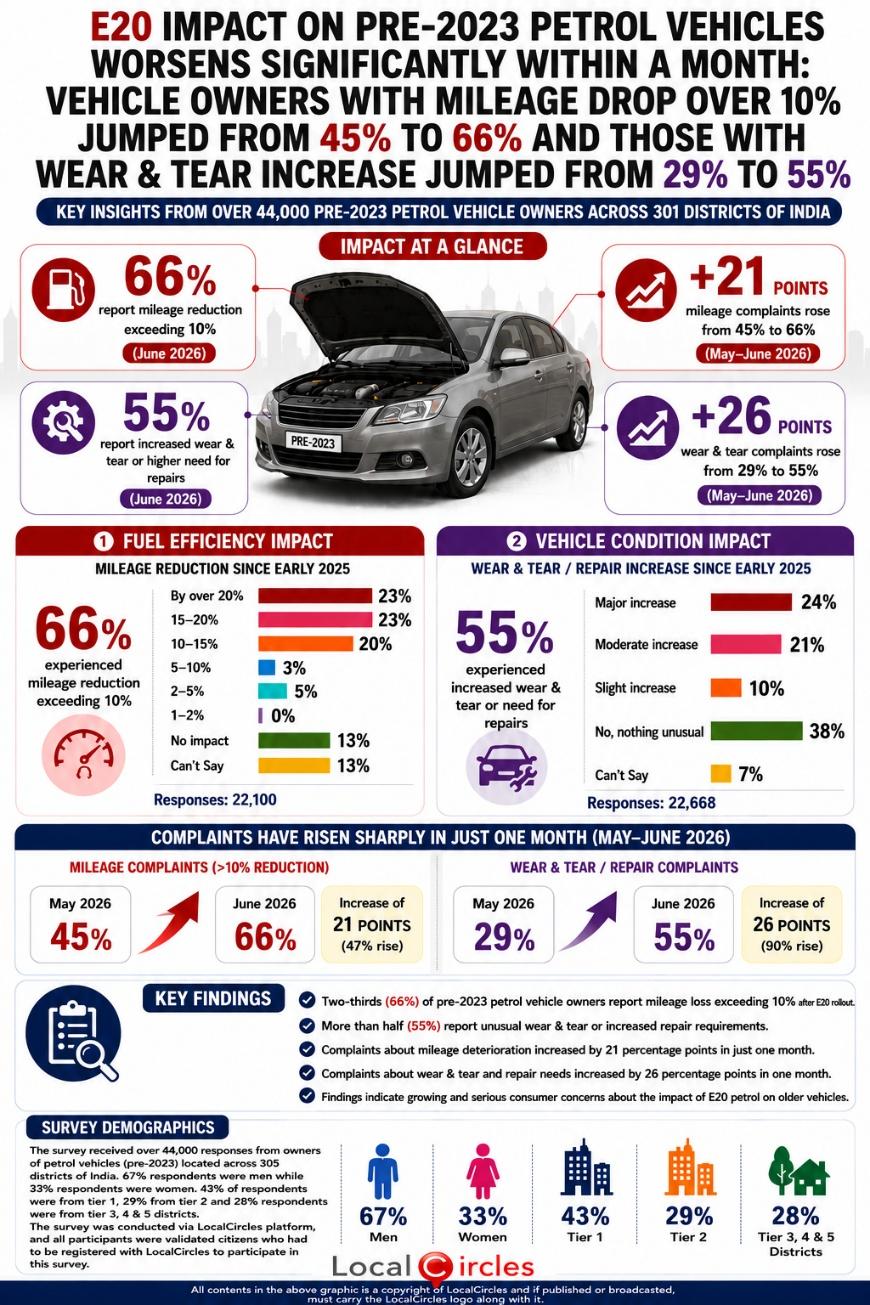
June 30, 2026, New Delhi: A little over a year after India completed the nationwide rollout of E20 petrol in April 2025 — achieving the 20% ethanol-blending target six years ahead of the original 2030 schedule — the on-road experience of owners of older petrol vehicles appears to be deteriorating rather than stabilising. The government, in a statement, has debunked misinformation about ethanol blended petrol stating that so far it has not received reports of engine failures due to it and that videos circulating about ants being attracted by ethanol in petrol are all false.
The statement by Ministry of Petroleum and Natural Gas, however, does not address the issue of higher wear and tear, nor complaints about lower mileage. A fresh LocalCircles survey conducted in June 2026 finds that the proportion of pre-2023 petrol vehicle owners reporting a mileage drop of over 10% has surged from 45% in May 2026 to 66% in June 2026, while those reporting an unusual increase in wear & tear or need for repairs has nearly doubled from 29% to 55% in the same one-month period. In short, owner-reported pain points around mileage and mechanical wear have worsened sharply within a single month of continued E20 usage.
This deterioration comes even as the Government accelerates the move to higher ethanol blends. In May 2026, the Bureau of Indian Standards notified IS 19850:2026 covering E22 to E30 blends, and from April 1, 2026, the Ministry of Petroleum and Natural Gas has mandated that all E20 petrol sold in India meet a minimum Research Octane Number (RON) of 95 to improve combustion stability and reduce engine knocking. Yet lakhs of consumers — particularly those whose vehicles were originally engineered for E5 or E10 fuel — say their real-world experience does not match the official Automotive Research Association of India (ARAI) estimate of a 1–6% dip in fuel efficiency, with several independent real-world tests now pegging losses at 8–12% in older cars. Industry estimates suggest nearly 80% of vehicles sold over the past 15 years, and close to 300 million vehicles on Indian roads, were never designed for E20.
The Government has firmly defended the programme. Union Petroleum Minister Hardeep Singh Puri has maintained that ethanol-blended fuel has minimal impact on vehicles and that mileage is influenced by many factors beyond fuel type, while the Supreme Court in September 2025 dismissed a PIL seeking continued availability of ethanol-free petrol, holding that consumer preference cannot dictate national energy policy. A June 2026 government statement reiterated that the current roadmap commits to E20 until October 31, 2026, with any decision on higher blends to follow an Inter-Ministerial Committee report and stakeholder consultations. Meanwhile, manufacturers are responding to consumer anxiety — Maruti Suzuki is preparing to offer E20 retrofit/upgrade kits (E20-compatible fuel lines, seals and gaskets) for cars up to 15 years old, reportedly priced at around ₹4,000–6,000. Even so, the gap between official assurances and on-ground consumer experience continues to widen, as captured in the findings detailed below.
On June 23, 2026, the Ministry of Petroleum and Natural Gas issued a statement asserting that the Ethanol Blending Programme is scientifically validated and continuously monitored, and cautioning that certain misleading and unsubstantiated claims are being circulated on social media to sensationalise the issue. These include old images and videos being recirculated, clips falsely portraying sugarcane juice being mixed directly with petrol, and viral videos linking E20 to ants gathering near vehicle fuel tanks — the latter clarified by Bharat Petroleum Corporation Limited (BPCL) on the basis that fuel-grade ethanol is produced through fermentation and distillation that eliminates residual sugars and contains denaturants repellent to insects.
The Government further noted that since the introduction of E20, no widespread engine failure or vehicle breakdown attributable to ethanol blending has been reported, and that claims around ethanol’s hygroscopic nature and its effect on vehicle insurance validity have been clarified as incorrect. LocalCircles agrees that such misleading videos and images must not be confused with the genuine, lived experience of vehicle owners. The findings presented in this survey are not drawn from viral clips or doctored visuals; they capture the first-hand, on-road experience of owners of pre-2023 petrol vehicles on two specific and measurable parameters — fuel efficiency/mileage and unusual wear & tear or need for repairs. It is precisely this real consumer experience, distinct from sensational social-media content, that the data below documents.
One year after the government mandated the supply of only E20 fuel, LocalCircles conducted a fresh survey to assess whether there has been any change in fuel efficiency or impact on older petrol vehicles, and how the situation has evolved since its previous survey a month earlier. The survey received over 44,000 responses from owners of petrol vehicles (pre-2023) located across 305 districts of India. 67% of respondents were men while 33% were women. 43% of respondents were from tier 1, 29% from tier 2 and 28% from tier 3, 4 & 5 districts. The detailed findings are presented below.
Over 6 in 10 owners of old petrol vehicles (pre-2023) surveyed confirm that fuel efficiency/mileage of their vehicle has reduced by over 10% since early 2025
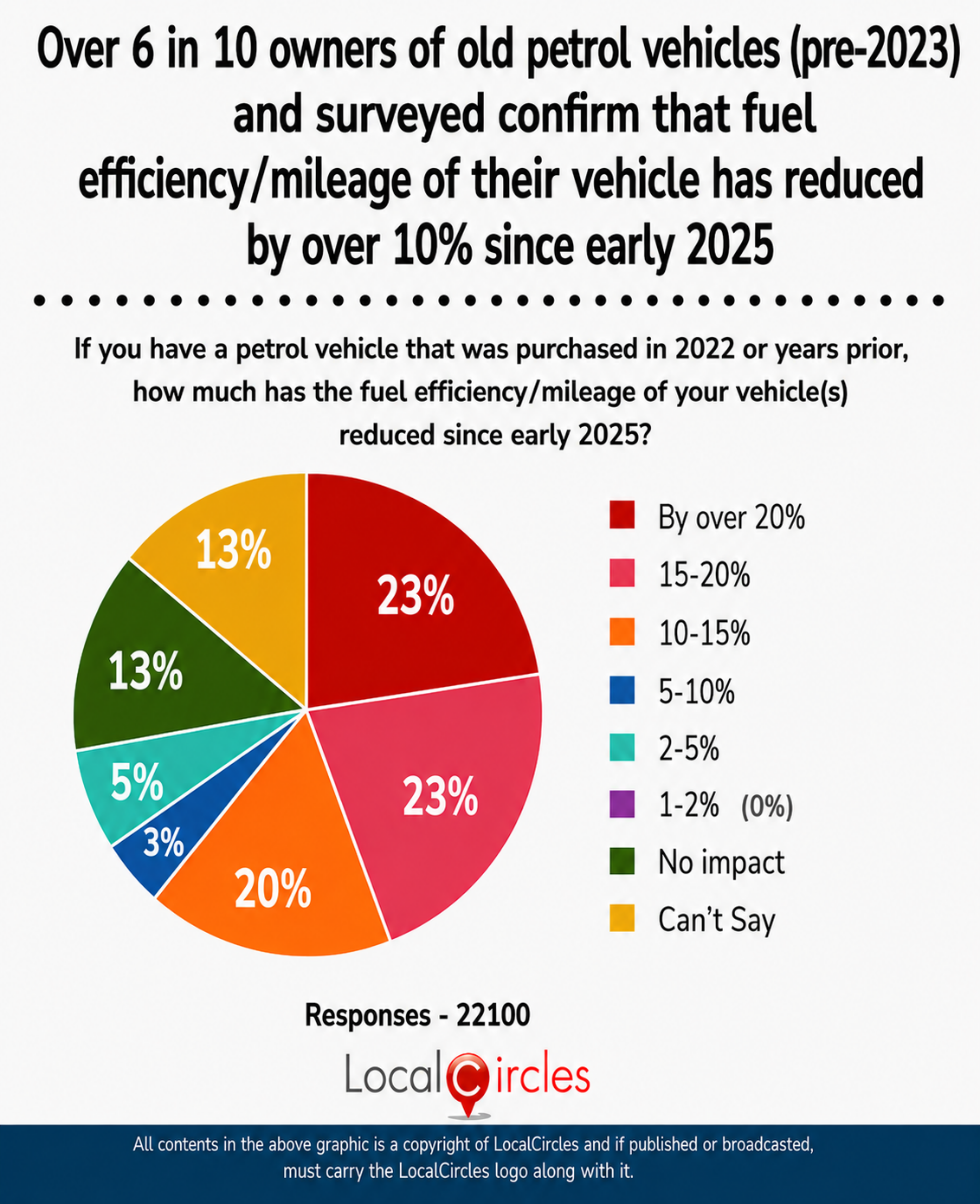
The survey first asked vehicle owners, “If you have a petrol vehicle that was purchased in 2022 or years prior, how much has the fuel efficiency / mileage of your vehicle(s) reduced since early 2025?” Out of 22,100 who responded to the question, 23% indicated that fuel efficiency has dipped “by over 20%”; another 23% indicated a dip of “15-20%”; 20% indicated a “10-15%” dip; 5% indicated a “5-10%” dip; 3% indicated a “2-5%” dip; 0% indicated a “1-2%” dip; 13% indicated “no impact”; and 13% did not give a clear answer. To sum up, over 6 in 10 (66%) owners of pre-2023 petrol vehicles confirm that their vehicle’s fuel efficiency/mileage has reduced by over 10% since early 2025 — a sharp rise from the 45% recorded in the LocalCircles May 2026 survey.
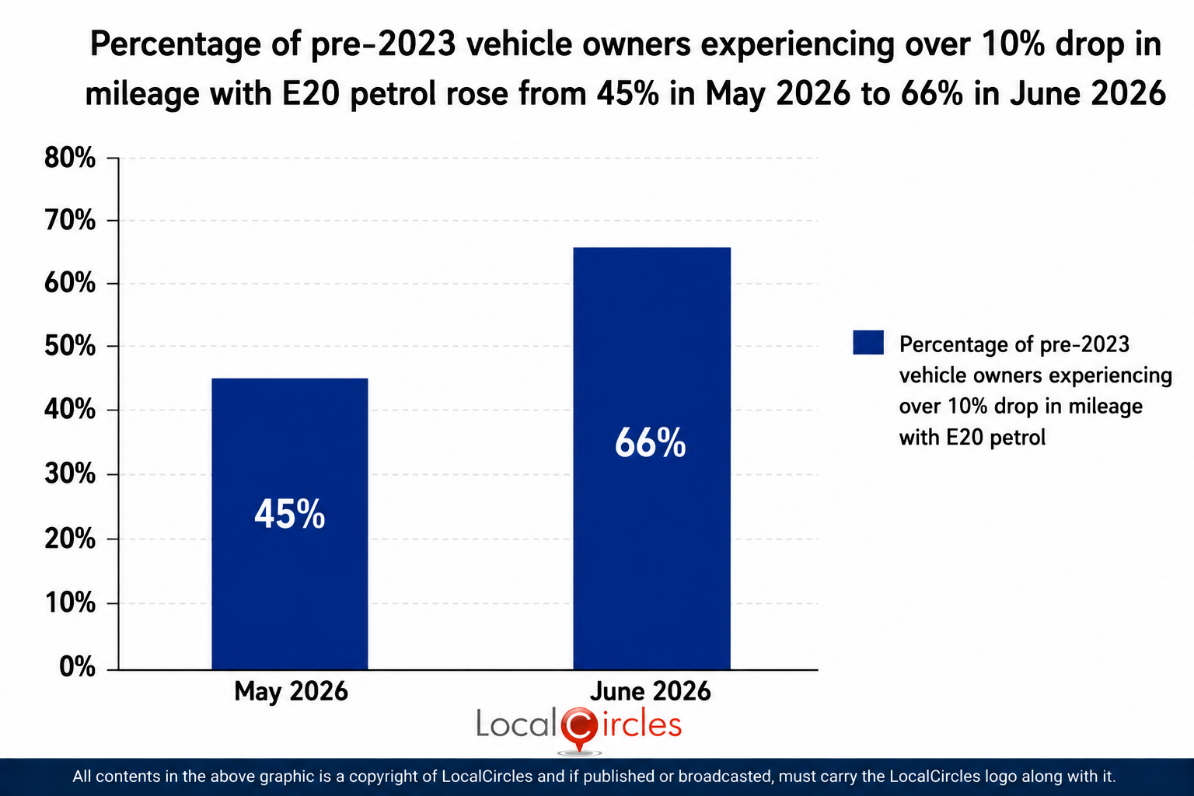
Percentage of pre-2023 vehicle owners experiencing over 10% drop in mileage with E20 petrol rose from 45% in May 2026 to 66% in June 2026
When compared with the LocalCircles survey conducted in May 2026, the findings reveal a steep month-on-month deterioration. The percentage of pre-2023 petrol vehicle owners reporting an over 10% drop in mileage with E20 petrol rose from 45% in May 2026 to 66% in June 2026 — an increase of 21 percentage points, or a 47% jump, in just one month. This rapid escalation suggests that the adverse mileage impact of E20 on older vehicles is intensifying with sustained usage rather than easing.
When compared with the LocalCircles survey conducted in May 2026, the findings reveal a steep month-on-month deterioration. The percentage of pre-2023 petrol vehicle owners reporting an over 10% drop in mileage with E20 petrol rose from 45% in May 2026 to 66% in June 2026 — an increase of 21 percentage points, or a 47% jump, in just one month. This rapid escalation suggests that the adverse mileage impact of E20 on older vehicles is intensifying with sustained usage rather than easing.
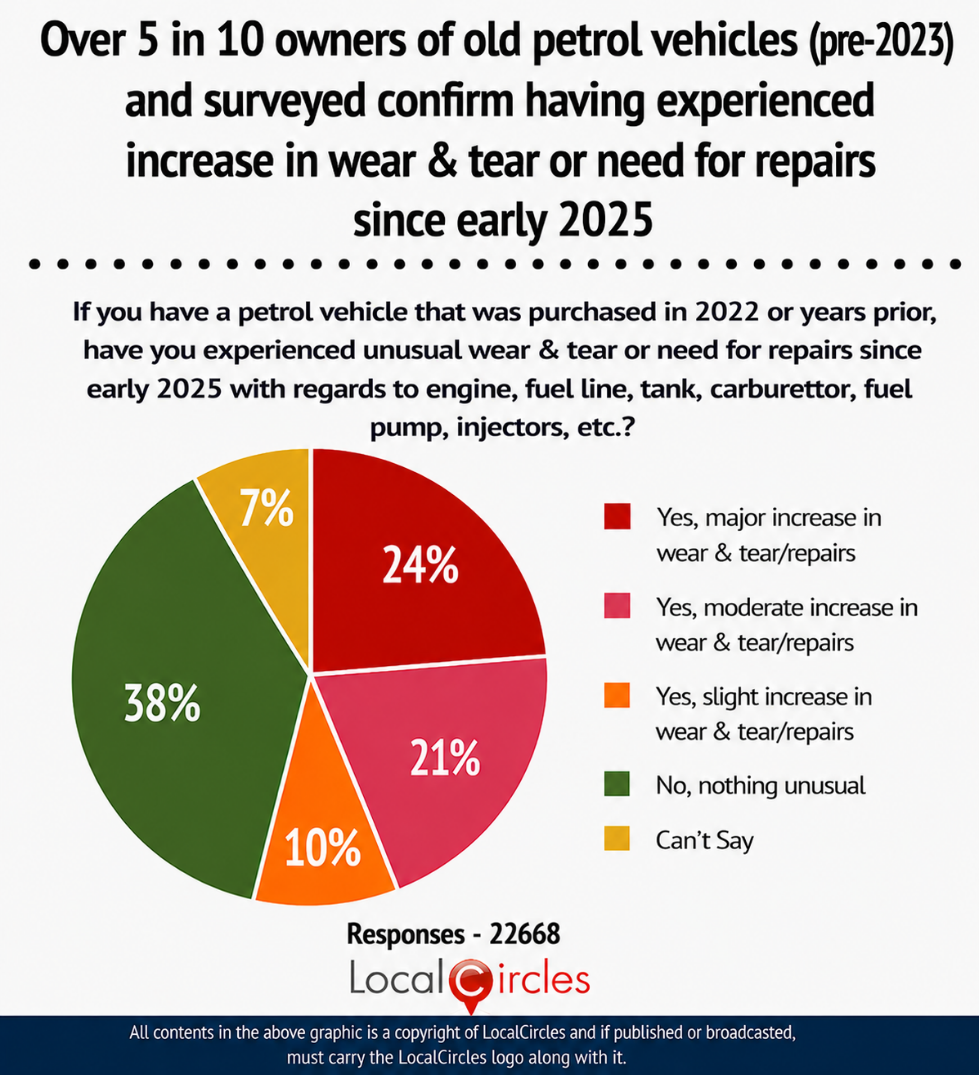
Over 5 in 10 owners of old petrol vehicles (pre-2023) surveyed confirm having experienced an increase in wear & tear or need for repairs since early 2025
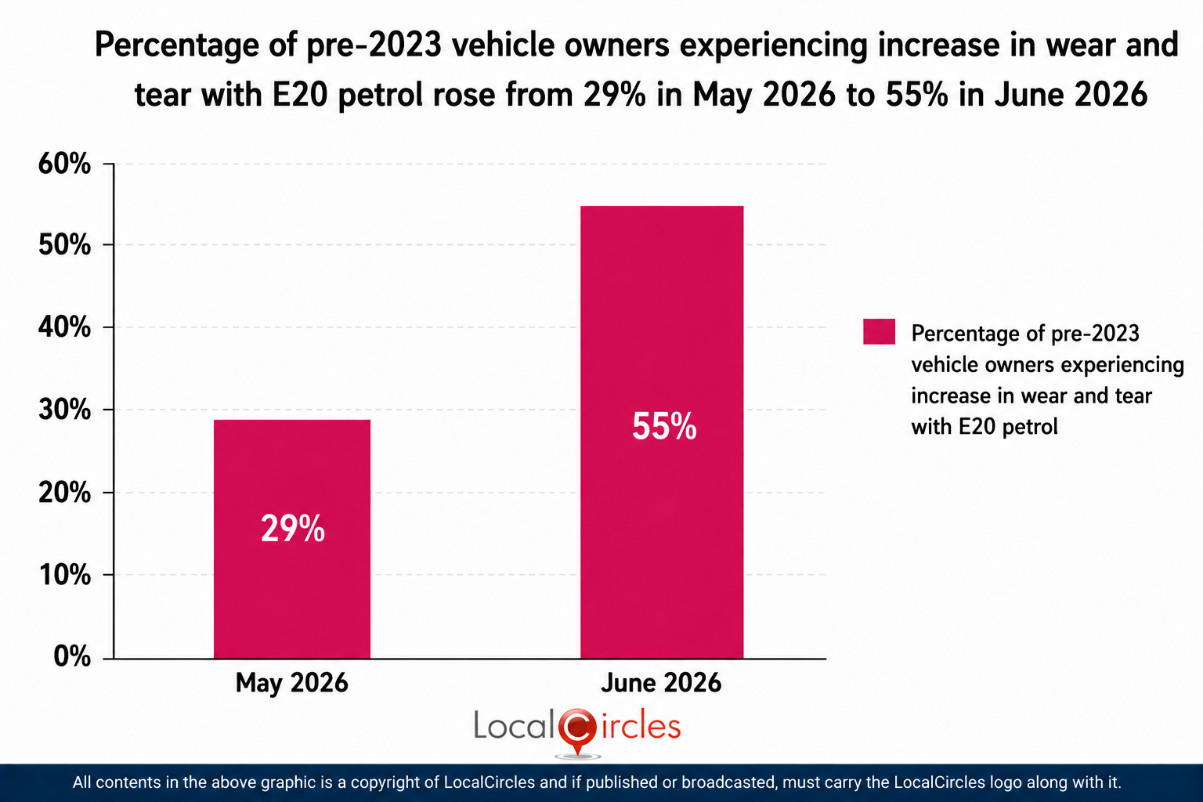
As many vehicle owners have complained on social media about more than usual wear and tear of their vehicles post usage of E20 petrol, the survey asked, “If you have a petrol vehicle that was purchased in 2022 or years prior, have you experienced an unusual level of wear & tear/need for repair since early 2025 with regards to engine, fuel line, tank, carburettor, fuel pump, injectors, etc.?” Out of 22,668 who responded to the question, 24% stated “yes, major increase in wear & tear/repairs”; 21% stated “yes, moderate increase in wear & tear/repairs”; 10% stated “yes, slight increase in wear & tear/repairs”; 38% stated “no, nothing unusual”; and 7% did not give a clear answer. To sum up, over 5 in 10 (55%) owners of pre-2023 petrol vehicles confirm having experienced an increase in wear & tear or need for repairs since early 2025 — nearly double the 29% recorded in the LocalCircles May 2026 survey.
Percentage of pre-2023 vehicle owners experiencing increase in wear and tear with E20 petrol rose from 29% in May 2026 to 55% in June 2026
The month-on-month comparison on vehicle condition is even starker than on mileage. The percentage of pre-2023 petrol vehicle owners reporting an increase in wear and tear with E20 petrol rose from 29% in May 2026 to 55% in June 2026 — an increase of 26 percentage points, or a 90% jump, in a single month. With more than half of older vehicles now reporting unusual wear and tear or a need for repairs, the risk of mounting maintenance costs and vehicles becoming un-roadworthy well before their permitted 15-year life is becoming a real and growing concern for owners.
Summary
In summary, the June 2026 study shows a rapid worsening of the E20 impact on older petrol vehicles within just one month. The share of pre-2023 petrol vehicle owners reporting a mileage drop of over 10% rose from 45% in May 2026 to 66% in June 2026, while the share reporting an unusual increase in wear & tear or need for repairs rose from 29% to 55% over the same period. These are increases of 21 and 26 percentage points respectively, indicating that owner-reported problems are escalating rather than settling as E20 usage continues. Importantly, these findings reflect the real, first-hand experience of vehicle owners — not viral social-media content. While the Government has rightly cautioned that misleading videos and images, such as clips falsely showing sugarcane juice mixed with petrol or ants gathering near fuel tanks, are being circulated to sensationalise the issue, such misleading material must not be confused with the genuine on-road experience of owners on mileage and increased wear and tear that this survey measures. It is this real consumer experience, on two specific and measurable parameters, that the data documents and that policy planners need to take seriously.
Whether the new higher-octane (RON 95) E20 standard and manufacturer retrofit kits will adequately address the issues facing owners of older petrol vehicles remains to be seen. In the interim, there is a clear need for policy planners to relook at the ethanol policy, as fuel efficiency must be treated as a priority alongside environmental and energy-security objectives, since these are interlinked. The finding that more than half of those surveyed have experienced unusual wear and tear, or a need for repair suggests that many vehicles could become un-roadworthy far sooner than the 15-year life fixed by the government for petrol vehicles. The government should seriously consider allowing consumers to choose petrol with lower blends of ethanol by making E0, E5 or E10 blends available at petrol pumps.
Survey Demographics
The survey received over 44,000 responses from owners of petrol vehicles (pre-2023) located across 305 districts of India. 67% of respondents were men while 33% were women. 43% of respondents were from tier 1, 29% from tier 2 and 28% from tier 3, 4 & 5 districts. The survey was conducted via the LocalCircles platform, and all participants were validated citizens who had to be registered with LocalCircles to participate in this survey.
About LocalCircles
LocalCircles, India’s leading Community Social Media platform enables citizens and small businesses to escalate issues for policy and enforcement interventions and enables Government to make policies that are citizen and small business centric. LocalCircles is also India’s # 1 pollster on issues of governance, public and consumer interest. More about LocalCircles can be found on https://www.localcircles.com
For more queries - media@localcircles.com, +91-8585909866
All content in this report is a copyright of LocalCircles. Any reproduction or redistribution of the graphics or the data therein requires the LocalCircles logo to be carried along with it. In case any violation is observed LocalCircles reserves the right to take legal action.
Enter your email & mobile number and we will send you the instructions.
Note - The email can sometime gets delivered to the spam folder, so the instruction will be send to your mobile as well


