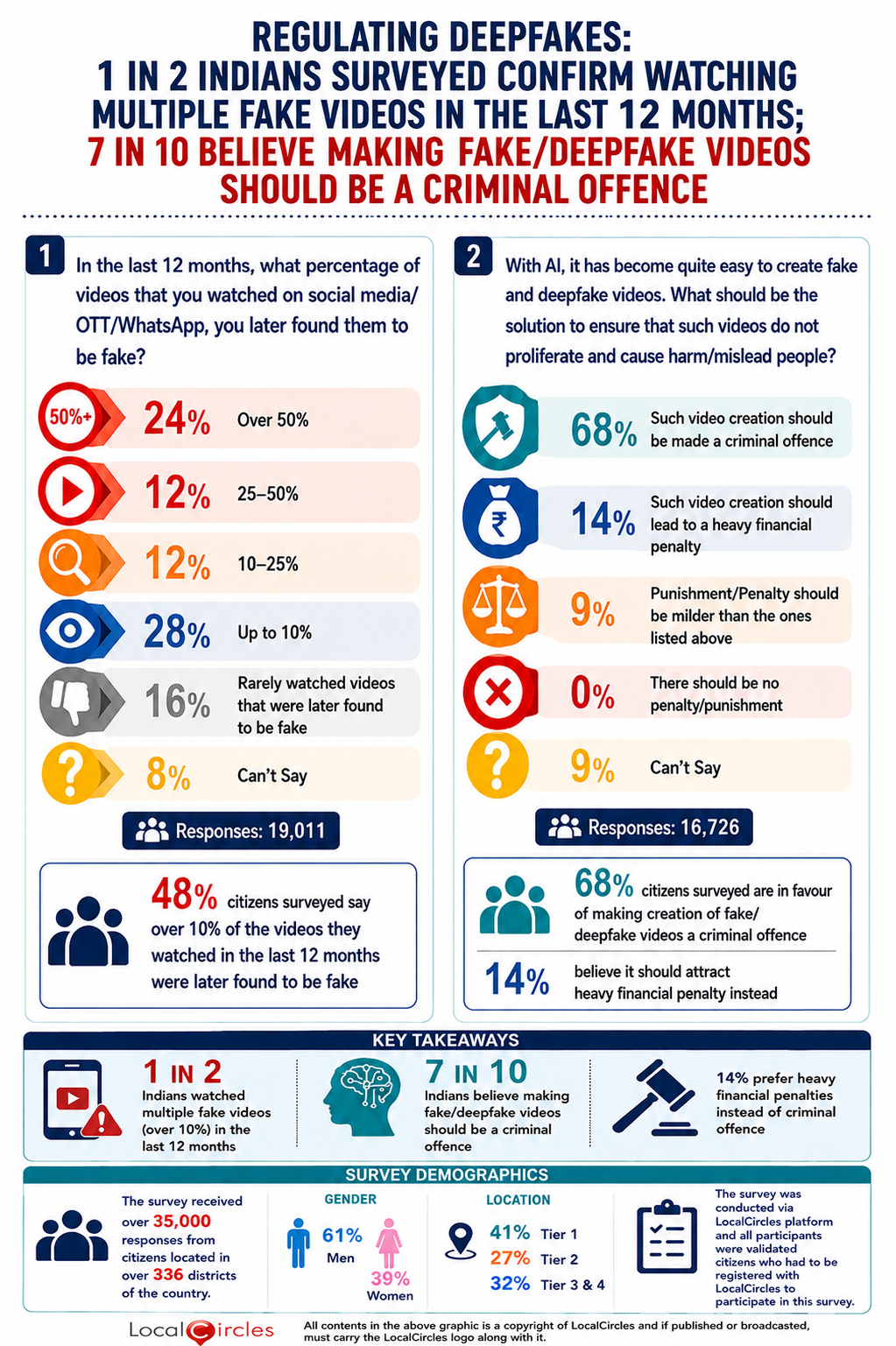
Regulating Deepfakes: 1 in 2 Indians surveyed confirm watching multiple fake videos in the last 12 months; 7 in 10 believe making fake/deepfake videos should be a criminal offence
- ● 14% of citizens surveyed feel such video creation should lead to a heavy financial penalty
August 7, 2026, New Delhi: As deepfakes move from a fringe curiosity to a mainstream threat, the Government of India is preparing to make their creation a distinct crime. The Centre has informed the Supreme Court that a dedicated Bill—seeking to define AI-generated deepfakes and digital arrest scams as standalone criminal offences—is under preparation and could be introduced in the ongoing Parliament session. The move follows the Court’s observation that existing laws do not specifically define these emerging offences, complicating investigation and prosecution. It also builds on the IT Rules amendments in force since February 20, 2026, which require intermediaries to prominently label AI-generated media and take down unlawful synthetic content within a fixed window. The pressure on platforms has sharpened in the days since: on August 3, 2026, a parliamentary standing committee told four of the world’s largest social media companies that they were failing to label AI-generated content as Indian law now requires, and on August 5 and 6, Meta’s executives are meeting IT ministry officials on the same set of issues.
The urgency is backed by hard numbers. Globally, the volume of deepfake files is estimated to have surged from about 500,000 in 2023 to roughly 8 million in 2025. In India, the Thales 2026 Data Threat Report found that 65% of organisations surveyed had experienced deepfake-driven attacks and 55% reported damage from AI-generated misinformation. A McAfee study, meanwhile, estimated that around 90% of Indians had encountered fake or AI-generated celebrity endorsements, with affected victims losing an average of Rs 34,500. Cybercrime complaints involving women have also climbed sharply, underscoring how non-consensual synthetic media is being weaponised. In the Supreme Court proceedings that prompted the Centre’s legislative move, it was submitted that Indians have lost over USD 5.5 billion to deepfake-aided and digital-arrest frauds over the past six years.
Created using AI that can convincingly superimpose faces, clone voices and fabricate realistic audio-visual content, deepfakes now go well beyond entertainment. They are used to spread misinformation, damage reputations, enable financial fraud and manipulate public discourse—risks that became especially visible during the 2024 Lok Sabha elections, when deepfake audio and video were deployed to confuse and mislead voters, and in the growing circulation of objectionable synthetic media targeting public figures without consent. The speed and scale at which such content spreads, particularly across social media and WhatsApp, make detection and debunking an uphill task for fact-checkers.
India’s response has shifted decisively from advisory to enforceable. Non-binding advisories in 2023 and 2024 have given way to the 2026 IT Rules, which impose stricter due-diligence duties on platforms—proactive identification and removal of deepfake content, labelling or watermarking of synthetic media where feasible, AI-based detection, and stronger grievance redressal. The proposed Bill would take this further by giving investigators explicit statutory offences to invoke, rather than stitching together provisions under the Bharatiya Nyaya Sanhita and the IT Act that were drafted before such crimes existed. Enforcement, however, remains the weak link. The Government’s own cyber-crime agency told Parliament this month that not one of the major platforms operating in India was complying with the labelling obligation.
Parliament and IT Ministry step up pressure on platforms over deepfake labelling
On August 5, 2026, the Parliamentary Standing Committee on Communications and Information Technology, chaired by BJP Lok Sabha MP Nishikant Dubey, met with senior executives of Meta (Facebook, Instagram and WhatsApp), Google/YouTube, X and Snap for a three-hour hearing on platform accountability. In a presentation to the committee, the CEO of the Indian Cyber Crime Coordination Centre (I4C), Rajesh Kumar, stated that none of the four platforms present was complying with the 2026 obligation to label synthetically generated information (SGI) — the statutory term that covers deepfakes. Committee members pressed the Government for a dedicated law on deepfakes and AI-generated content, and for independent audits of platform algorithms.
The hearing also underlined how hard redressal remains for ordinary citizens. Actor and BJP Lok Sabha MP Kangana Ranaut raised a viral deepfake video showing her being beaten, and was asked by Instagram’s India public policy head to share the URL so it could be actioned. The committee chairperson noted that even he, as a sitting Member of Parliament writing to the authorities, had been unable to get false content about himself taken down — prompting the question of what recourse an ordinary citizen is left with. Members also flagged X’s decision to stay off I4C’s Sahyog takedown portal and YouTube’s long compliance turnaround times, and sought data on how much content platforms had removed within the newly shortened three-hour takedown window, down from 36 hours. Meta’s executives have also begun two days of meetings with officials of the Ministry of Electronics and Information Technology (MeitY), scheduled for August 5 and 6. IT Secretary S. Krishnan said the talks would cover the framework under which Meta operates in India, the extent to which synthetically generated content is being addressed, child sexual abuse material, and safeguards for verified accounts of prominent personalities whose content is taken down.
Read together, the parliamentary hearing and the ministry’s talks with Meta point to the same conclusion citizens have reached: voluntary labelling commitments have not worked, and enforceable consequences are now on the table.
LocalCircles through a survey has strived to find out about citizens’ experience of deepfakes and sought their views on how it should be curbed. The survey received over 35,000 responses from citizens located in over 336 districts of the country. 61% respondents were men while 39% respondents were women. 41% respondents were from tier 1, 27% from tier 2 and 32% respondents were from tier 3 and 4 districts.
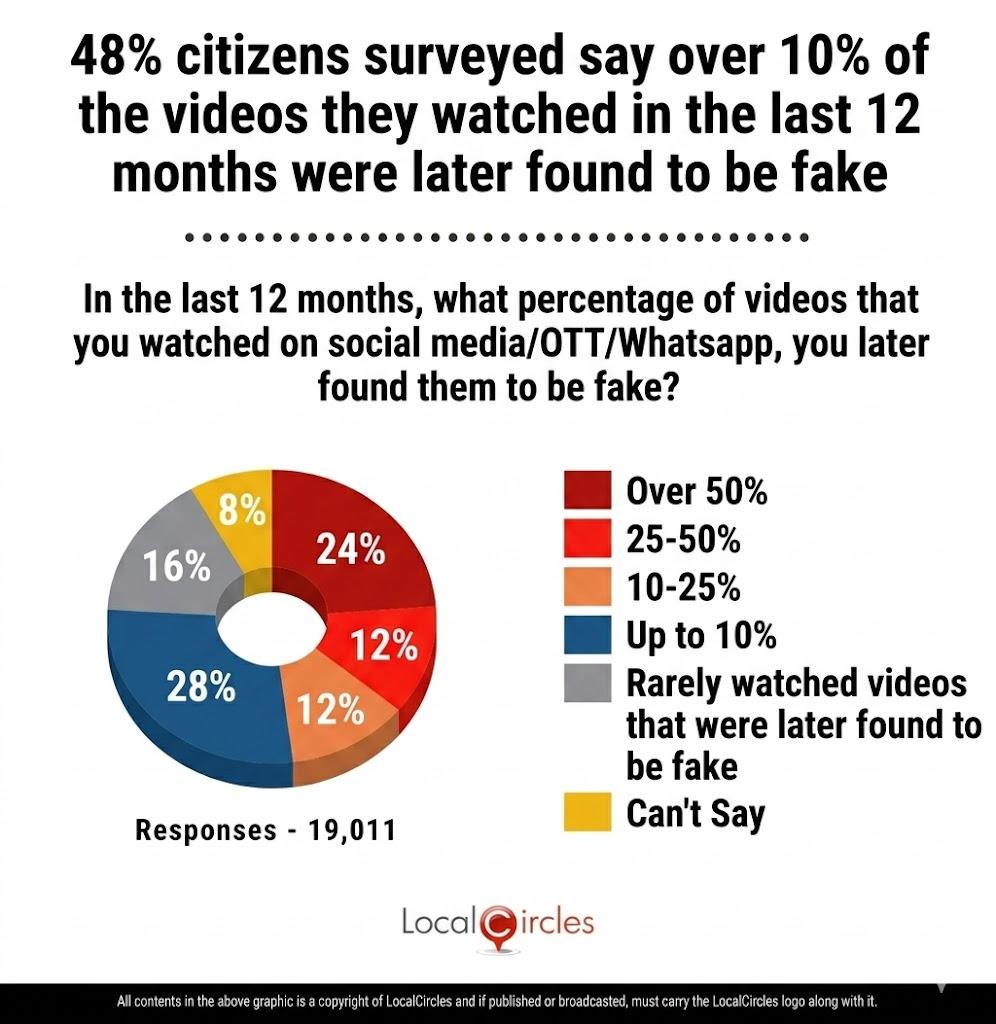
48% of citizens surveyed say over 10% of the videos they watched in the last 12 months were later found to be fake
People watch videos on several platforms particularly social media and WhatsApp, where they share what they think others in the group would like to view. These videos can be harmless humour or even malicious in content, intending to harm someone or spread misinformation. The survey first asked citizens, “In the last 12 months, what percentage of videos that you watched on social media/OTT/WhatsApp, you later found them to be fake? Out of 19,011 who responded to the question 22% stated “over 50%”; 11% of respondents stated “25-50%”; 11% of respondents stated "10-25%”; 26% of respondents stated “up to 10%”; 15% of respondents stated “rarely watched videos that were later found to be fake”; 7% of respondents did not give a clear answer and 8% of respondents stated “not applicable (do not watch videos at all). To sum up, 48% of citizens surveyed say over 10% of the videos they watched in the last 12 months were later found to be fake.
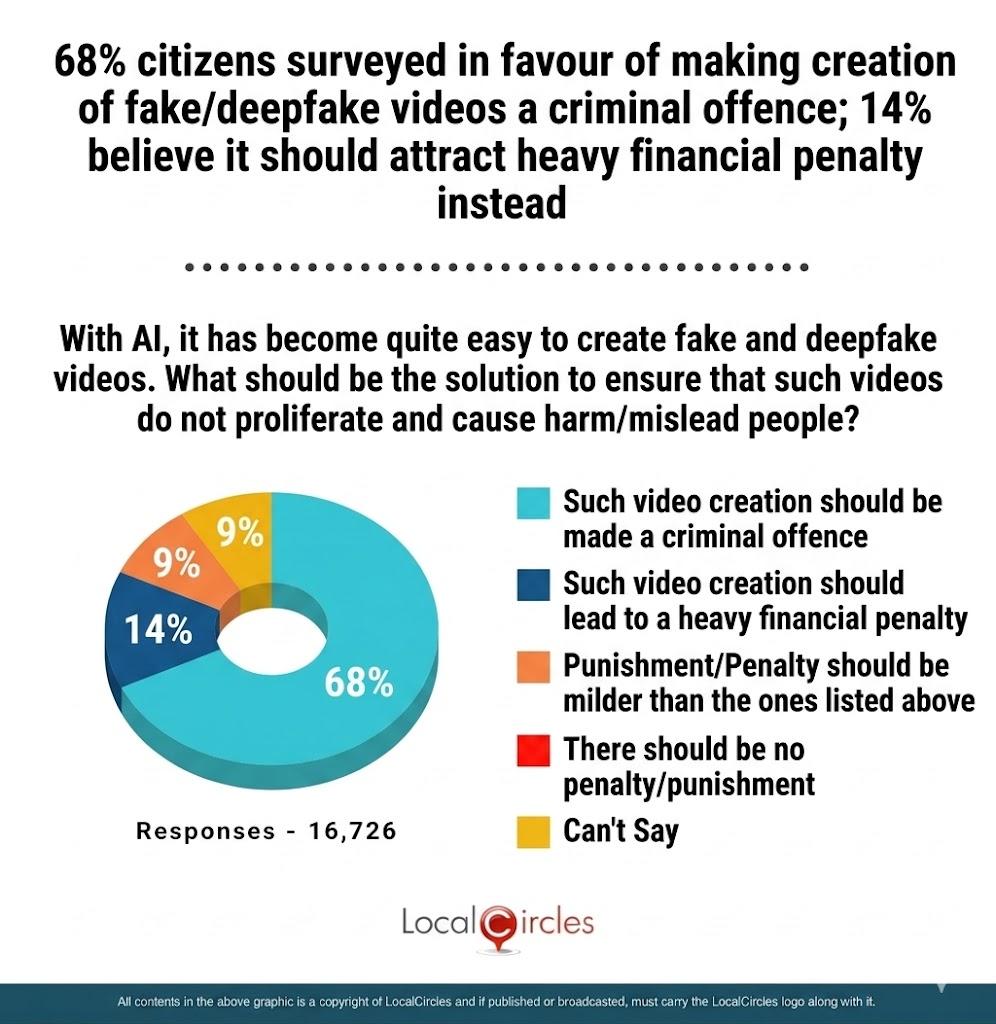
68% of citizens surveyed are in favour of making creation of fake/ deepfake videos a criminal offense; 14% believe it should attract a heavy penalty instead
With the rise in deepfakes and their wide-ranging impact on those targeted and the intended risk due to misinformation campaigns, the survey asked, “With AI, it has become quite easy to create fake and deepfake videos. What should be the solution to ensure that such videos do not proliferate and cause harm/mislead people?” Out of 16,726 who responded to the question 68% stated “such video creation should be made a criminal offence”; 14% stated “such video creation should lead to a heavy financial penalty”; 9% stated “punishment/penalty should be milder than the ones listed above”; and 9% of respondents did not give a clear answer. To sum up, 68% of citizens surveyed are in favour of making creation of fake/ deepfake videos a criminal offense; 14% believe it should attract a heavy penalty.
In summary, deepfake videos seem to be widely circulated as 48% of citizens surveyed say over 10% of the videos they had watched in the last 12 months were later found to be fake. Many people having witnessed or heard of the impact of fake/ deepfakes, it is not surprising that 68% of citizens surveyed are in favour of making creation of fake/ deepfake videos a criminal offense; 14% believe it should attract a heavy penalty.
This citizen sentiment closely mirrors the direction the Government is now taking. With a dedicated Bill on standalone criminal offences under preparation, clear statutory recognition of deepfake creation as a crime would strengthen investigations, improve conviction rates, and send an unambiguous signal that such acts constitute serious criminal conduct rather than harmless spoof. Parliament’s own scrutiny is moving in the same direction, with the standing committee this month questioning whether platforms that repeatedly fail to comply should continue to enjoy safe harbour.
Survey Demographics
The survey received over 35,000 responses from citizens located in over 336 districts of the country. 61% respondents were men while 39% respondents were women. 41% respondents were from tier 1, 27% from tier 2 and 32% respondents were from tier 3 and 4 districts. The survey was conducted via LocalCircles platform, and all participants were validated citizens who had to be registered with LocalCircles to participate in this survey.
About LocalCircles
LocalCircles, India’s leading Community Social Media platform enables citizens and small businesses to escalate issues for policy and enforcement interventions and enables Government to make policies that are citizen and small business centric. LocalCircles is also India’s # 1 pollster on issues of governance, public and consumer interest. More about LocalCircles can be found on https://www.localcircles.com
For more queries - media@localcircles.com, +91-8585909866
All content in this report is a copyright of LocalCircles. Any reproduction or redistribution of the graphics or the data therein requires the LocalCircles logo to be carried along with it. In case any violation is observed LocalCircles reserves the right to take legal action.


