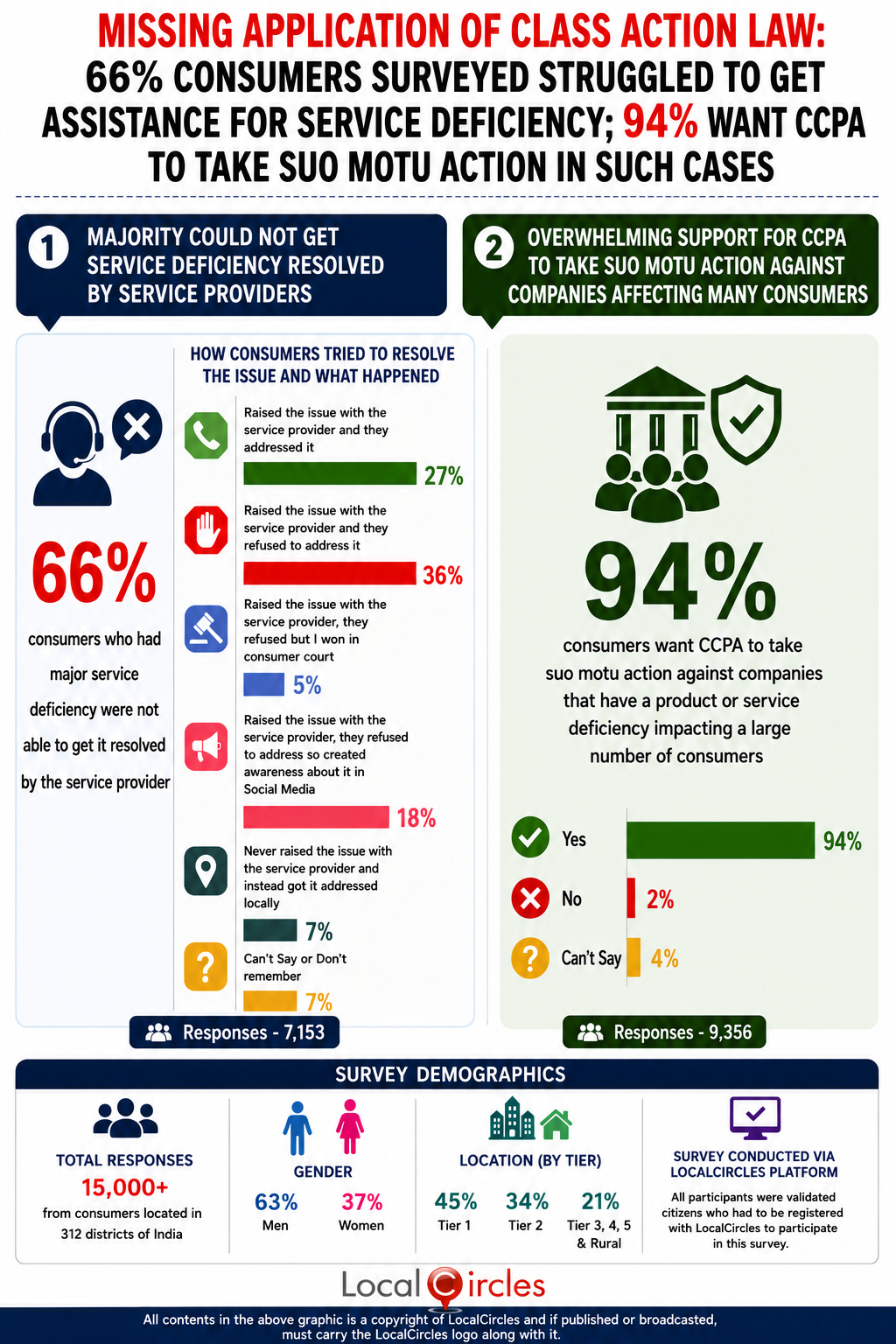
Missing application of Class Action Law: 66% consumers surveyed struggled to get assistance for service deficiency; 94% want CCPA to take Suo Motu action in such cases
- ● 36% consumers faced with service deficiency raised the issue with the provider who refused to redress it
- ● Brands facing Class Actions in USA/Europe escape accountability in India for the same products/services because of inability of CCPA to timely invoke Class Action provision of CP Act 2019
August 03, 2026, New Delhi: Without admitting wrongdoing, Apple has agreed to a proposed $250 million class-action settlement in the United States over allegations that it misled consumers by advertising Apple Intelligence and AI-powered Siri features that were unavailable when certain iPhone models launched. The lawsuit covers around 36 million eligible U.S. customers who purchased an iPhone 16 model or iPhone 15 Pro/Pro Max between June 10, 2024, and March 29, 2025. Subject to court approval, eligible claimants could receive between $25 and $95 per device.
The settlement raises an obvious question for India: why are Indian consumers, who may have faced similar issues with the same Apple product/service, unlikely to receive comparable relief? The Indian consumers collectively, despite raising issues against various services are unable to get the Central Consumer Protection Authority (CCPA) to invoke the Class Action provision of the Consumer Protection Act 2019 against companies like Apple, Uber or home grown Indigo.
In December 2025, thousands of IndiGo passengers were affected when the airline cancelled hundreds of flights—including more than 550 in a single day—without adequate prior notice or alternative arrangements. Likewise, Uber has faced complaints over alleged use of dark patterns and pricing practices that consumers say resulted in harassment and higher fares. Yet no class-action action followed in either case.
The only application of Class Action provision by CCPA has been in October 2024 where it initiated a class-action proceeding against Ola Electric after receiving more than 10,000 complaints regarding vehicle quality and after-sales service and prior to it, the Suo Motu action against online travel platform Yatra over delayed refunds for flight cancellations during the COVID-19 lockdown, directing the company to expedite refunds and establish a dedicated consumer support mechanism.
India's legal framework provides the CCPA with significant authority. The Consumer Protection Act, 2019 empowers the regulator to investigate violations of consumer rights, order recalls of unsafe goods and services, curb unfair trade practices and misleading advertisements, impose penalties, and file class-action complaints on behalf of consumers after a preliminary inquiry. These powers were introduced to strengthen consumer protection, particularly in an era of e-commerce and digital platforms.
Globally, authorities routine pull up brands for product or service deficiencies and impose heft penalties making them compensate the consumer. The deficiencies range from after sales services for gadgets to automobiles and from airline services to telecom services where brands pay compensation to consumers for such deficiencies. However, the same does not happen in India for the same products and services like it has been observed in the case of Apple. There has been no announcement or order from CCPA on the misleading advertising and product/service deficiency observed in iphone 16 and iphone 15 Pro/Pro Max.
LocalCircles through a new survey has sought to find out how consumers are faring under the new legislation that promised to get them faster resolution in the case of defective or deficient products/services. The survey received over 15,000 responses from consumers located in 312 districts of India.63% respondents were men while 37% respondents were women. 45% respondents were from tier 1, 34% from tier 2 and 21% respondents were from tier 3, 4, 5 & rural districts.
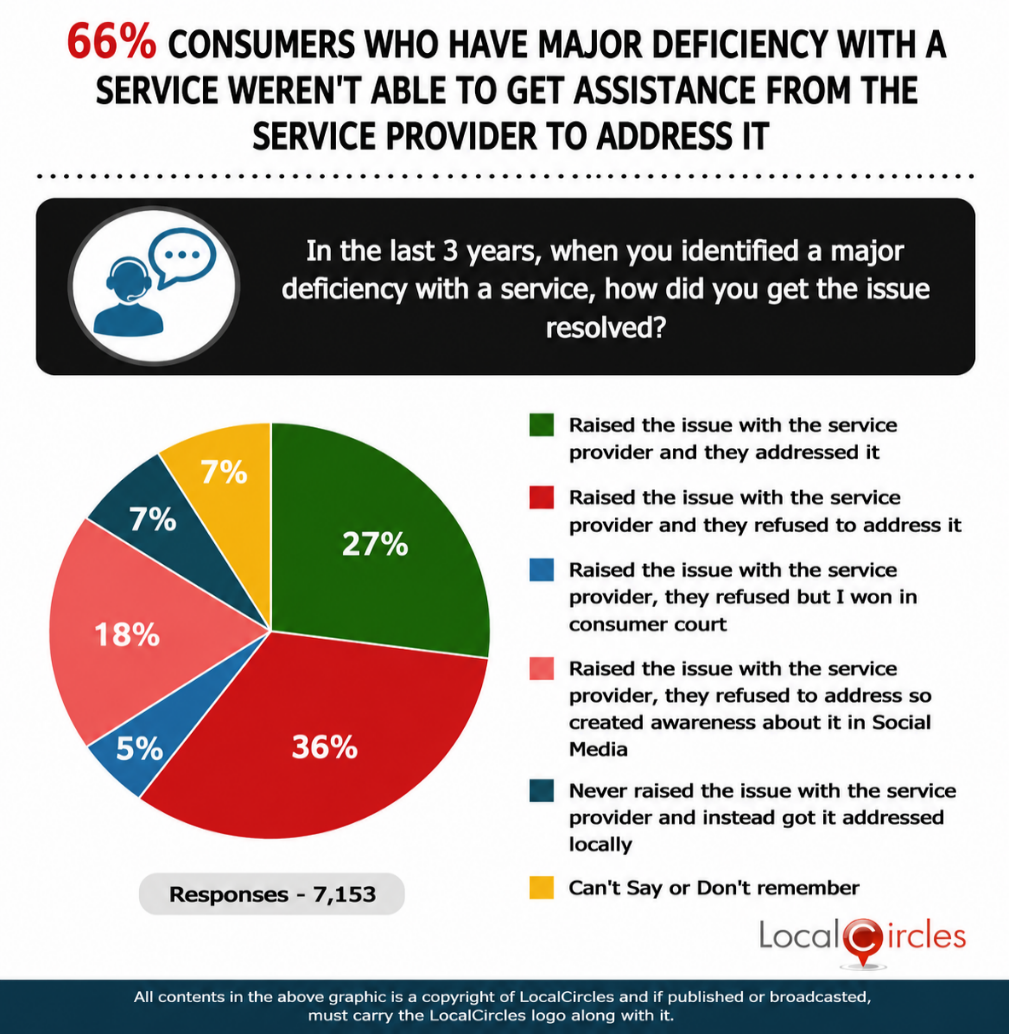
66% of consumers who have major deficiency with a service couldn’t get assistance from the service provider to address it
Many times, consumers feel cheated when they end up getting a defective product or poor service for which they may have paid a large sum but get no resolution in terms of replacement/ repair/ compensation. The survey asked consumers, “In the last 3 years, when you identified a major deficiency with a service, how did you get the issue resolved?” Out of 7,153 who responded to the question 27% indicated that they “raised the issue with the service provider and they addressed it”; 36% of respondents indicated that they “raised the issue with the service provider and they refused to address it”; 5% of respondents indicated that they “raised the issue with the service provider, they refused but I won in consumer court”; 18% of respondents indicated that they “raised the issue with the service provider, they refused to address so created awareness about it in Social Media”; 7% of respondents indicated that they “never raised the issue with the service provider and instead got it addressed locally”; and 7% of respondents did not give a clear answer. To sum up, 66% of consumers who have major deficiency with a service couldn’t get assistance from the service provider to address it.
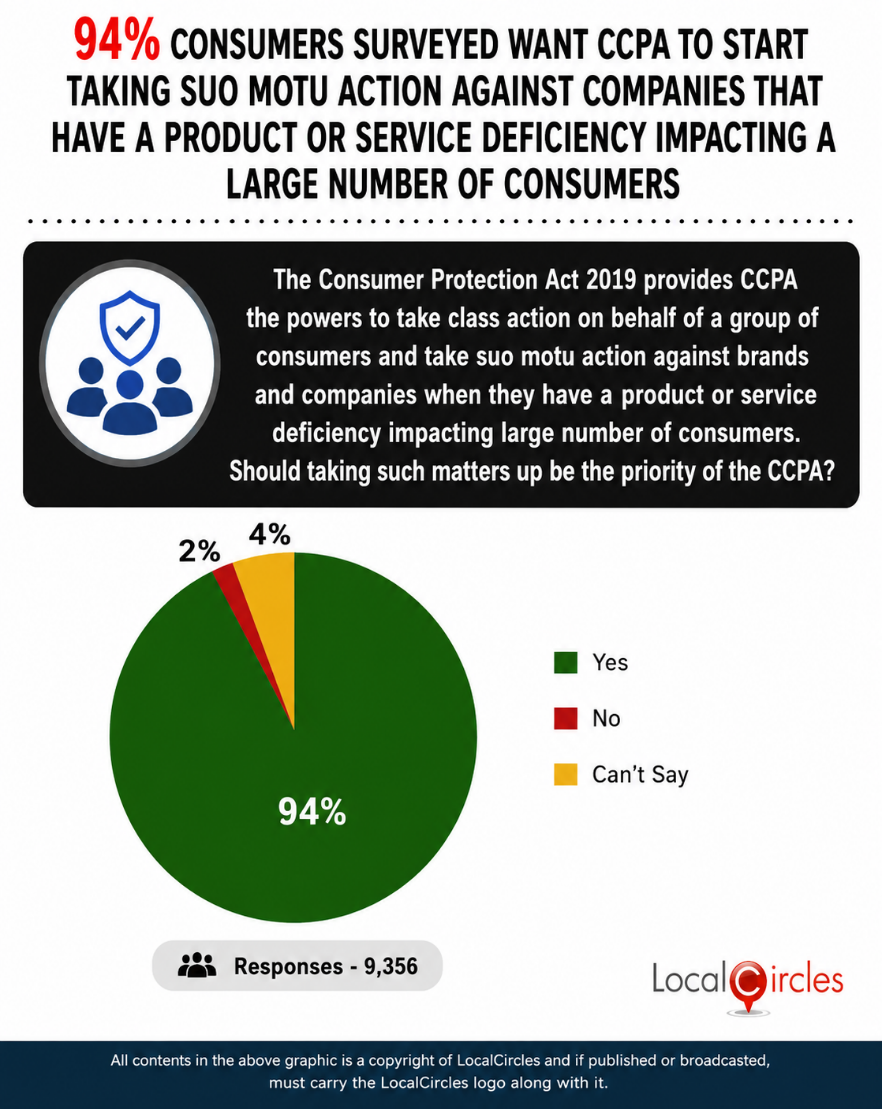
94% of consumers surveyed want CCPA to start taking Suo Motu action against companies that have a product or service deficiency impacting many consumers
When a large section of consumers is impacted by bad or defective product or service and there is no redressal, it is often the case when class action is contemplated. The survey asked consumers, “The Consumer Protection Act 2019 provides CCPA the powers to take class action on behalf of a group of consumers and take Suo Motu action against brands and companies when they have a product or service deficiency impacting large number of consumers. Should taking such matters up be the priority of the CCPA?” Out of 9,356 who responded to the question 94% indicated “yes” taking such matters up should be the priority of the CCPA; 2% of respondents indicated “no” and 4% of respondents did not give a clear reply. In essence, 94% of consumers surveyed want CCPA to start taking Suo Motu action against companies that have a product or service deficiency impacting many consumers.
In summary, the study shows that 66% of consumers surveyed who have had major deficiency with a service weren't able to get assistance from the service provider to address it. The result is that 94% of consumers surveyed want CCPA to start taking Suo Motu action against companies that have a product or service deficiency impacting many consumers.
The absence of class-action intervention in several high-profile consumer disputes raises questions about the consistency of India's consumer protection regime. Whether it is Apple's alleged misleading AI advertising, IndiGo's mass flight disruptions, or complaints against Uber and other app-based taxi platforms over alleged dark patterns and unfair pricing, the Central Consumer Protection Authority (CCPA) has largely refrained from exercising its class-action powers despite widespread consumer grievances.
In IndiGo's case last December, thousands of passengers reportedly suffered financial losses, missed important personal and business commitments, and endured significant inconvenience after large-scale flight cancellations and delays. Many families, including those travelling during the peak wedding season, were left stranded for hours without adequate assistance. These are precisely the kinds of cases the Consumer Protection Act, 2019 envisaged for collective action. Consistent and timely use of the Class Action provision by CCPA powers would not only provide relief to affected consumers but also strengthen corporate accountability and deter unfair trade practices.
Survey Demographics
The survey received over 15,000 responses from consumers located in 312 districts of India.63% respondents were men while 37% respondents were women. 45% respondents were from tier 1, 34% from tier 2 and 21% respondents were from tier 3, 4, 5 & rural districts. The survey was conducted via LocalCircles platform, and all participants were validated citizens who had to be registered with LocalCircles to participate in this survey.
About LocalCircles
LocalCircles, India’s leading Community Social Media platform enables citizens and small businesses to escalate issues for policy and enforcement interventions and enables Government to make policies that are citizen and small business centric. LocalCircles is also India’s # 1 pollster on issues of governance, public and consumer interest. More about LocalCircles can be found on https://www.localcircles.com
For more queries - media@localcircles.com, +91-8585909866
All content in this report is a copyright of LocalCircles. Any reproduction or redistribution of the graphics or the data therein requires the LocalCircles logo to be carried along with it. In case any violation is observed LocalCircles reserves the right to take legal action.


