Locked out of their own money: Over 5 in 10 Indian banking users surveyed confirm facing delays or difficulties in withdrawing their own money in the last 3 years due to bank’s processes
- ●67% of Indian banking users surveyed confirmed facing repeated KYC requests despite completing them earlier as the most inconvenient banking issue in the last 3 years
- ● 58% of Indian banking users surveyed say significant stress and anxiety has been the biggest impact when bank processes prevented or delayed access to their own money
- ● Nationwide survey receives 114,000 responses across 307 districts of India
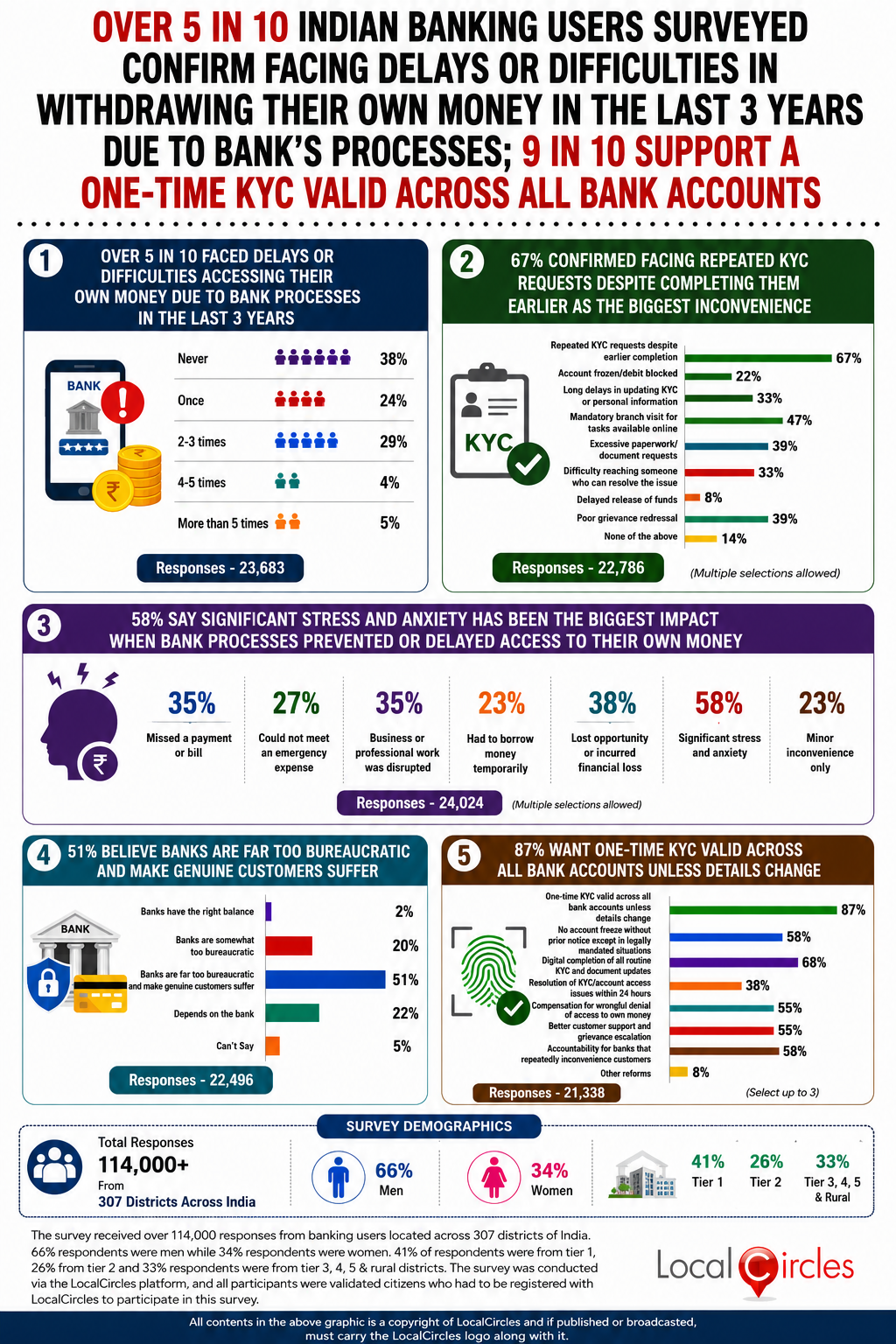
September 28, 2026, New Delhi: Over 5 in 10 Indian banking users surveyed say they have faced delays or difficulties in accessing their own money in the last three years because of their bank’s processes, and nearly 4 in 10 have faced it more than once. Repeated KYC requests despite having completed them earlier (67%) and mandatory branch visits for tasks that should be available online (47%) are the most cited grievances. The toll is real: 58% say the biggest impact has been significant stress and anxiety, 38% lost interest, a business opportunity or money, and 35% missed a payment or bill. Only 2% believe banks have got the balance between fraud prevention and customer convenience right, while 87% want a one-time KYC valid across all their bank accounts. The LocalCircles national survey received over 114,000 responses from banking users across 307 districts of India.
The findings come as the United Forum of Bank Unions (UFBU) deferred its three-day nationwide strike planned for September 28 to 30, following late-night talks with the Indian Banks’ Association on September 27. While customers have been spared an extended branch closure, the everyday frictions they face in dealing with their banks remain unresolved. Re-KYC, reactivation of frozen or inoperative accounts, release of debit-blocked funds and in-person document verification continue, in practice, to require a trip to the branch — and it is precisely these processes that banking users say have kept them from their own money over the last three years.
India’s banking system today serves well over a billion account holders and processes more digital transactions than any other country in the world. Yet for a growing number of citizens, the difficulty is no longer opening an account or making a payment — it is getting access to money that is already theirs.
Over the last three years, repeated Know Your Customer (KYC) requests, sudden account freezes, debit blocks pending fresh documentation and long waits at branches for tasks that ought to be completed online have become a recurring feature of everyday banking. The Reserve Bank of India (RBI) has itself acknowledged the scale of the problem: customer grievances against banks rose 14% in 2025 as per the RBI Annual Report 2025-26.
The KYC process, in particular, has emerged as the single biggest point of friction between banks and their customers. RBI Governor Sanjay Malhotra has publicly urged banks to stop repeatedly calling customers for KYC documents, describing the practice as an “avoidable inconvenience” and pointing out that most banks and NBFCs have still not enabled their branches to retrieve records from the Central KYC Records Registry (CKYCR), which is precisely why the same customer is asked for the same documents again and again.
The Governor has also warned banks against misclassifying customer complaints to suppress numbers, terming it a “gross regulatory violation”, and asked senior management to review customer service at least once a week. The RBI has since amended its KYC Master Direction to make periodic updation strictly risk-based, permit business correspondents and video-based customer identification for re-KYC, mandate advance intimations and reminders before an account is restricted and require OTP-based retrieval of records from CKYCR — with banks directed to implement the changes by January 1, 2026, and low-risk customers given until June 30, 2026, to complete pending updation.
Running alongside this is the sharp escalation in account freezes triggered by the national crackdown on cyber fraud. Between September 2024 and January 2026, the Indian Cyber Crime Coordination Centre shared details of more than 27 lakh suspected “Layer 1” mule accounts with financial institutions, helping block transactions worth over ₹9,518 crore. While the intent is unquestionably sound — Indians lost ₹22,495 crore to cyber fraud in 2025 across 28.1 lakh complaints — the blunt application of freezes has drawn ordinary customers into the net.
A single cyber fraud investigation in Faridabad alone triggered freezing of over 36,000 bank accounts across the country, many of them flagged simply for having received small sums linked to a larger scam. The Delhi High Court has urged the Ministry of Home Affairs to frame a uniform policy and standard operating procedure for such freezes, observing that “innocent recipients bear the brunt”, and in a January 2026 ruling held that the mere possibility of an offence does not by itself justify unilaterally freezing accounts without informing the customer of the reasons.
More recently, the Rajasthan High Court, in its August 20, 2026, judgment in Shree Balaji Enterprises v. Reserve Bank of India, laid down statewide guidelines against indiscriminate and indefinite freezing of bank accounts in cyber fraud investigations, including cases where accounts had been frozen over sums as small as ₹100. The Court held that where the disputed amount is identifiable, only that amount should be placed under lien instead of freezing the entire account, that freezes cannot continue indefinitely merely because an investigation is pending, and that a restraint must be withdrawn forthwith once no link to the offence is found.
At the national level, the Supreme Court, in its August 4, 2026, order in the suo motu matter In Re: Victims of Digital Arrest, directed the RBI to prepare and circulate a standard operating procedure for dealing with bank accounts linked to cyber fraud, and asked courts to prioritise cases involving frozen accounts. Following this, on September 11, 2026, the RBI released draft amendments to its KYC directions under which banks would have to immediately inform account holders of any hold placed on their account along with the reasons, and release the hold within 60 days unless a law enforcement agency or competent authority directs otherwise. The draft also requires that holds on an entire account be used only as a last resort. The draft, however, does not provide for interest or compensation to customers whose funds are held wrongly. Public comments on the draft have been invited till October 2, 2026, and the framework is proposed to take effect from April 1, 2027.
The regulatory response has continued into this year. The revamped Reserve Bank – Integrated Ombudsman Scheme (RB-IOS), 2026, which came into effect on July 1, 2026, raises the compensation a customer can seek to ₹33 lakh — up to ₹30 lakh for consequential financial loss arising from deficiency in service and up to ₹3 lakh for the complainant’s time, expenses, harassment and mental anguish — against ₹20 lakh and ₹1 lakh respectively under the 2021 framework. The enhanced compensation for harassment and mental anguish is a tacit acknowledgement that the cost of being locked out of one’s own account is not merely financial.
Against this backdrop, LocalCircles conducted a national survey to assess how widespread these difficulties are, what they cost citizens, and what reforms banking users want RBI and banks to implement. The key findings of the survey are detailed below.
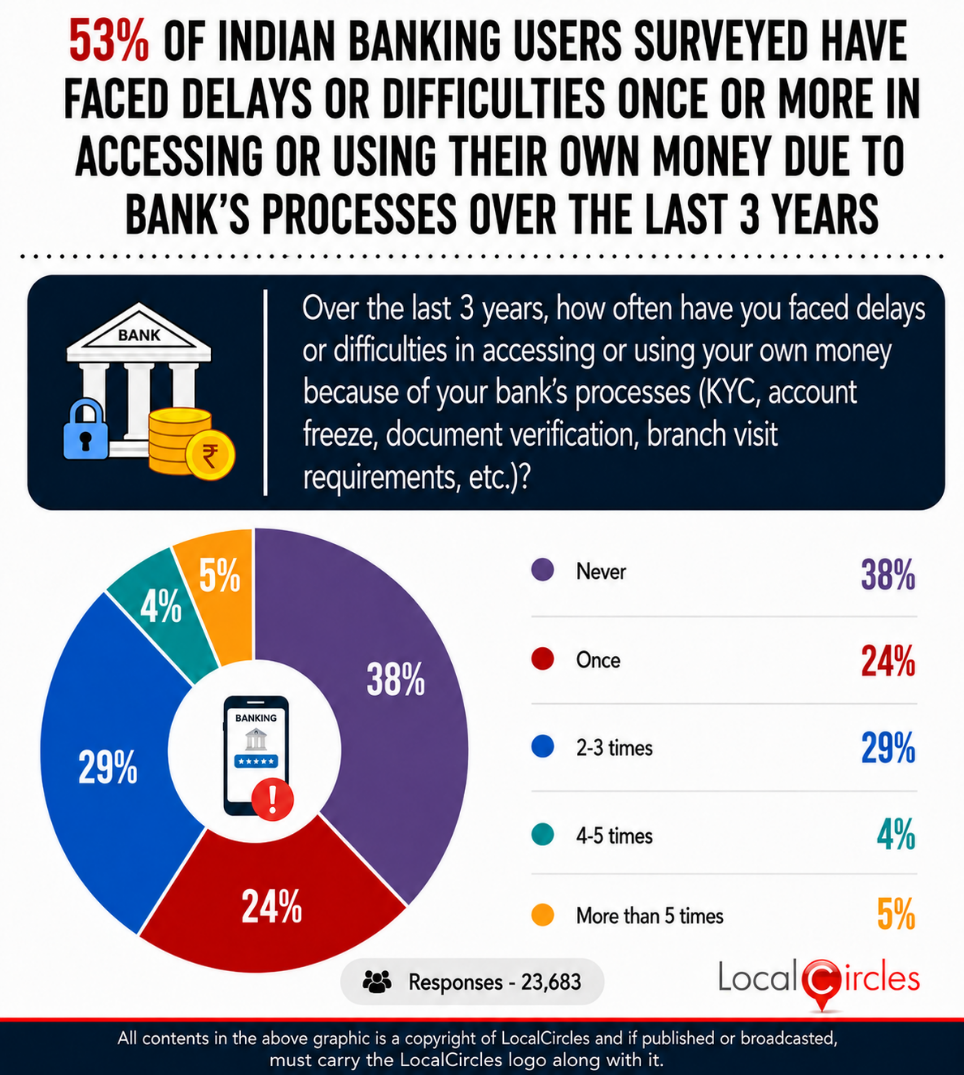
53% of Indian banking users surveyed have faced delays or difficulties once or more in accessing or using their own money due to bank’s processes over the last 3 years
To establish how common the problem is, the survey asked banking users, “Over the last 3 years, how often have you faced delays or difficulties in accessing or using your own money because of your bank’s processes (KYC, account freeze, document verification, branch visit requirements, etc.)?” This question received 23,683 responses. In response, 38% said never, while 24% said once, 29% said 2-3 times, 4% said 4-5 times and 5% said more than 5 times. In effect, 53% of banking users surveyed — over 5 in 10 — have been held up between one and three times in the last three years while trying to access money that already belonged to them, and a further 9% have faced it on four or more occasions. For the majority of banking users, therefore, this is not a one-off administrative hiccup but a recurring feature of their relationship with their bank.
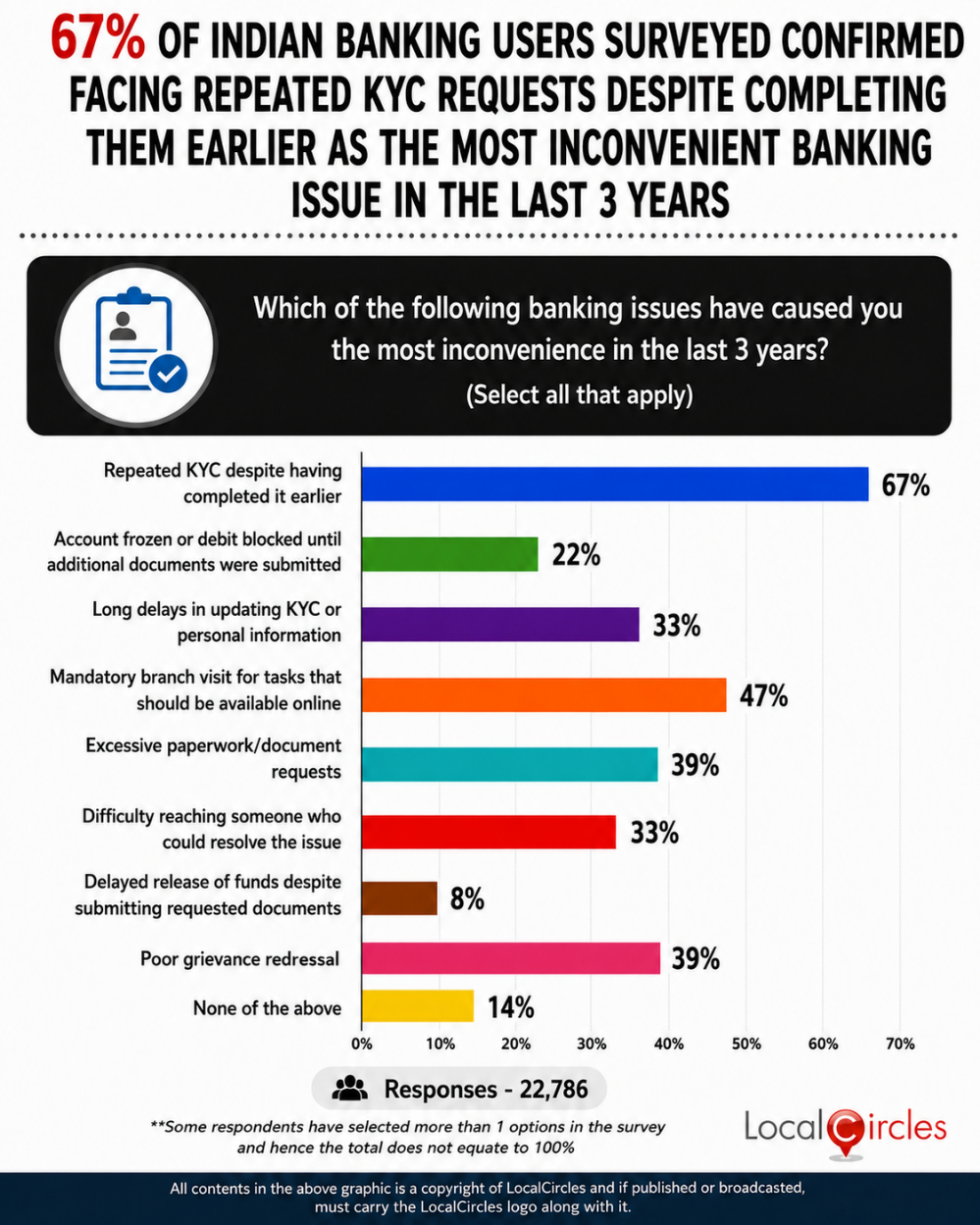
67% of Indian banking users surveyed confirmed facing repeated KYC requests despite completing them earlier as the most inconvenient banking issue in the last 3 years
The survey next sought to identify which specific bank processes cause the most difficulty, asking, “Which of the following banking issues have caused you the most inconvenience in the last 3 years?” This question received 22,786 responses, with respondents able to select more than one option. In response, 67% pointed to repeated KYC despite having completed it earlier, making it by a wide margin the single most cited grievance. This was followed by 47% citing mandatory branch visits for tasks that should be available online, 39% each flagging excessive paperwork or document requests and poor grievance redressal, and 33% each reporting long delays in updating KYC or personal information and difficulty reaching someone who could actually resolve the issue. Another 22% said their account was frozen or debit blocked until additional documents were submitted, while 8% reported delayed release of funds despite having submitted the requested documents. Only 14% selected none of the above. The pattern closely mirrors the concerns the RBI Governor has raised with banks — that customers are being asked repeatedly for information the system already holds, and are being made to travel to branches for work that ought to be fully digital.
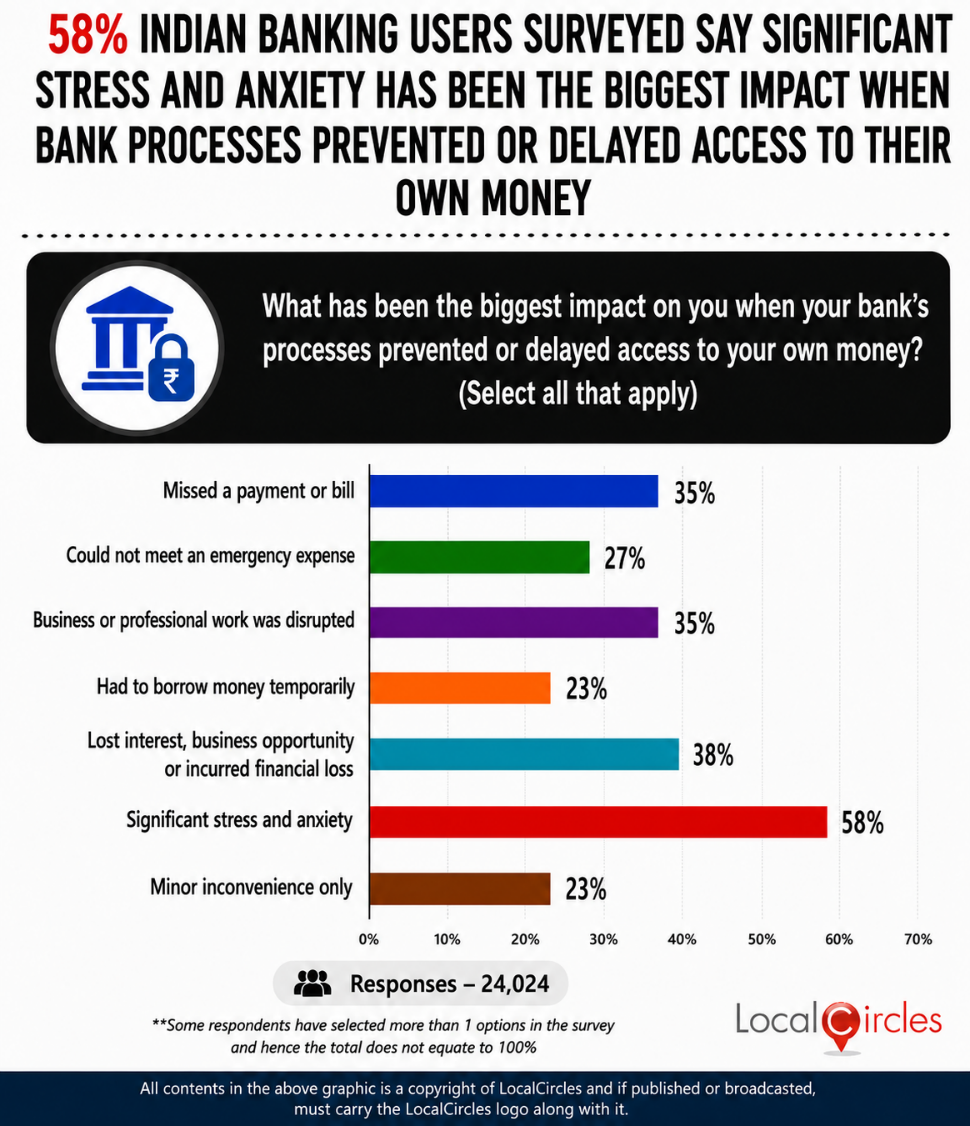
58% of Indian banking users surveyed say significant stress and anxiety has been the biggest impact when bank processes prevented or delayed access to their own money
To understand what these delays actually cost citizens, the survey asked, “What has been the biggest impact on you when your bank’s processes prevented or delayed access to your own money?” This question received 24,024 responses, with respondents able to select more than one option. In response, 58% reported significant stress and anxiety, making it the single largest impact. This was followed by 38% who lost interest, a business opportunity or incurred a financial loss, 35% each who missed a payment or bill and whose business or professional work was disrupted, 27% who could not meet an emergency expense, and 23% who had to borrow money temporarily. Only 23% described the experience as a minor inconvenience. The findings make it clear that for the overwhelming majority, being locked out of one’s own account carries a real emotional and financial cost — a point the revamped Ombudsman scheme now recognises through enhanced compensation for harassment and mental anguish.
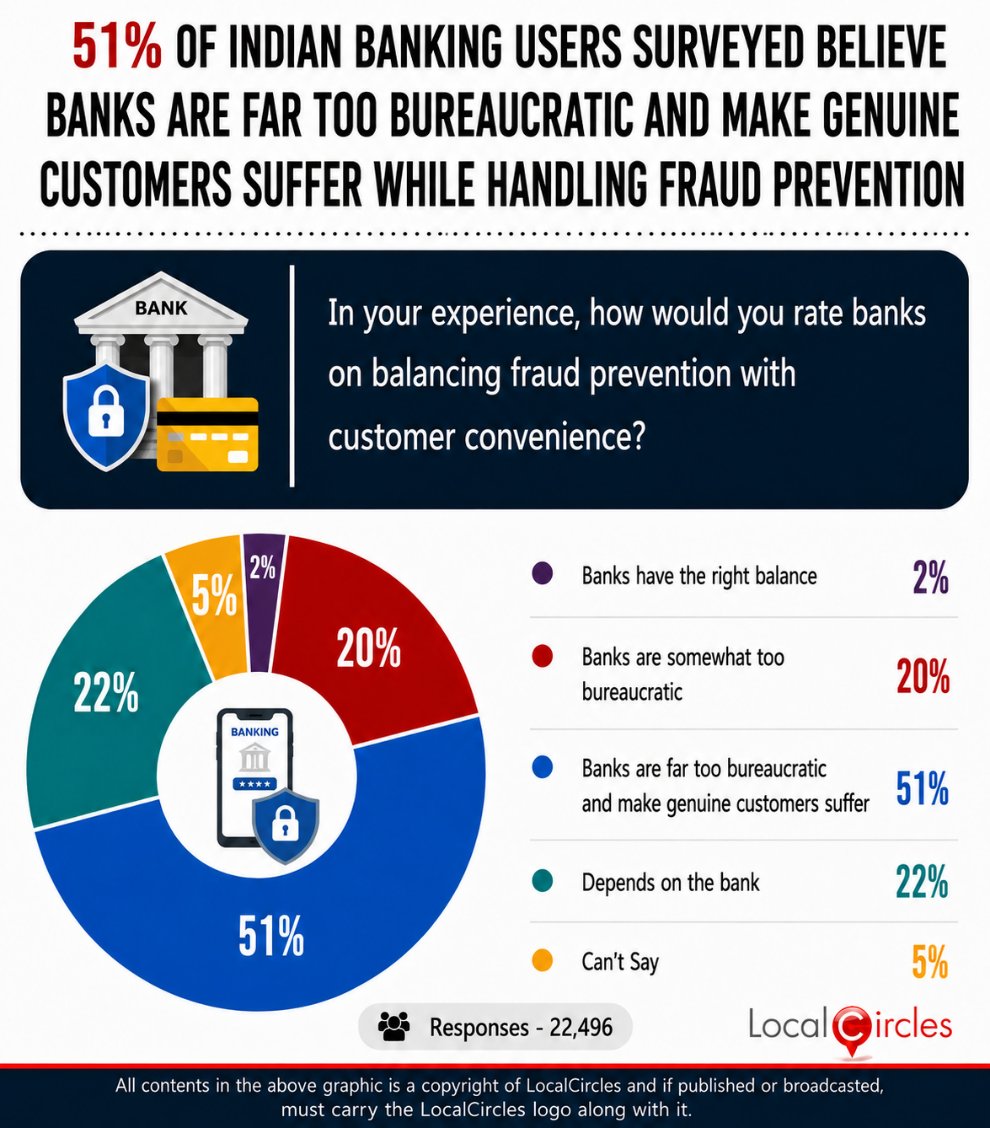
51% of Indian banking users surveyed believe banks are far too bureaucratic and make genuine customers suffer while handling fraud prevention
With banks under regulatory and law enforcement pressure to curb mule accounts and digital fraud, the survey asked users how well banks are striking the balance: “In your experience, how would you rate banks on balancing fraud prevention with customer convenience?” This question received 22,496 responses. In response, only 2% said banks have the right balance, while 51% said banks are far too bureaucratic and make genuine customers suffer and another 20% said banks are somewhat too bureaucratic. A further 22% said it depends on the bank and 5% could not say. Taken together, 71% of banking users surveyed believe banks are erring on the side of bureaucracy at the customer’s expense. Citizens are not questioning the need for fraud controls — they are questioning why the burden of those controls falls so heavily on customers who have done nothing wrong. The Supreme Court’s August 2026 directions, the Rajasthan High Court’s August 2026 guidelines limiting restraints to the disputed amount, and the RBI’s September 2026 draft framework on account holds are a step towards correcting this imbalance, though the framework is yet to be finalised.
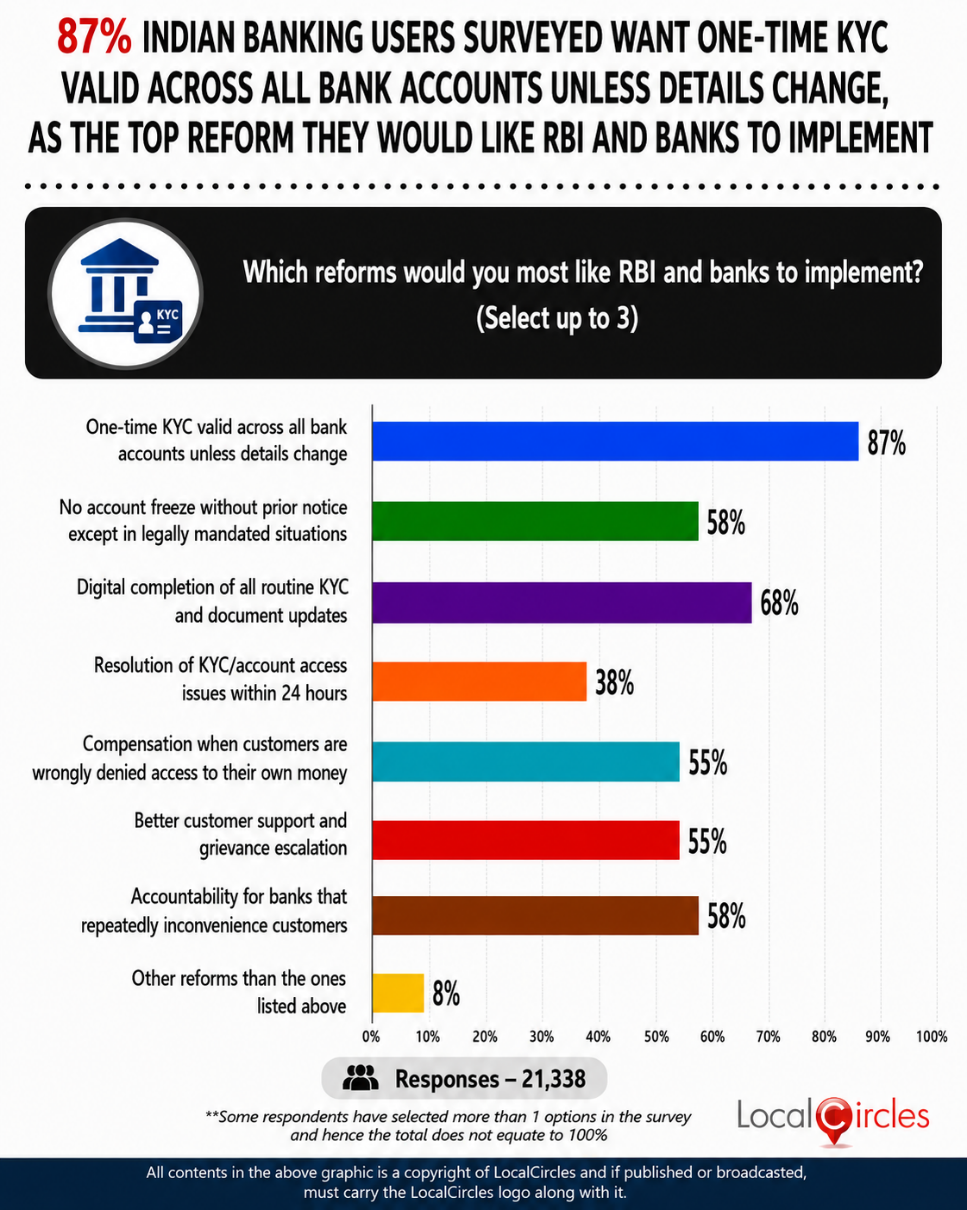
87% of Indian banking users surveyed want one-time KYC valid across all bank accounts unless details change, as the top reform they would like RBI and banks to implement
Finally, the survey asked banking users, “Which reforms would you most like RBI and banks to implement?” This question received 21,338 responses, with respondents able to select up to three options. In response, an overwhelming 87% wanted a one-time KYC valid across all bank accounts unless details change, followed by 68% who wanted digital completion of all routine KYC and document updates. Another 58% sought no account freeze without prior notice except in legally mandated situations and accountability for banks that repeatedly inconvenience customers, while 55% each want compensation when customers are wrongly denied access to their own money and better customer support and grievance escalation. A further 38% wanted resolution of KYC or account access issues within 24 hours, and 8% cited other reforms. Notably, the top two demands are precisely what the CKYCR was designed to deliver — a single, portable KYC record that any regulated entity can retrieve digitally with the customer’s consent — indicating that the gap lies not in policy intent but in implementation at the branch level. The RBI had also amended its KYC Master Direction in December 2025 to make the bank or NBFC that last uploads or updates a customer’s record in the CKYCR fully responsible for verifying it, allowing other regulated entities to rely on that record without fresh verification. As recently as this month, the RBI penalised a co-operative bank for, among other lapses, failing to upload customers’ KYC records to the CKYCR within the prescribed timeline.
In Summary
The survey findings indicate that difficulty in accessing one’s own money has become a mainstream banking experience in India rather than an exception. With 53% of banking users surveyed reporting such delays between one and three times in the last three years and a further 9% facing them four or more times, and with 67% identifying repeated KYC requests as the single most inconvenient issue, the evidence points to a systemic gap between the RBI’s stated policy and what customers actually encounter at the branch counter. The impact is far from trivial: 58% report significant stress and anxiety, 38% lost interest, a business opportunity or incurred a financial loss, and 35% each missed a payment or had their professional work disrupted. Only 2% believe banks have got the balance between fraud prevention and customer convenience right, while a combined 71% believe banks are too bureaucratic — findings that align closely with the RBI Governor’s own assessment that repeated KYC calls are an avoidable inconvenience and that banks have failed to enable branch-level access to the central KYC database.
Most tellingly, 87% of banking users surveyed want a one-time KYC valid across all bank accounts unless details change, and 68% want all routine KYC and document updates completed digitally — both of which the Central KYC Records Registry and the amended KYC Master Direction already envisage. A combined majority also want procedural protections that go beyond KYC: no account freeze without prior notice except where legally mandated, compensation when customers are wrongly denied access to their own money, accountability for banks that repeatedly inconvenience customers, and resolution of account access issues within 24 hours. The message from banking users is clear: fraud controls and compliance cannot come at the cost of honest customers being locked out of their own money, and banks must now deliver on the customer-centric standard that regulators have already set.
LocalCircles will be escalating these findings to the Reserve Bank of India, the Department of Financial Services under the Ministry of Finance and other relevant authorities, so that the citizen pulse on banking access can lead to supervisory action on KYC implementation, the framing of a uniform standard operating procedure for account freezes, including early finalisation of the RBI’s draft framework on account holds, and the effective implementation of the revamped Integrated Ombudsman Scheme. With the June 30, 2026, deadline for low-risk KYC updation now behind us, RB-IOS 2026 in force since July 1, and the RBI’s draft framework on account holds open for public comment till October 2, 2026, these findings offer timely and representative input on whether the customer-centric intent of these reforms is reaching the account holder.
Survey Demographics
The survey received over 114,000 responses from banking users located across 307 districts of India. 66% of respondents were men while 34% of respondents were women. 41% of respondents were from tier 1, 26% from tier 2 and 33% of respondents were from tier 3, 4, 5 & rural districts. The survey was conducted via the LocalCircles platform, and all participants were validated citizens who had to be registered with LocalCircles to participate in this survey.
About LocalCircles
LocalCircles, India’s leading Community Social Media platform enables citizens and small businesses to escalate issues for policy and enforcement interventions and enables Government to make policies that are citizen and small business centric. LocalCircles is also India’s # 1 pollster on issues of governance, public and consumer interest. More about LocalCircles can be found on https://www.localcircles.com
For more queries - media@localcircles.com, +91-8585909866
All content in this report is a copyright of LocalCircles. Any reproduction or redistribution of the graphics or the data therein requires the LocalCircles logo to be carried along with it. In case any violation is observed LocalCircles reserves the right to take legal action.
Enter your email & mobile number and we will send you the instructions.
Note - The email can sometime gets delivered to the spam folder, so the instruction will be send to your mobile as well


